Key Takeaways
- Sensor Tower’s 2026 "State of AI Report" suggests that AI companions are emerging as a strong competitor to traditional dating apps.
- AI companions win on consistency and convenience, yet dating apps continue to outperform them in early user retention and real-world relationship potential.
- Fears about AI replacing romance dominate headlines, but only a small share of young adults use AI companions, and even fewer seek genuine companionship from them.
- As more people turn to AI for emotional support, the technology is exposing a broader challenge: Daters want intimacy, but not the friction required to build it.
- As AI reshapes dating, Sensor Tower’s research highlights a timeless truth: People may want convenience, but they still crave genuine emotional connection.
In Sensor Tower’s 2026 “State of AI Report,” the research company tracked a notable increase in AI companion use alongside a decrease in social discovery and dating app use.
This doesn’t mean people are taking their MacBooks on dates (not everyone, at least), but rather that people are more likely to choose low-pressure AI interactions over human ones.
The numbers speak for themselves: Global time spent on AI companion apps has more than doubled in the first half of 2026, according to Sensor Tower, and approximately 130 AI companion apps have added new AI capabilities in that time frame. It’s safe to say that AI companionship is a growing source of interest among daters.
Or, maybe more accurately, it’s a source of curiosity. In its report, Sensor Tower found that internet searches beginning with “AI” were often followed by words related to dating or companionship: “girlfriend,” “character,” “friend,” “conversation” — and, yes, the words “dating” and “companions,” too.
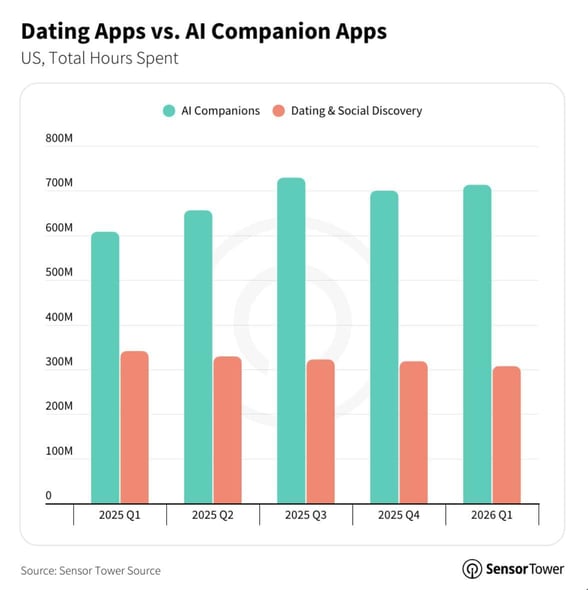
In Q1 2025, Americans spent approximately 580 million hours on AI companion apps, compared to 330 million hours on dating and social discovery platforms, per Sensor Tower. This gap became a chasm in 2026; AI companions reportedly take up 705 million hours while dating and social discovery apps take up just 280 million hours.
Not to state the obvious, but that’s a lot of time spent flirting with a robot — so much time, that it’s worth wondering why people are increasingly willing to build a relationship with a machine rather than a living, breathing person. What’s causing this gap turned chasm, and is there still value in a traditional dating app?
Why Do People Like AI Companions?
Sensor Tower chalks this chasm up to the average user’s desire for consistent engagement. This points to a major area of need for daters: the need for ongoing validation and frequent emotional check-ins. Humans can do this; AI can do it faster.
“Dating apps can be transactional, where the user ultimately leaves the app after a successful match, but AI companions offer an ongoing relationship that keeps users online longer,” according to Sensor Tower.
This sounds counterintuitive — I thought modern daters prefer meeting IRL? — but it actually points to the average person’s conflicting needs for both authentic connection and low-pressure stakes. In other words, we want to have our cake and eat it, too.
“Dating apps can be transactional, where the user ultimately leaves the app after a successful match, but AI companions offer an ongoing relationship that keeps users online longer.” — Sensor Tower
With people pivoting away from dating apps towards AI companions, is it any wonder that approximately 80 dating apps have added new AI features this year? Dating apps are experimenting with new and innovative ways to keep users engaged, which means embracing AI.
And it’s possible that efforts by dating apps to streamline with AI have been paying off. Whether they used AI for safety purposes (like Match Group’s Face Check verification) or to implement structural changes (like Grindr’s gAI), dating platforms still have stronger early retention rates than AI companions, according to Sensor Tower.
It seems that what makes AI chatbots so successful — their long-term engagement potential — is also what makes them more labor-intensive, mainly at the beginning of the process.
When you create a dating app profile, you can start swiping and connecting right away. But it takes time to develop an authentic rapport with an AI persona. In this case, faster isn’t always better. AI can only replicate connection; humans can create the real thing.
How Do People Really Feel About AI in the Dating World?
If you’re picking up on some major contradictions, you’re not alone. The use of AI in the dating world is especially controversial. Some see it as an intrusion into a strictly human process; others welcome any tech that makes the process emotionally and/or logistically simpler.
A recent Match Group study of 1,000 people put this polarity on display when nearly half (47%) of respondents reported having a negative view of AI’s use in romance. More specifically, 51% of women 18-24 said they would not date someone who uses an AI companion app.
I can’t really blame them: The images conjured by the phrase “AI companion” run the gamut from “wacky romcom” to “horror film.” I can’t help but picture someone sitting in front of a laptop, pale and wide-eyed, the only light in the room coming from the blue fluorescent screen.
0% of women said they would not date someone who uses an AI companion.
Dramatic? Yes. But if you were to judge the headlines alone, it would seem like everyone and their mother is having an illicit affair with their laptops. The reality is far less cinematic: Only 12% of the surveyed 18-to24-year-olds in Sensor Tower’s study have used an AI companion app over the last three months.
This is definitely a higher number than some might expect, but when you consider how only a third of that 12% said they sought authentic companionship from an AI chatbot, those headlines I mentioned feel much less dire.
Less dire, yes, but still worth a serious discussion. This article is mainly about romantic AI companionship, but it’s worth mentioning Adam Raine, the 16-year-old who took his own life in 2025. He’d formed an emotional attachment to the AI, and had confided in it about his suicidal thoughts.
This story puts the power AI plays in our emotional lives into sharp relief. It’s easy to paint people with AI companions as weird; it’s much harder to confront the very real, very serious fact that we are increasingly likely to seek emotional fulfillment, romantic or otherwise, from the non-judgmental robots on our phones.
We Embrace AI When Life Gets Overstimulating
Most of our complicated feelings about AI are centered in what it can do that humans can’t. You can’t deny that the tone, personality, and content produced by an AI companion is ultimately shaped by the user. Whether intentionally or unintentionally, it becomes a reflection of the user’s romantic fantasy.
With an AI, you don’t have to deal with the realities of modern dating: the waiting, the ghosting, and those pesky, inconvenient human emotions. Even so, one woman told DatingNews that her relationship with an AI persona “has left me feeling hopeful, content, fulfilled, and helped me tap into socio-emotional development.”
These daters do what any modern person does when faced with a complex thought, emotion, or situation: They turn to the internet. And these days, they turn specifically to AI.
Last year, sexologist Natassia Miller took DatingNews through the vicious cycle facing many modern daters. Their “nervous systems [are] being overstimulated by fast, frictionless tech and undernourished by real, vulnerable connection,” she told us.
To combat this overstimulation, we tend to do the worst possible thing — retreat deeper into our phones — because they give us the instant gratification or validation we crave. It’s a tale as old as the internet itself.
But according to Miller, truly fulfilling dating and sex experiences “require friction, discomfort and time. And when people aren’t used to tolerating those things, they start to look for depth without knowing how to build it.”
These daters do what any modern person does when faced with a complex thought, emotion, or situation: They turn to the internet. And these days, they turn specifically to AI.
Our Greatest Dating Needs Are Not About AI
Regardless of how common AI companionship actually is, our curiosity about it — and in some cases, our dread — speaks volumes. It’s obvious that we’re increasingly reliant on AI for both short-term and long-term emotional fulfillment. It’s not a matter of if AI will transform the dating industry, but how, and how much.
But this doesn’t mean that the industry has to bow down to it. The dating world can regain its human-led foothold by reading in between the headlines. It’s like Miller said: People aren’t embracing AI because they absolutely love chatting with a non-human, but because it lifts the emotional pressure brought on by real, human interactions.
AI addresses a vital area of need for daters: it’s efficient, yes, but also customizable. You can build upon your relationship with an AI bot, and then go back and change something if it doesn’t go in the “right” direction.
Only 0% of surveyed young daters have recently used an AI companion.
Most importantly, an AI is only one click away, which feels especially poignant in the face of rising loneliness.
Of course, as I said earlier, this industry is teeming with contradictions. While some daters crave low-pressure interactions from the safety of their sofas, others are yearning for IRL interactions. But these different dating approaches have the same core need: authentic, emotionally fulfilling connections.
This is what the dating industry can take away from Sensor Tower’s finding: Platforms that use AI as a bridge to authentic connection, rather than as a replacement for it, have a better shot at making a meaningful impact in the industry. After all, AI companions may be a hot topic, but emotionally fulfilling IRL relationships are still daters’ ultimate goal.

![5 Best Android Dating Apps[updated_month_year before=" (" after=")"]](https://www.datingnews.com/images/uploads/2023/11/best-android-dating-apps.jpg?width=342&height=135 "5 Best Android Dating Apps[updated_month_year before=\" (\" after=\")\"]")