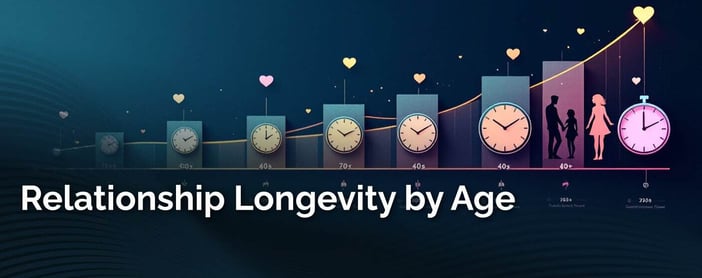
At the start of a good relationship, it’s easy to think it will last forever. You can’t imagine ever falling out of love with your partner when you’re in the thick of it.
But the reality is that not all relationships are meant to go the distance. About 70% of couples break up within the first year of dating1. And while some of those relationships were toxic to begin with, many relationships are great for the short-term, but simply not meant to last.
At different points in your life, it may be more or less likely that a relationship will stick around. Read on to learn about how the length and health of your relationships can shift over time.
Stats for Teens and Young Adults
Dating as a teen or young adult can be thrilling. This is the time when you’re figuring out what relationships look like and who you want as a partner. While some sweetheart relationships last forever, most of them are more about starting your dating experience and less about finding your person.
1. The Average Relationship for 14-to-15-Year-Olds Lasts 5 Months
One’s teenage years are a time of exploration, first dates, first kisses, and new relationships. It should surprise no one that these relationships don’t typically last long. Even Romeo and Juliet didn’t make it a week2.
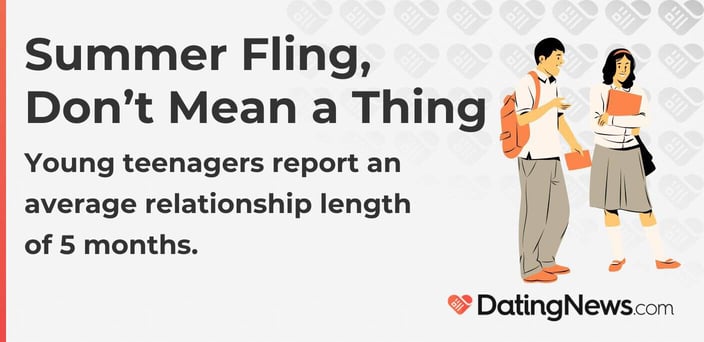
A study by the University of Florida found that the average relationship for 14- and 15-year-olds lasts about 5 months3. That’s not exactly forever, but it is a long time for teens going through significant life changes and milestones every few months.
In early high school, most teens are figuring out who they are and the type of person they want to be. It’s no surprise that oftentimes, that person is a bit different from the person they started dating a few months earlier.
2. By Age 16, Romantic Relationships Tend to Last About 2 Years
By 16, many teens have already had their first relationship. So when they start dating someone around this age, they have a better sense of who they are and what they’re looking for in a high school relationship. And, according to the same UF study, it lasts a couple of years4.
Sweet 16 relationships last two years on average before the couple calls it quits.
Two-year-long relationships make a lot of sense at this age. While 16-year-olds may have a better sense of dating than they did the year before, they’re going to graduate high school and have to navigate those challenges.
3. One-Third of 18-to-29-Year-Olds Are in a 3-Year Relationship
In their 20s, most people start to enter a period where their relationships get more serious. Even if they aren’t with the person they end up marrying, many people in this age group are being intentional about who they choose for a relationship.
That’s likely why, according to Statista, 34% of 18-to-29-year-olds have been in their current relationship for between one and three years, higher than any other age group5.
A three-year commitment is a significant life choice. It means spending holidays together and integrating with family and friend groups. Some of these relationships will end in marriage, while others will be test runs for future romances.
Of course, it's worth noting that 2 out of 3 young adults are not in three-year relationships. They may not even be looking for love. And that's OK too.
4. Young Adults Spend 3 Hours Per Day With Their Partners
Young adult relationships can be intense simply because younger people typically have more time to devote to one another. One study found that the average young adult couple spent three hours together each day6.
With fewer day-to-day obligations and responsibilities, young people can spend hours in each other’s company.
I think it’s worth noting that even if young adult relationships don’t tend to last forever, young adults spend a ton of time getting to know each other and diving deep into their relationships.
Midlife Relationship Longevity
In midlife, relationships tend to get more serious. There’s more pressure to formalize a relationship. Children might enter the mix as a new stressor and shared obligation. Couples might start growing together…or they may start growing apart.
What does that mean for relationship longevity? Those stats point to some best practices and some volatility.
5. The Best Age to Meet Your Spouse Is Ages 27 to 35
To be clear: the most important part of finding your partner is finding the right person. It would be a wild choice to meet the love of your life and then break up because you met younger or older than you thought you should.
According to mathematician Hannah Fry, couples who see the most success in their relationship generally met between ages 27 and 357.
In this age range, you’ve gone out with enough people that you’re not just picking the first one who comes your way, but you also aren’t settling out of desperation. That doesn’t mean that high school sweethearts of midlife divorcees have no shot… It’s just not the norm.
6. The Median Duration of a First Marriage is 21 Years
Marriage defines midlife for many people. The median length for a first marriage is 21 years, according to Bowling Green State University8. That’s a significant period of time that sees people establish careers, raise families, and mature into who they’re meant to be.
After two decades, couples may find themselves at a crossroads. Children leave the house, and it can be a turning point where the relationship runs its course.
7. The Median Age at First Divorce is 43.3 for Men and 41.9 for Women
After decades with your partner, you may find that your spouse is different from the person you first fell in love with. Or, after buying a home, having children, and navigating your careers, you may find that you aren’t suited to be life partners anymore.
Many relationships don’t survive midlife changes. Bowling Green State found that the median age at first divorce is 43.3 for men and 41.9 for women9.
8. Age Gaps Over 5 Years Increase the Chance of Separation by 18%
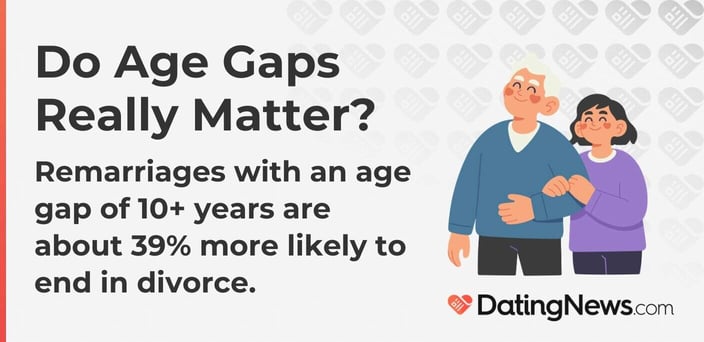
Let’s talk about age-gap relationships now and how they stack up to dating norms. One study found that couples with an age gap are worse off. Couples with an age gap of five years or more have an 18% higher chance of splitting than couples with no age gap10.
It’s not hard for me to imagine why this is. Partners are at different stages of life. They may disagree about what the future should look like, or they may feel societal judgment and pressure from friends and family members. Their finances might be in totally different places.
These issues don’t have to be relationship killers, but they’re certainly tricky to navigate and require strong communication skills from both partners.
Senior Relationship Longevity
Senior relationships can be especially beautiful. Some fortunate couples enter retirement and their golden years together. Sitting on the porch in rocking chairs. Traveling the world and toasting to their love on the beach.
Seniors benefit from the longevity of their relationships, but those later-life changes can also deteriorate their connection. Whether it’s illness or empty nests, seniors face their fair share of challenges, and their relationships aren’t always strong enough to weather them.
9. Relationship Satisfaction Dips Around Age 40, Then Goes Back Up
Divorces are especially common in one’s early 40s. It’s a time of relationship stress. But it does get better. One study found that relationship satisfaction hits its lowest point around age 40, but then it gradually goes back up over time11.
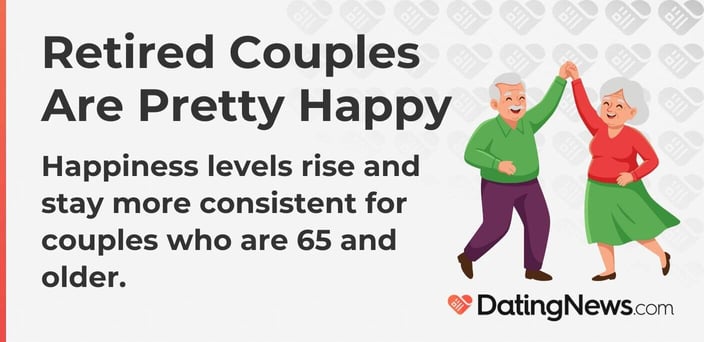
Not every couple needs to fight through issues that come up in their relationship. Some people truly aren’t meant to be together anymore. But if you’re hitting a low point in midlife, know that there’s a pretty good chance it won’t always be that way.
10. Divorce Among Those Over 50 Surged From 8.7% to 36% Since 1990
It’s never too late to realize it’s time to call it quits. An increasing number of seniors are getting divorced. In 2019, senior divorces made up 36% of all divorces, compared to just 8.7% in 199012.
Seniors today might feel more freedom to change course than seniors did in 1990. But it may also be a downstream component of the divorce wave of the 1980s13, when divorce hit its all-time peak. Baby Boomers feel less beholden to staying married for life, and gray divorces continue to be a trend in the U.S.
11. In 2018, Only 8% of Marriages Made It 50 Years
The median first marriage length might be 21 years, but some couples go far beyond that. In 2018, about 8% of marriages made it past the 50-year mark14.
A lot needs to line up for a marriage to last 50 years. Not only do you have to stay together that whole time, you also need to get together young enough and live long enough that you can spend an entire 50 years together.
The math is simple. If a couple marries at age 30, that means both partners need to make it to 80.
Fortunately for married couples, just being married will increase their chances of living a long life. One study found that marriage adds about two years to the lives of both men and women15.
12. About 74% of People Over 50 Have Been in a 10-Year Relationship
Most seniors in relationships are in it for the long haul. According to Statista, 74% of people over 50 have been in their current relationship for at least 10 years16.
Early in life, breakups have fewer repercussions. It makes sense to try out different relationships. Life moves fast. But as you age, the stability of long-term commitment becomes more desirable, and integrated families make it harder to sever ties completely.
Love Can Last at Any Age
Many people have strong opinions about when the right time to meet your partner is, and there is some data to back them up. Meet your person too young, and you’re headed for divorce; meet them too old, and you’re too set in your ways to make the change in the first place.
Regardless of the statistics, I don’t believe there is one set path for a loving relationship. We all get there in our own way and navigate the challenges as we go. I hope these stats inform and prepare you for what’s ahead, but don’t let them pen you in. Love is resilient, and true love finds a way.
Sources & Further Reading:
- https://www.marriage.com/advice/relationship/how-many-relationships-fail/ ↩︎
- https://www.reddit.com/r/Showerthoughts/comments/amjhsj/romeo_and_juliet_isnt_even_a_love_story_its/ ↩︎
- https://ufdc.ufl.edu/IR00002319/00001/pdf ↩︎
- https://ufdc.ufl.edu/IR00002319/00001/pdf ↩︎
- https://www.statista.com/statistics/669175/length-of-americans-relationship-status-by-age/ ↩︎
- https://pmc.ncbi.nlm.nih.gov/articles/PMC9820285/ ↩︎
- https://ideas.ted.com/when-should-you-settle-down/ ↩︎
- https://www.bgsu.edu/ncfmr/resources/data/family-profiles/payne-median-duration-marriages-fp-20-16.html ↩︎
- https://www.bgsu.edu/ncfmr/resources/data/family-profiles/FP-25-23.html ↩︎
- https://papers.ssrn.com/sol3/papers.cfm?abstract_id=2501480 ↩︎
- https://psycnet.apa.org/fulltext/2022-16081-001.html ↩︎
- https://www.apa.org/monitor/2023/11/navigating-late-in-life-divorce ↩︎
- https://www.pewresearch.org/short-reads/2025/10/16/8-facts-about-divorce-in-the-united-states/ ↩︎
- https://www.bgsu.edu/ncfmr/resources/data/family-profiles/payne-median-duration-marriages-fp-20-16.html ↩︎
- https://fortune.com/2023/01/13/why-are-married-men-healthier-on-average-women-gender-research/ ↩︎
- https://www.statista.com/statistics/669175/length-of-americans-relationship-status-by-age/?srsltid=AfmBOop7wDlpuElJ7W-VKNE9IrabiLJGKAoNnnDAw3PJtfsu-yCXEesT ↩︎