For monogamous daters who live staunchly in the mainstream, ethical non-monogamy (ENM) is often a big, shadowy question mark. What exactly do people in a non-monogamous relationship do? How do they make it work? What’s the secret to sharing love? And perhaps the most common question: Is non-monogamy a form of cheating?
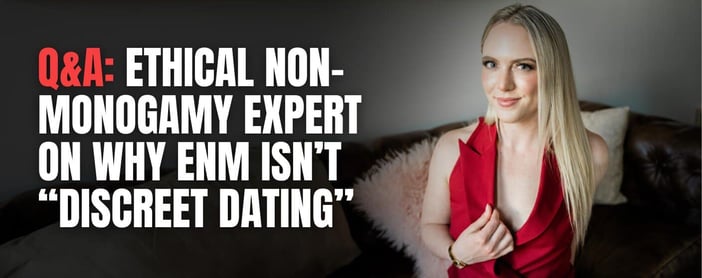
Victoria Joseph, founder of ENM matchmaking service Birds of a Feather Matchmaking, has the answers to these questions — and her own personal experience to boot.
As a matchmaker, event host, and participant in her own ENM relationship, Joseph knows that people and dating platforms alike often erroneously connect non-monogamy and discreet dating. But in reality, they couldn’t be more different.
Ethical non-monogamy is often a big, shadowy question mark for most people.
Her lesson? Non-monogamy isn’t a form of discreet dating because, by nature, it requires transparency. What makes ENM ethical is the fact that it isn’t discreet for the people in the relationship. It’s open, it’s honest, and it isn’t ashamed to be different.
As the ENM community grows, so, too, does its need for platforms that understand and respect their lifestyle. Joseph sat down with DatingNews to explain how the dating industry can better respond to non-monogamous daters living outside of the mainstream.
DN: What specific design or structural choices on apps can unintentionally reinforce secrecy rather than transparency?
VJ: Well, there are definitely a few things that these apps who are helping keep their members information private may be also keeping their secrets alive and well.
And it’s starting out with being able to use fake names, using usernames instead of names, offering incognito mode so that they can view profiles, but then their profiles can’t be seen by others. Not being able to link social media accounts, not allowing screenshots, and allowing photos that do not show faces.
DN: If you were advising a major dating platform today, what concrete changes would you recommend?
VJ: I do have a few recommendations, but I would like to use the new app called Beyond as a really great example. It (feels like) a hybrid of Raya and Feeld. It’s great for modern relationships. It’s highly inclusive when it comes to describing yourself and includes all relationship styles in a tasteful way.
The app is also very community focused. There are regional group chats. There’s one in New York City, California, Miami, and Chicago where people can make IRL plans, as well as other niche group chats. So if you want to lead a group chat, you just kind of tell them why you would be in a good position to run a group chat.
And if I were to advise some changes, I would say partnering with locals who put together community events and helping people connect off the apps by getting the word out is what we really need right now.
“Helping people connect off the apps….is what we really need right now.” — Victoria Joseph
Especially if these apps could specifically say, “Hey, this is for the non-monogamous community. Here’s when, here’s what time,” and get people off the apps, and get them connected, and make people meet in person.
I also think that the apps could benefit from having a feedback form on members so that they can track patterns and make efforts to remove bad people from their apps. That would be a huge thing, especially if there are really, really bad people on the apps.
So having the apps have feedback forms and to be able to report members, and then do something with that information, I think would make for a safer society.
DN: Is there tension between what ethically non-monogamous communities need and what platforms build?
VJ: I don’t know if tension is the right word per se, but frustration? Absolutely. Because oftentimes on these dating platforms, they automatically assume everyone’s monogamous unless they change and alter those kinds of questions.
But I don’t think the apps allow you to be able to pick both monogamy and non-monogamy. And believe it or not, people are able to do both depending on the partner that they’re with.
And also being able to differentiate the different types of non-monogamous styles like polyamory, open relationships, the swinger lifestyle, or just to be monogamish, or exploring.
A lot of apps don’t have room or space to fill out those questions. So it’s definitely a lack of information to share, but also lack of information to receive from your matches to make better informed decisions moving forward.
DN: How does app-based non-monogamy differ from community-based non-monogamy?
VJ: So a few things come to mind when it comes to the difference of the app experience versus community in-person experience. When it comes to apps, especially for women, we are overloaded with likes and connections and matches from men.
So someone like in my personal experience here, I have thousands and thousands of matches and likes that I haven’t even got a chance to look at. And when you’re in person, it’s a smaller crew and you can kind of pick and choose who you want to talk to.
I guess one thing too about apps is that if you match with somebody on the app, it’s probably because there is a mutual attraction there, so you kind of don’t have to do too much guesswork, whereas community-based connections, you kind of have to.
You’ve got to gauge the social interactions and try to see if someone else might be interested in you and practicing on how to word those conversations. When it comes to non-monogamous apps as well, because it is a bit more sex positive, some of the photos can be pretty off-putting.
A lot of men will just kind of come in really hot and heavy at the first message, and it’s really off-putting. And I’m sure that happens with monogamous apps too and all, but it feels like maybe it’s a little excessive when it comes to non-monogamy because for those who don’t know, when it comes to non-monogamy, it’s not a free-for-all.
It’s not easy to connect with or get connected in that kind of way with. It’s a little bit harder because especially someone who’s experienced, we look for lot of different characteristics in new people that we’re meeting.
When it comes to outsourced community too, it’s like people have different online personas. Oftentimes, we’ll go back and forth with the conversation, it’s going well, and then you talk to them in person and they have no personality, they have no conversation skills.
“When it comes to non-monogamy, it’s not a free-for-all.” — Victoria Joseph
And so it feels like a bit of a waste of time. One thing too that’s nice about community based non-monogamy is that you’re not putting your whole evening or all your eggs in one basket, right? Because you are amongst many people. And so you have opportunities for multiple connections.
And if maybe you went to this community event with a couple in mind and didn’t hit it off, you can still, you know, keep it moving and try to meet someone else.
Those are the main differences I would say when it comes to non-monogamous apps and then non-monogamous community events.
My preference is definitely in-person events because you can really gauge chemistry that way. People also have really iffy photos too when it comes to that.
So in-person, you can really just see the person in the flesh. Another thing too, when it comes to like apps is that when you’re not monogamous, it might mean there’s more than one person or two people’s schedules involved.
When it comes to trying to get off the apps and trying to meet, (it’s) just a little bit tricky, a little bit harder. So that’s why I like meeting at events. You can get a vibe check right away.
And then if you really hit it off with someone, you get their contacts and then you keep the momentum going and you hang out and maybe do a one-on-one date because you know that they were able to hold a conversation and they were actually enjoyable to be around.
Those are definitely the differences that I compare with apps versus the community.