Key Takeaways
- Throwing more AI technology at app-fatigued daters only makes them less prepared for the messy authenticity of real romance.
- Dating professionals can use AI for effective skill-building tools, but must remember that AI will never understand the nuance of yearning and love.
- With a growing number of daters relying on AI, now is the time for dating professionals to set clear boundaries and express AI’s limits.
AI is taking over the dating industry, but its potential downfall could be hiding in its own name: It’s artificial. And if dating professionals know anything, it’s that today’s generation of daters crave authentic love more than ever.
In fact, people want to feel the intense, emotional longing for romance that pains the soul as much as it fulfills it. In short: The people yearn to yearn, as a recent Wired article put it. But it’s become increasingly clear that AI may not be the nuanced yearning coach, lover, or matchmaker that some Gen Z daters want it to be.
Dating apps are banking on AI to fix dating fatigue, but piling more tech onto a growing demand for authenticity is like like trying to douse a fire with gasoline.
If AI and dating apps can’t tap into the humanity of dating, they won’t appeal to the yearners of the world.
“Fast, Frictionless Tech” Leaves Us Overstimulated
Dating apps were built for the opposite of yearning: Quick, casual, superficial connections that tend to fizzle before they’ve even begun. Overly edited photos and AI-optimized profiles take the raw humanity out of dating.
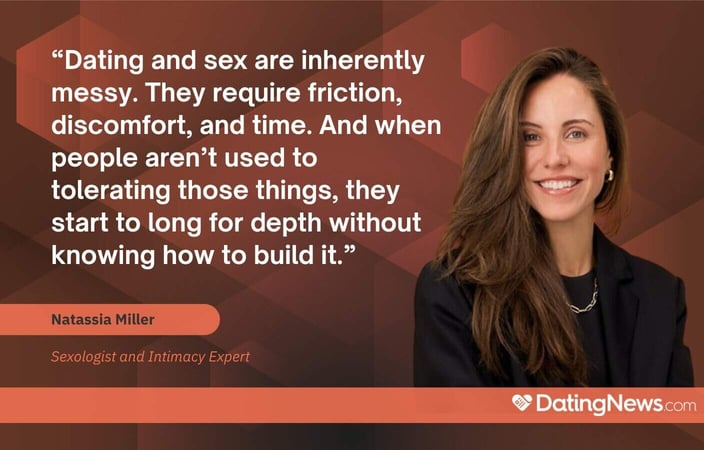
Sexologist Natassia Miller told DatingNews how genuine intimacy and technology usually don’t mix, despite many apps’ best efforts.
“While we’re more digitally connected than ever, the sheer volume of options has made people more anxious and less willing to invest in any one connection,” she explained.
The gamification of dating apps gives people “this constant feeling that someone better might be one swipe away, so we don’t take the time to truly get to know someone, and we pull away at the first sign of discomfort.”
Tech is supposed to make things easier for humans, but as Miller explained, true romantic connections aren’t easy, and they certainly aren’t artificial.
As Miller put it, daters’ “nervous systems” are “being overstimulated by fast, frictionless tech and undernourished by real, vulnerable connection,” resulting in a generation of daters who don’t actually know how to date.
We’re all digital natives, but making real connections may require leaving the digital nest. In other words, more optimization on dating apps may hinder some daters more than it helps them. It may be time for dating platforms to rethink their growing reliance on AI.
“Dating and sex are inherently messy,” Miller reminded us. “They require friction, discomfort, and time. And when people aren’t used to tolerating those things, they start to long for depth without knowing how to build it.”
When this happens, “the yearning grows,” she said. “But the tools to satisfy it feel increasingly out of reach.”
AI Can Be An Effective Intimacy Tool — But Nothing More
Those tools aren’t entirely out of reach, however.
Some dating apps now have features that help promote authenticity and genuine romance, and match profiles based on values and not physical appearance. Dating apps can, ironically, create the individual tools people need to access the emotional depth they crave.
For example, modern-day yearners can be found on BookTok, the corner of TikTok where Gen Z readers romanticize their love lives like they’re in one of their favorite fantasy romance novels.
Hinge ran with BookTok’s popularity when it published literary versions of user love stories on Substack as part of its “No Ordinary Love” campaign in 2025. The dating platform is promoted as a romance app and not a hookup app, and this campaign further solidified its reputation for romance and long-term love.
Grindr, meanwhile, is introducing a “gayborhood expansion” meant to open the app up to a broader audience and encourage deeper, more long-lasting romances. Even Tinder is getting on the authenticity train with its new “Double Date” feature, which helps people date safely and intentionally in the real world.
Dating professionals must treat AI and dating apps as dating tools, not as total substitutes for genuine romance or connection.
Yearning requires a type of depth that AI simply can’t replicate — yet. This hasn’t stopped daters from craving the superficiality that AI provides.
AI Is Here, Whether We Like It or Not
In 2025, the AI dating assistant Wingmate found that 41% of surveyed adults have used AI to help them break up with someone, and 43% used it to navigate emotional conversations with a partner.
Another 34% have sought dating advice from AI, and even 38% used AI to help resolve conflict.
It’s clear AI is lending a helping hand, but it may not be so helpful in the long run. This type of dependence on AI could be the “fast, frictionless tech” Miller warned us about — the kind that leaves daters unprepared for the messiness of authentic love and yearning.
But a majority of respondents said they used AI solely as a tool to make certain elements of online dating easier: 45% said they use AI to help reply to messages, 51% use AI for icebreakers or conversation starters, and 62% use it to help spruce up their profiles.
For better or worse, Wingmate’s survey shows that young people are turning to AI to make dating easier. But when it comes to navigating the trickier, more human parts of dating — conflict, intimacy, and yes, yearning — AI has a lot to learn.
Gen Z’s thirst for authentic love may only be temporarily quenched by AI solutions. The yearn will always return.

![22 Marriage Stats by Age, Race, State & Generation[updated_month_year before=" (" after=")"]](https://www.datingnews.com/images/uploads/2020/12/Dating-Personals.jpg?width=342&height=135 "22 Marriage Stats by Age, Race, State & Generation[updated_month_year before=\" (\" after=\")\"]")