Key Takeaways
- France is pioneering an unprecedented collaboration between government, dating apps, and advocacy groups to combat anti-LGBTQ+ violence.
- Dating apps can enable some of the most violent premeditated ambush attacks, making stronger safety tools and cooperation with police essential.
- Ambush attacks are espescially hard for dating platforms to prevent because of just how deceitful the behavior is prior to the ambush, they could spend weeks gaining the person's trust.
- The charter’s real impact depends on whether authorities and platforms follow through on promises and can be held accountable.
When we imagine the “worst dating app date ever,” most of us have quasi-humorous visions of bad profile pics and worse conversation. But Léo, Ibrahim, and Irina’s worst dating app experiences were anything but funny. By the end, they were just grateful to be alive.
Léo’s date began with a “like” on a dating app and ended with him being drugged and kidnapped by two men (thankfully, he was able to escape). Another man, Ibrahim, did the right thing on his own Grindr date when he asked to meet in a public park. But this measure of precaution didn’t stop him from being attacked by a masked man.
Every day, people in the LGBTQ+ community are targeted by predators on dating apps.
And Irina? She was never even given a choice: Not only did someone create a fake dating profile using her name, but they told men on the app where she lived, and some men even showed up at her door, expecting… what, exactly?
The possibilities of what could’ve happened were terrifying to Irina, for whom transphobic attacks have become a matter of when, not if.
Léo, Ibrahim, and Irina’s stories are disturbing, but they’re not unique. Every day, people in the LGBTQ+ community around the world are targeted by predators on dating apps. So much so, in fact, that the French government and leading dating app companies have decided that the best way to combat these attacks is to work together.
The Charter Focuses on Prevention, Reporting, and Protection
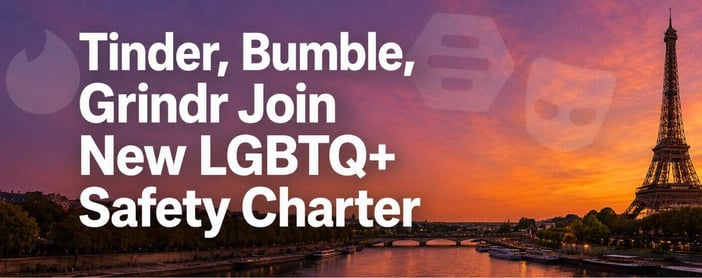
France’s ministry in charge of fighting discrimination has invited dating apps, including Tinder, Bumble, Grindr, and happn, to sign a charter “for the prevention of violence and the safety of LGBT+ people,” according to the ministry.
Specifically, the charter establishes “concrete commitments around three priorities: prevent, report and protect.” This partnership is bolstered by the support of leading non-profit groups like Stop Homophobie, Le Refuge, Flag!, and SOS Homophobie, the organization that originally published Léo, Ibrahim, and Irina’s stories.
This level of collaboration between a government, dating apps, and nonprofit groups is unprecedented, according to the junior minister for fighting discrimination, Aurore Bergé. She said France is “the first country in the world to establish this level of cooperation,” not only with dating apps and non-profits, but with law enforcement, too.
This collaboration may be unprecedented, but it’s born of necessity: In 2024, “Numerous calls for help reached SOS Homophobie, marked by despair, weariness, and exhaustion, along with a feeling of being perpetually trapped in a nightmare,” the organization said of the LGBTQ+ people who reached out for help.
A Surge of Anti-LGBTQ+ Hate Makes Reporting Essential
Statista found that reported LGBTQ+ attacks in France rose from 1,810 in 2019 to nearly 5,000 in 2024. And the real total is undoubtedly higher. The fear and shame of what they experienced can be so intense that victims suffer in silence, especially if they’ve been ignored or shamed by law enforcement in the past.
If reporting a crime or bad experience isn’t a tactful and straightforward process on your dating app, then you’re not meeting the moment for LGBTQ+ daters. Laure Salmona, co-founder of French organization Féministes contre le cyberharcèlement, explained why it isn’t in the best interest of platforms to allow violence to continue unchecked.
“These acts of violence serve a political purpose: they aim to silence LGBTI individuals, pushing them to self-censor or to leave platforms altogether,” she told SOS Homophobie.
SOS Homophobie says authority figures in government and law enforcement have a responsibility to publicly condemn LGBTQ+ hate, “So that victims do not feel dread after an assault and do not fear being taken lightly — or even being further targeted — by law enforcement.”
They may fear retaliation by the app themselves, too. Remember Ibrahim, the man who was allegedly attacked by a Grindr date in a park? He says he tried to warn other dating app users about his experience, but was blocked from the app, and wasn’t even able to recreate his account.
“The Most Violent Assaults” Begin on Dating Platforms
Hate speech is damaging on its own, but the charter aims to neutralize a specific type of violence: pre-meditated ambushes that begin on dating apps.
“This phenomenon is particularly alarming, as it is often the source of the most violent assaults in public spaces,” SOS Homophobie explained. “Indeed, most testimonies reporting ambush-related attacks describe extremely brutal physical and verbal violence against the victims.”
Platforms have undeniably become breeding grounds for predators who see the LGBTQ+ community as prey. Dating app predators take advantage of the connective nature of dating apps, using them to find vulnerable victims instead of matches.
By signing the charter, dating apps acknowledge that they play a vital role in protecting users from violence.
By signing the charter, dating apps acknowledge that they play a vital role in protecting users from violence. Shiny new AI-powered safety tools and connective shortcuts are fine and dandy, but if users continue to get hurt, then these techy solutions clearly aren’t cutting it.
“Tools designed to create meetings and connections can no longer be diverted to set traps and organise hate,” Bergé explained in a statement.
Platforms that sign the charter bring their “prevention” and “reporting” goals to life by agreeing to increase the number of verified profiles and by streamlining the reporting process. This likely means stronger safety tools, liveness verification, and more straightforward involvement with law enforcement.
Most notably, platforms that sign the charter promise to send relevant user data to law enforcement, even if an account has been deleted, if doing so helps to identify the perpetrators of a hate crime.
Why Ambush Attacks Are Especially Difficult for Platforms to Prevent
The type of violence targeted by the charter presents a unique challenge for dating apps because it often begins with accounts that appear completely normal.
Unlike spam accounts or obvious scams, people who organize ambush attacks can spend days or weeks building trust with potential victims before arranging an in-person meeting. They may use real photos, hold convincing conversations, and avoid behavior that would trigger automated moderation systems.
Many platforms already encourage users to meet in public places, share plans with friends, and report suspicious activity. Those precautions can help, but as Ibrahim’s experience demonstrates, they do not eliminate the risk. Preventing violence is always easier than responding to it afterward, but identifying bad actors before they strike can be extraordinarily difficult.

Dating Apps Face Growing Pressure to Verify Users
For years, verification was largely seen as a way to reduce catfishing, but today, platforms are finally starting to treat it as a core safety feature. Many dating apps now use selfie verification and liveness checks that require users to prove they are real people rather than bots or impersonators. Some platforms have gone even further.
Earlier this year, Coffee Meets Bagel expanded identity verification efforts in Singapore, allowing users to verify details like their age and marital status through a government-backed system. These tools aren’t foolproof, but trust and safety teams view verification as one of the few preventative measures available.
For LGBTQ+ users, that extra layer of accountability could make a meaningful difference.
Dating-App Safety Is Drawing Increased Government Scrutiny
We’ve reported on age-verification proposals in the U.S. to stricter online safety requirements in Europe and the United Kingdom, regulators are placing greater pressure on platforms to demonstrate that they are taking meaningful steps to protect users.
France’s new charter treats dating-app safety not just as a platform issue, but as a matter of public concern.
A Charter Is Meaningless Without Actionable Change
On paper, this all sounds wonderful. Finally, real acknowledgement from real authority figures that the violence suffered by LGBTQ+ daters must be addressed. But in-the-know daters and dating professionals know full well that these types of gestures can be just that — a meaningless gesture, an empty promise.
“Despite the increasing severity of these acts of violence, the institutional response remains insufficient,” SOS Homophobie said in its 2025 report. This organization saw firsthand how easy it is for governmental authorities to make seemingly empty promises to vulnerable groups.
“Although the government launched a National Plan for Equality, Against Hate, and Anti-LGBT+ Discrimination in 2023 — which includes training for law enforcement and support for LGBTI organizations — we struggle to see its effects on the ground or reflected in the testimonies we collect,” SOS Homophobie claimed.
If this charter wants to make a truly unprecedented impact, then it has to follow through on its promises.
If this charter wants to make a truly unprecedented impact, then it has to follow through on its promises. Bergé, for her part, certainly speaks with conviction: “Behind a screen, perpetrators think they can escape justice,” she told French LGBT+ magazine Têtu. “That is false.”
Hate crimes can happen anytime anywhere, but this partnership between the French government and dating app companies suggests they both think the apps are on the front lines of anti-LGBTQ+ violence, and can therefore play a vital role in preventing this violence from unfolding in the first place.
A few signatures on a virtual piece of paper may sound meaningless, but they’re tangible evidence that the world’s leading dating platforms did, in fact, promise to innovate for the increased safety of LGBTQ+ users. This makes it easier for all of us to track their progress — and to hold them accountable.