Key Takeaways
- Nearly 1 in 4 (23%) American singles say they would accelerate cohabitation with their partners to save money.
- Gen Z leads the trend, with 38% saying today’s economy is the catalyst for this decision.
- On the other end of the spectrum, a third (33%) of surveyed Americans say the economy is making them think about committing to a relationship.
Singles are feeling the pressure of inflation and are wielding an eye-opening strategy to help beat it.
Nearly 1 in 4 (23%) surveyed U.S. singles say they would fast-track cohabitation with their partners to find financial relief, according to The State of Us: National Study on Modern Love & Dating in 2025, a survey conducted in partnership by DatingNews.com and the Kinsey Institute.
Rising rent and financial strain are reshaping how singles set their dating timelines — but not only in one direction. In fact, while some singles are pushing to move in sooner to fight inflation, others are pressing pause on dating completely.
The reaction among those surveyed was split: Inflation is both slowing down and speeding up relationship progression, revealing that how people deal with financial strain isn’t a universal experience.
DatingNews.com partnered with scientists at the Kinsey Institute to uncover the effect the current economic climate is having on relationships and how daters are adjusting.
Nearly 40% of Gen Z Say Today’s Economy is Pushing Them to Move in Sooner
Younger Americans are more likely to embrace practical partnerships — cohabitating to cut living costs — in light of the current economy.
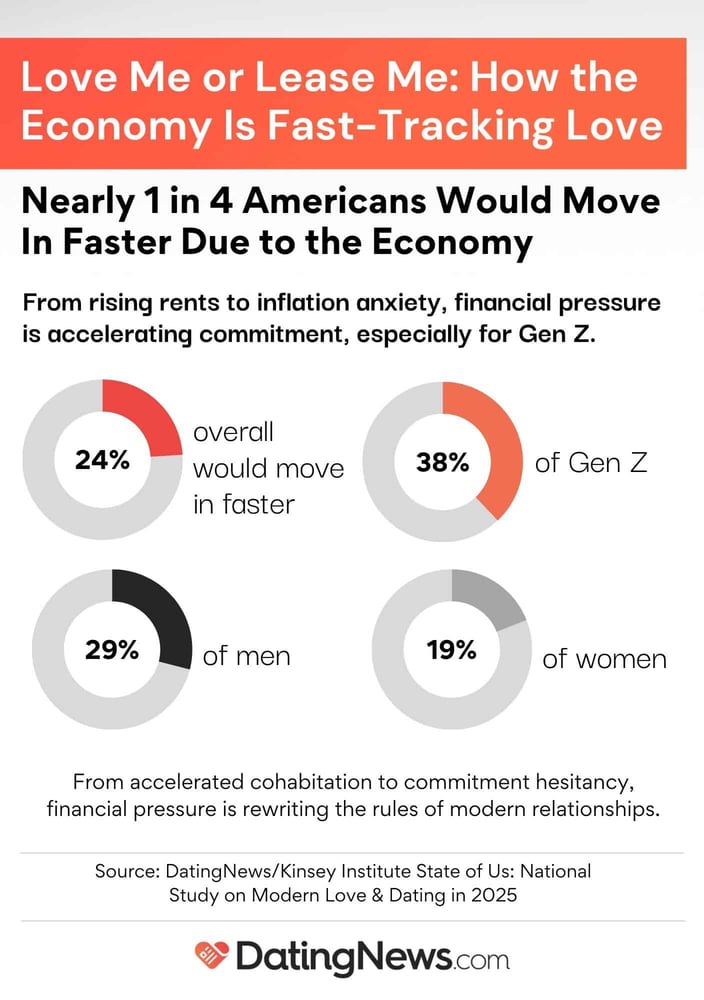
Leading this trend is Generation Z. About 38% of Gen Z respondents said they would move in sooner due to the economy, and 26% said they would marry faster. Gen Z is far more likely to support this approach over its older counterparts, who, in contrast, had lower numbers:
- Millennials: 29% move in faster; 20% marry faster.
- Gen X: 21.8% move in faster; 15% marry faster.
- Boomers: 11% move in faster; 7.2% marry faster.
As for gender demographics, there’s a clear gap. Men are far more likely to want to move in — 28.6% vs. 18.8% — and marry faster — 18.8% vs. 13.7% — than women.
However, we can’t ignore the downsides to this seemingly well-designed plan. Moving in too soon could spell disaster for couples who aren’t yet ready for that level of commitment in their relationships.
It could also add unnecessary layers of confusion and complication if a breakup were to occur. A shared lease or mortgage would only make breaking up more complicated for couples, leaving them in an even more sour situation. So young adults who embrace these practical partnerships should heed with caution.
Nearly Half of Gen Z Say The Economy Makes Them Hesitant to Commit
On the other side of the inflation coin are singles who are taking a much more conservative approach to dating in this economy.
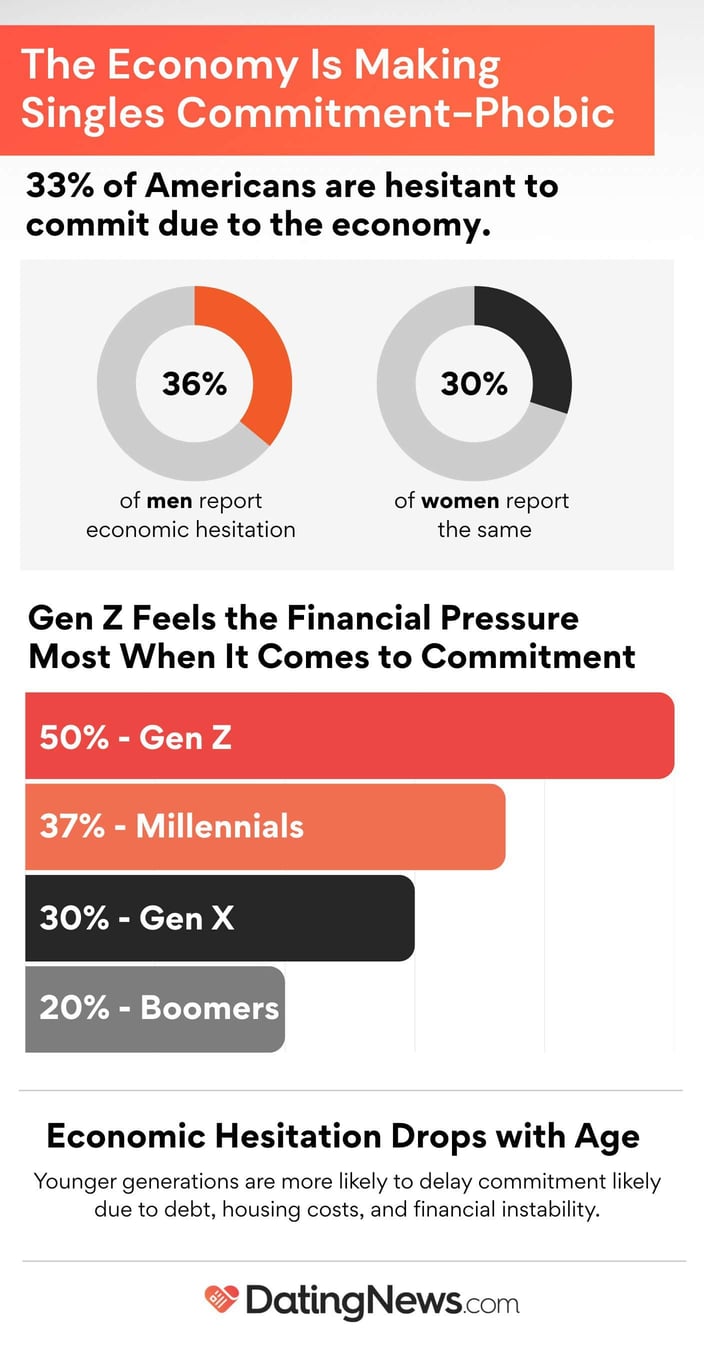
About 33% of surveyed U.S. adults say the economy makes them more hesitant to commit. Once again, Gen Z is leading the pack in the inflation fight.
Nearly half of Gen Z respondents cited hesitance to commit — the highest among generations. Here’s how older generations scored in comparison:
- Millennials: 37.3% hesitant
- Gen X: 30.2% hesitant
- Boomers: 20.1% hesitant
But there is a trend here: Hesitancy drops off gradually with age. Boomers are far more likely to say they are unaffected by economic factors than their counterparts. That’s probably due to their higher financial stability or lack of desire to seek committed relationships altogether.
On the other hand, Gen Z respondents are more likely to be just starting off their careers, meaning less financial security. Unsurprisingly, our data reveals that the younger a person is, the more hesitant they are about serious commitment.
“Inflation and the current economic climate are having a particularly pronounced effect on how Gen Z is approaching relationships,” says Dr. Justin Lehmiller, Senior Research Fellow at the Kinsey Institute and one of the study’s lead authors.
“It appears that some young adults are putting their love lives on hold while they get on more solid financial footing, whereas others appear to see marriage and cohabitation as a pathway to greater financial security,” Lehmiller continues.
Our data found that men are more likely to show hesitancy toward commitment than women due to economic pressures — 36.1% vs. 29.5%.
Meanwhile, women are more inclined to decline the idea of serious relationships — 30.6% vs. 17.0% — regardless of the economic climate. These results suggest women are less influenced by economic pressures when it comes to relationships.
37% of Singles Are Spending Less on Dating Overall
Inflation and financial fragility are causing singles to shift their spending behavior, and those concerns are spilling over into their dating habits.
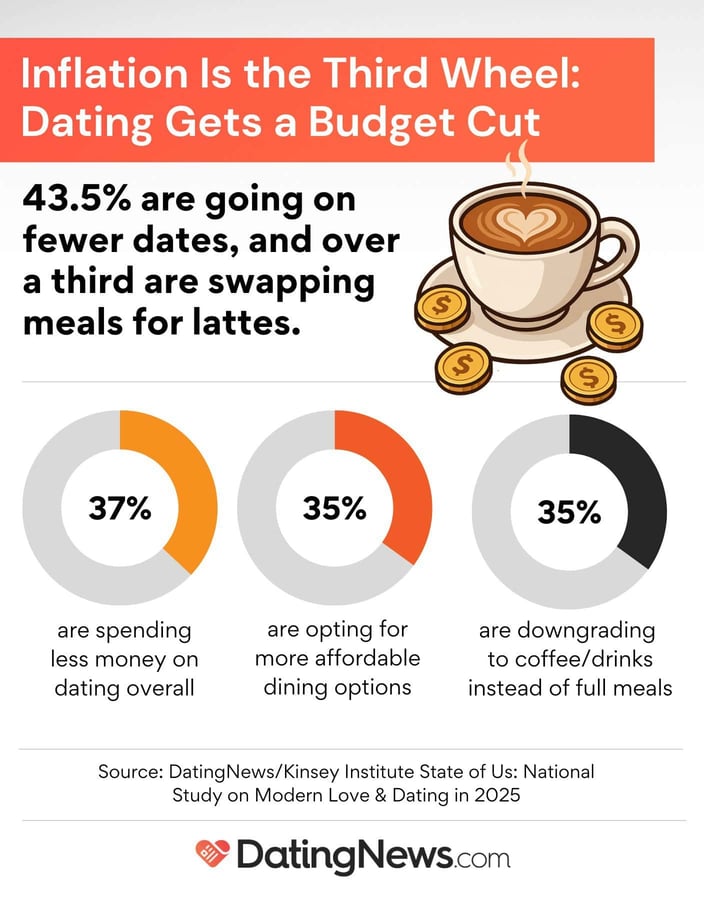
People aren’t just adjusting their relationship timetables; they are also adjusting their dating approach to survive in the current economy. We asked respondents how they are shifting their approach. And these were their top responses:
- 43.5% going on fewer dates due to inflation
- 37.2% spending less money on dating overall
- 35.2% choosing coffee/drinks over full meals
- 35% opting for more affordable restaurants
A frugal dating culture is emerging, signalling a shift toward fewer dates and lower-cost dating experiences for many singles. This trend underscores the increasing financial strain many daters are facing in this current economic climate and what they are doing to keep their love life alive in spite of it.
Love in a Time of Inflation
The economy is changing not only whether people commit but also how and when. For younger generations, dating and relationships are increasingly intertwined with financial stability, making commitment just as much a financial decision as it is an emotional one.
“Young adults are the most likely to say that economic factors are making them more hesitant to commit, but they’re also the most likely to say that it’s leading them to escalate their relationships faster. This might sound paradoxical at first, but it’s not. It simply reflects the fact that economic issues don’t affect everyone the same way,” says Lehmiller.
Economic pressures are shaping Gen Z’s relationship timelines more than any other generation, underscoring the level of heightened financial anxiety many are experiencing. Future cohabitation and marriage trends may be driven as much by rent prices as it is by romance.
Methodology
The State of Us: National Study on Modern Love & Dating in 2025 was conducted by DatingNews.com and the Kinsey Institute, led by Dr. Justin Lehmiller and Dr. Amanda Gesselman.
Data was collected by Prodege.com among a nationally representative sample of 2,000 single U.S. adults ages 18 to 91 via an online survey from April 29 to May 8, 2025.
The sample was balanced for age, gender, household income, geographic region, and race/ethnicity. Margin of error: ±3 percentage points at the 95% confidence level.
Press inquiries: Colleen@datingnews.com