Key Takeaways
- While 84% of people surveyed said they view sex outside of relationships as the ultimate betrayal, half of singles also say emotional and financial betrayals count as cheating.
- 20% of respondents say they admitted to cheating in the past, while 76% confessed to covering it up.
- About two-thirds (60%) of surveyed Americans believe communication can prevent cheating in relationships.
While most people view sex outside of a relationship as the ultimate betrayal, definitions of cheating have expanded to more than just physical acts.
In today’s digital world, technology has reshaped boundaries, making emotional and financial infidelity just as common and detrimental as physical betrayals. Yet, no matter how cheating is viewed, most people can agree on one thing: infidelity can be enough to end any relationship.
A new study conducted by DatingNews.com in partnership with the Kinsey Institute, “State of Us: National Study on Modern Love & Dating in 2025,” reveals that 84% of surveyed Americans regard cheating as an unforgivable act.
Breaking the boundaries of a relationship can have serious consequences for couples, even more so for women who tend to have stricter conceptualizations of relationship boundaries than men. Our study, in partnership with scientists at Kinsey Institute, explores cheating in the modern dating world.
Singles Say Emotional & Financial Betrayals Count as Cheating
Infidelity isn’t just about sex. Half of surveyed singles say emotional affairs and financial support constitute infidelity just as much as physical intimacy, such as sex and kissing, does.
The perceptions of cheating are wide and varied, mostly depending on a person’s own boundaries. Yet, certain behaviors are perpetually out in the court of public opinion.
So what exactly counts as cheating in today’s modern playbook? Our study breaks down the results into three specific categories (physical, emotional, and financial) below.
Physical:
- Having sex with someone else: 84% agree
- Kissing someone else: 70% agree
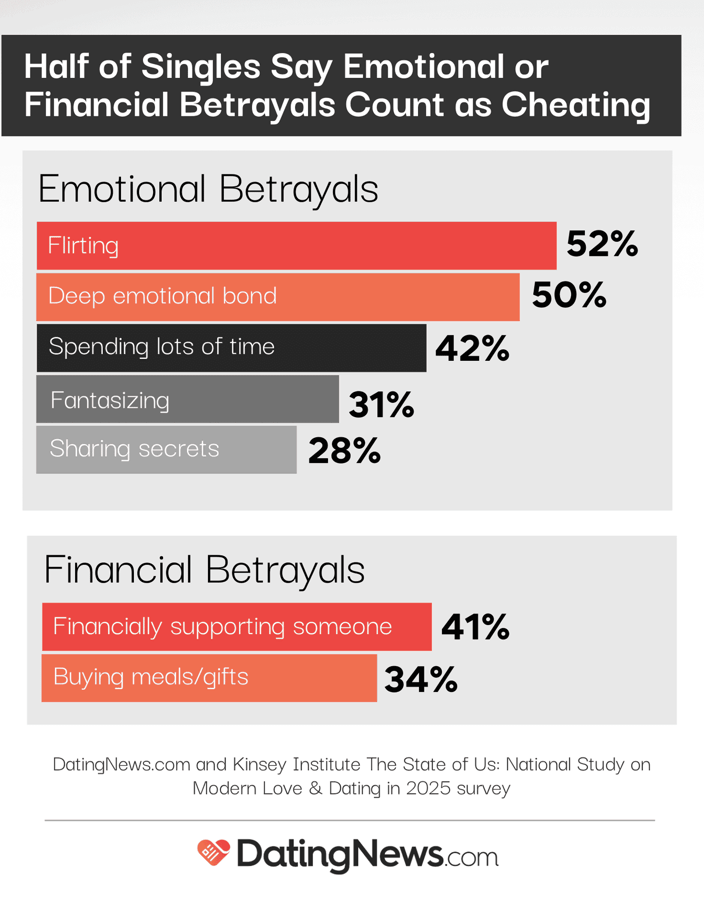
What’s more interesting: Our study found that women in particular were more likely to view a higher number of behaviors as cheating than men. That suggests female partners are more prone to setting stricter boundaries when it comes to cheating and relationships than men.
Older generations also showed to have tighter constraints when it came to relationships. While younger generations primarily view physical intimacy as cheating, older generations were more likely to view all behaviors as a breach to a relationship’s guardrails.
As for sexual orientation, respondents who identified as LGBTQ+ were slightly less likely than cisgender/heterosexual respondents to view all behaviors as cheating, revealing a more flexible approach to relationship boundaries.
If one thing is true, our study reveals: cheating doesn’t look the same for everyone.
72% Say Sex Ends a Relationship — But Over Half Would Leave Over Money or Emotional Betrayals, Too
Daters are drawing the line at infidelity, and adding new lines that are sharper than they are flexible. Betrayals, whether physical or not, are leading to breakups for many singles.
Singles have little tolerance for cheating. And our findings reveal just how much of a dealbreaker cheating is in relationships. According to our respondents, these transgressions are the most unforgivable:
- Having sex with someone else (72%)
- Forming a deep emotional bond with someone else (55%)
- Having a romantic relationship with an AI companion / chatbot (54%)
- Financially supporting someone else (54%)
- Sending money or gifts to a cam model (53%)
While 72% call sex unforgivable, singles are just as likely to end things over an emotional bond, AI relationships, or financial betrayals, showing little tolerance for betrayal in any form.
Still, some demographics are willing to show more grace than others.
Our study shows that men were more likely to forgive all of the above transgressions, compared with their female counterparts.
Older generations were also more forgiving, showing a higher likelihood of pardoning a partner who had sex or formed a deep emotional connection with someone else. Interestingly, though, older daters were less likely to excuse AI companionships or financial support, compared to younger generations.
While women and young daters draw the sharpest lines, LGBTQ+ singles reported more flexibility compared with cisgender/heterosexual folks. LGBTQ+ respondents showed slightly more forgiveness across the board, more likely to say each transgression is forgivable.
When Someone Cheats: 20% Admitted It, 76% Tried to Hide It
Cheating is more common than many think. In fact, 1 in 5 surveyed U.S. singles confessed to straying and stepping out on a partner in the past. Surprisingly, men and women were equally guilty — 20% versus 21% — in their omission.
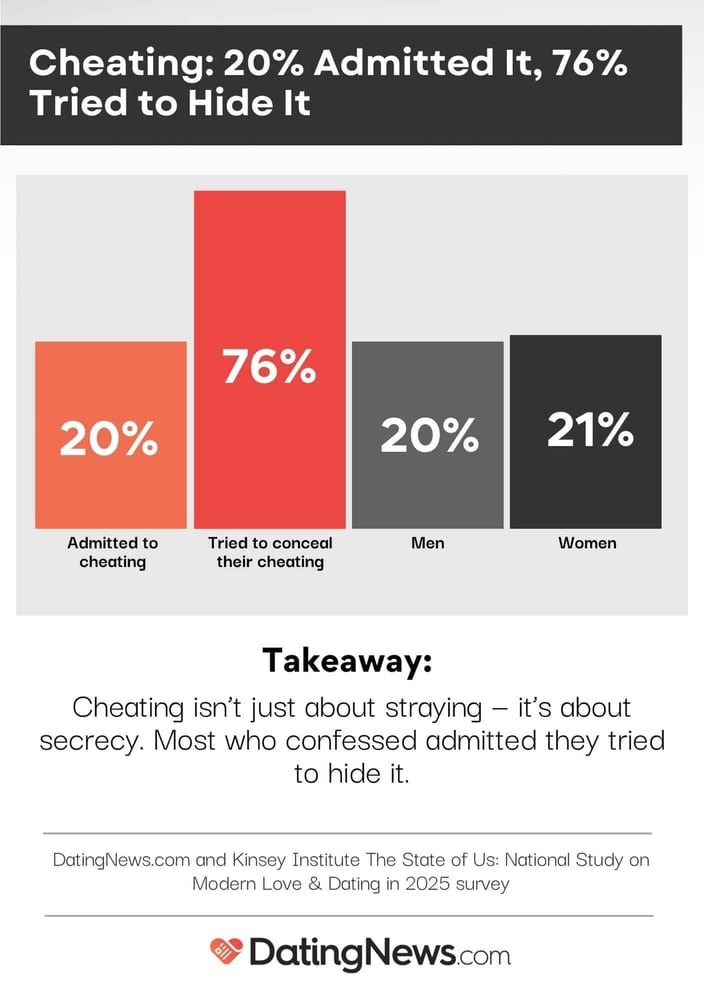
Of those who cheated, 76% admitted to trying to conceal it. Their top secret tactics included:
- Acting like everything was normal (47%)
- Deleting messages or data that could reveal the affair (26%)
- Only meeting up in very discreet or remote locations (26%)
- Making up excuses to be away (e.g., work project, gym) (26%)
- Ending the affair before it could be discovered (20%)
- Showing increased interest in their established partner (11%)
- Introducing their affair partner as a new “friend” or “colleague” (10%)
- Enlisting a friend as an alibi (10%)
- Adding or changing passwords on their devices (10%)
- Using a burner phone (5%)
While male and female daters engaged in these behaviors equally, they deviated on the following acts: making up excuses to be away (31% men, 21% women); enlisting a friend as an alibi (13% men, 8% women); only meeting up in very discreet or remote locations (23% men, 29% women).
Generational differences also revealed striking contrasts in how daters hide their unfaithful behavior. Not surprisingly, younger generations were more likely than older generations to leverage electronics to sneak around:
- Deleting messages or data that could expose their affair:
- Gen Z: 43%, Millennials: 40%, Gen X: 26%, Boomers: 10%
- Using a burner phone:
- Gen Z: 16%, Millennials: 10%, Gen X: 2%, Boomers: 0%
- Adding or changing passwords on their devices:
- Gen Z: 11%, Millennials: 19%, Gen X: 9%, Boomers: 3%
These findings align with age-based differences in comfort and technology use. Younger adults are more likely to rely on their devices to communicate and connect with partners than older adults, showing why they lean harder on tech to cover their tracks.
There were also differences among sexual orientation and gender identity-related groups. LGBTQ+ and non-LGBTQ+ respondents showed the most variance in their approaches to these four strategies:
- Show increased interest: 19% LGBTQ+, 9% Cisgender/heterosexual
- Enlist a friend as an alibi: 15% LGBTQ+, 9% Cisgender/heterosexual
- Make up excuses to be away: 16% LGBTQ+, 21% Cisgender/heterosexual
- End the affair before it could be discovered: 21% LGBTQ+, 27% Cisgender/heterosexual
60% Say Communication Can Prevent Cheating, 23% Say Nothing Works
Can cheating be prevented? According to our study, 60% of surveyed singles say cheating prevention is possible with communication.
On the flip side, 23% of respondents say nothing can stop someone from committing infidelity. But those who do believe in prevention pointed to these strategies as the key to establishing infidelity-free relationships:
- Having open communication with your partner (60%)
- Establishing clear boundaries (49%)
- Prioritizing your relationship with date nights or quality time (38%)
- Being upfront about what you think constitutes cheating (37%)
- Giving each other some personal space (32%)
- Having regular sex with one another (30%)
- Avoiding risky or tempting social situations (28%)
- Staying away from social media (12%)
It’s clear that singles believe communication and boundaries are the answer to creating fulfilling and satisfying relationships. In fact, a meaningful share of younger adults believe that defining and discussing what constitutes as cheating early in relationships can prevent infidelity, more so than their older counterparts:
- Having open communication with your partner:
- 43%, Millennials: 40%, Gen X: 38%, Boomers: 31%
- Setting clear boundaries:
- Gen Z: 57%, Millennials: 51%, Gen X: 50%, Boomers: 41%
Boomers, however, stood apart. Almost a third (32%) of boomers said there’s nothing you can do to deter cheating, double the rate of Gen Z (16%), and much higher than millennials (20%) and Gen X (22%).
Gender splits also reveal stark contrasts. Men were more likely to favor sex as a safeguard (34% vs. 26% of women), while women put greater weight on boundaries (46% men, 52% women) and quality time (35% men, 41% women).
While LGBTQ+ respondents leaned more toward communication (45% vs. 36%) for prevention, cisgender/heterosexual respondents were more likely to view staying off social media (13% vs. 8%), regular sex (31% vs. 25%), and avoiding tempting situations (29% vs. 21%) as antidotes.
Our study reveals that though a share of daters feel prevention is impossible, a large majority of singles believe employing surefire strategies, such as quality time and communication, can safeguard against infidelity in relationships.
Respondents leaned heavily on tactics deeply rooted in communication, boundaries, and quality time, suggesting that miscommunication and neglect could influence infidelity.
From sex to secrets, cheating is the ultimate betrayal of trust in relationships, showing why so many singles find it unforgivable. Infidelity doesn’t just violate the boundaries of a relationship; it jeopardizes the long-term sense of security and trust between partners.
As technology opens new avenues for secrecy and betrayals, singles will need to lean on communication to draw the line in their relationships and set clear boundaries to protect their hearts as they form romantic connections.
Methodology
The State of Us: National Study on Modern Love & Dating in 2025 was conducted by DatingNews.com and the Kinsey Institute, led by Dr. Justin Lehmiller and Dr. Amanda Gesselman.
Data was collected by Prodege.com among a nationally representative sample of 2,000 single U.S. adults ages 18 to 91 via an online survey from April 29 to May 8, 2025. The sample was balanced for age, gender, household income, geographic region, and race/ethnicity. Margin of error: ±3 percentage points at the 95% confidence level.
Media inquiries can be sent to Colleen@datingnews.com.