Key Takeaways
- The Goose controversy suggests that trust in dating apps begins long before users create a profile—it starts with how platforms market themselves.
- The controversy illustrates how quickly trust can erode when marketing appears indistinguishable from genuine community engagement.
- The allegations against Goose underscore that authenticity isn't just a user obligation, but also a platform responsibility.
- The question isn't whether brands can use AI in marketing, but whether consumers will trust them when they do.
- The dating industry's investment in trust and safety means little if users question a platform before they even download it.
AI was always going to be a problem for daters who prioritize authenticity. But what we didn’t expect was how quickly AI’s use would spread throughout the industry. And I’m not talking about edited profile pics or generative text, but something potentially more insidious: Marketing strategy.
Wired’s investigation into the advertising tactics of GBTQ dating and friendship app Goose suggests that users’ expectation of trust don’t actually begin at the moment of download, but earlier, in the marketing stage.
There are a few vital facts for you to know about Goose. First of all, it calls itself “the gay app” despite, you know, Grindr’s decade-long dominance. At the end of June, the app peaked at #4 in the App Store’s free lifestyle downloads category.
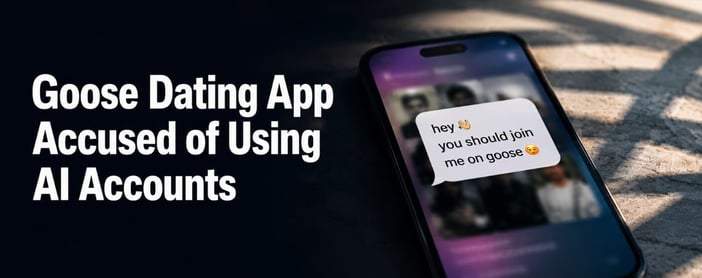
And lastly, handsome Goose users are reportedly cold-calling (cold-DMing, more accurately) other men with flirty invites to join the app’s growing community. This all sounds normal enough — until you realize that these “users” are all a little too coiffed, a little too polished, a little too partial to the fire emoji.
Wired alleges that these perfectly-imperfect users aren’t real people at all, but AI-generated avatars created solely for marketing purposes.
This means that Goose, an outspoken proponent of authentic connection that wants to help you “meet guys through the life you already have,” is reportedly relying on the most infamously inauthentic technology currently available to draw in users.
How Realistic Are These AI Goose Users?
If you came across these fake accounts, you might just think they were real people using Goose. In one case, an avatar’s account said he worked in an art gallery. Other “Goose users” comment on each other’s photos the way real friends would.
Eventually, Wired identified twenty four seemingly fake accounts that were allegedly used to bait users into signing up for Goose.
Dalton Bauer, a very real human who received invites to join Goose from multiple “accounts,” told Wired that the avatars are “shady and deceiving.”
“This is the first time I’ve seen this on Instagram, and at this scale,” he said. “I think someone needs to shed light on this.”
It’s not just the alleged AI use that leaves a bitter taste. It’s ironic that Goose, which purports to be a safe place for gay men to interact, seemingly begins the process with a deception.
What Goose markets as a highly freeing experience is tainted by distrust before users even decide to download the app.
Goose Doesn’t Follow its Own Rules
Funnily enough, Goose warns users not to post what it calls “malicious content” on the app. “No scams like deceptive relationships or advertisements, and no spam like unwanted bulk messages,” according to Goose’s community guidelines. It also warns users against sharing “false or misleading information.”
And the platform’s “Identity” guidelines are bound to make irony-lovers laugh. “Show up honestly at all times, and only as yourself: your real age, name, and face,” Goose says. “Identity is everything in a space created for authentic connection and pride.”
The cherry on top? “Do not share content created from generation or content-altering tools,” Goose warns. “Do not create a fake account, especially with the intention to deceive, entrap or mislead others.”
The app makes it sound like trust is solely the user’s responsibility, but we in the dating industry know better. Users expect platforms to take trust just as seriously as they do. No one wants to get catfished — not from a potential partner, and not from the platform on which they post their personal information and photos.
“It’s exhausting enough trying to dodge regular catfish and scam bots on these apps,” Reddit user u/nancyso said in response to the allegations against Goose. “But when the platform itself is the one actively manufacturing fake people to keep you swiping, the whole ecosystem is cooked.”
Advertising Has a Complicated Relationship with AI
Are companies even allowed to use AI to promote their products on Instagram? The answer is “it’s complicated.”
While the FTC doesn’t prohibit brands from using AI-generated or virtual influencers, it does require endorsements to be truthful and not misleading. And in some states, brands must indicate when an ad uses AI or it will have to pay a $1,000 fine.
But as you probably guessed, that doesn’t mean deceptive advertising never happens.
One scroll through Instagram Reels is all you need to see this for yourself: Women performing perfect warrior poses on an expensive yoga mat; men with animated facial hair hawking razors; uncanny-looking people showing off their new bodies in an ad for diet pills.
The more you watch these ads, the less real they look — the more those AI-generated cracks start to show.
Although Goose’s founders, Derek Chadwick and David Aliagas, didn’t respond to Wired’s request for comment, Chadwick did send a statement to Queerty.
“Our team hand-picked every person who received an invite to our app and we are proud of the community we are building,” he said. “We work 24/7 to keep our app safe and free of the fake profiles that have soured other platforms. Clearly our competitors are taking notice.”
Just How Important is User Trust, Anyway?
I’ve written ad nauseum about how users want nothing more than to feel safe and valued on dating platforms. Platforms are continuously coming up with ways to establish trust earlier and earlier in the profile creation process (ID verification, selfie checks, and fraud detection systems, oh my!) all so users feel safe interacting with an app from the get-go.
These efforts lose some of their impact if the very first interaction a potential user has with a platform is itself artificial. That’s why this story matters far beyond one upstart dating app.
If trust is the backbone of the dating industry, then AI just might be its biggest threat. After all, if users question how a platform introduced itself, they may also question what they’ll find once they join. I’m not saying AI doesn’t have an ethical place in advertising, but that brands must consider how their specific use of AI will affect user trust.
Because at the end of the day, user trust is a hot commodity. The dating industry can’t afford to lose it.