Key Takeaways
- Bumble's latest feature, Plans, flips the traditional dating app model by putting real-life connections first and online discovery second.
- By putting real-world commitment ahead of endless swiping, Bumble makes dating feel intentional again and makes effort a compatibility marker.
- The next phase of online dating may be less about keeping users on the app and more about getting them off it, monetizing real-world connections in the process.
- Plans signals a future where dating apps build communities, not just matches, with a newfound emphasis on real experiences instead of algorithms.
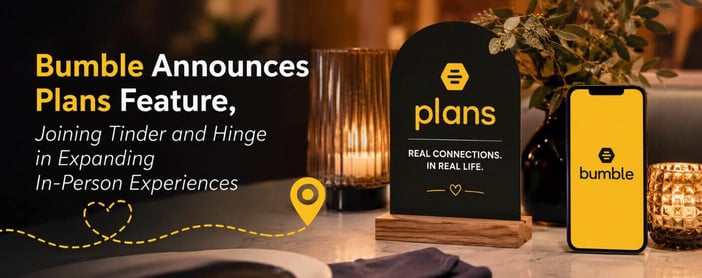
Bumble isn’t just getting rid of the swipe, it’s evolving beyond online connections entirely. Its new paid in-person group dating format, Plans, is designed to turn digital matches into real-world encounters while potentially generating new (and much needed) revenue.
Plans invites users to RSVP to curated group dating events (for a fee, of course). Attendees can optionally bring a friend for an additional charge, but there’s a catch: The event location is only revealed after payment.
After meeting in person at a Plans even, users can reconnect and match with the people they met back on the app. I think it’s interesting how Plans takes a backwards approach to the typical flow of online dating, starting with IRL connections and then transitioning into online discovery.
This may seem like a drastic shift of priorities for Bumble, the dating app that has long championed women-led online connections based in safety. But then I remembered all the startup founders I’ve talked to over the last year whose entire pitch is basically, “What if dating apps involved more actual dating?”
Bumble has picked up on what modern daters really want: IRL meet-cutes based on real, authentic, in-the-moment chemistry. With Plans, Bumble is essentially leaning into a hybrid model: part dating app, part event company.
How Plans Changes Bumble’s Matchmaking Strategy
By getting rid of the swipe and transitioning into IRL interactions, Bumble is publicly saying goodbye to the algorithmic matchmaking strategies of yesteryear. For modern daters, the message is clear: No more swiping in isolation. It’s time to get back into the living, breathing dating scene.
Detractors might wonder how Bumble plans to maintain the efficiency of online dating in an IRL space. We have, after all, gotten used to seeing countless profiles in a single swipe-session; being IRL cuts down on exposure to potential daters dramatically, right?
The dating app company is betting on drawing enough daters to these IRL meet-ups that people will be able to meet with multiple potential dates in one night.
Not necessarily, according to Bumble. The dating app company is betting on drawing enough daters to these IRL meet-ups that people will be able to meet with multiple potential dates in one night, not unlike if they were swiping in their pajamas on the couch.
Instead of simply RSVPing, users commit financially up front, suggesting Bumble is not only trying to improve attendance rates, but also to filter for intent. This way, people will be able to interact with those who, importantly, share their willingness to invest in an offline dating experience.
If you ask me, this is a smart move from Bumble, because the paid structure becomes its own compatibility marker.
Why is Bumble Investing in Offline Matches?
As products of the digital age, we’ll always crave attention and validation in some small way. But that doesn’t mean daters are as enamored with online-only intimacy as they used to be.
Years spent burning our retinas with blue light has made the outside world look more inviting.
Daters’ reignited enthusiasm for IRL connections has contributed to slower growth and increased competition, and not only from rival apps, but also from social platforms and real-life social events.
In that context, you can read Plans as Bumble’s attempt to reclaim relevance by meeting users where behavior is already heading: toward blended online-offline socializing. But even Bumble’s approach to IRL dating stands out to me because of how it ties monetization to offline interaction.
Plans is Bumble’s attempt to reclaim relevance by meeting users where behavior is already heading: toward blended online-offline socializing.
Dating apps are trying to hone their own aesthetics and become the type of IRL brands that influencers want to work with, and that everyone else wants to engage with.
Rather than treating events as optional brand extensions (take Grindr’s wellness platform, Woodwork, or Tinder’s ‘Tinder Made’ streetwear brand), Plans makes in-person dating feel like a paid core product. And like any product that positions itself as both “core” and “paid”, Plans must provide real value.
Ask anyone in this industry, and they’ll tell you the same thing: swipe fatigue isn’t something we should ignore. In response, companies like Bumble are looking for ways to monetize meaningful engagement rather than maximize screen time.
Bumble: From Dating App to a Lifestyle Brand?
As Bumble enters the world of event planning, I can’t help but wonder if Bumble will be able to create environments where attraction, conversation, and chemistry can happen in real time.
Some of you might argue that this is easier said than done. After all, Bumble has spent the last decade perfecting its online dating environment; real-life dating environments are another beast entirely.
We associate dating apps with intangibilities, like swipes and likes, which makes envisioning a real-life Bumble environment difficult for some people, myself included.
In truth, dating apps may begin to look less like software companies and more like hybrid lifestyle brands. When I think “modern lifestyle environments,” I think of Tarte’s notorious influencer-filled brand trips, Goop’s vague wellness and lifestyle curation, and pretty much any Lululemon-hosted festival or workshop.
Dating apps are trying to hone their own aesthetics and become the type of IRL brands that influencers want to work with, and that everyone else wants to engage with.
What all of these brands have in common is name recognition, a strong social media presence, and a loyal customer base. With its new offline ventures, Bumble could easily be on the same path.
Dating apps are trying to hone their own aesthetics and become the type of IRL brands that influencers want to work with, and that everyone else wants to engage with. Take Grindr’s annual Pride Month bus tour, for example. With Plans, Bumble is taking another step away from online dating and toward IRL lifestyle relevance.
If people like it, Plans could be one of the first major evolutions of the dating app model that brings dating into the real world. If not, it may serve as another reminder of just how difficult it is for legacy swipe-based platforms to reinvent engagement.
Either way, the future of dating apps may not be in more profiles or better algorithms, but in getting people off the screen entirely. A screen-free dating world may sound like science fiction or something to you, but trust me on this: It could easily be our reality.