Key Takeaways
- By addressing the financial pressures keeping Gen Z from dating, BLK is proving that accessibility and affordability are as valuable to users as the app experience.
- Gen Z’s so-called “antisocial” behavior may have less to do with disinterest in dating and more to do with the rising financial burden of modern romance.
- BLK’s gas-card campaign highlights how dating apps can build stronger user loyalty and provide real value by addressing users’ real-world financial barriers.
- The future of dating apps may depend less on expensive new features and more on whether platforms can make dating itself feel affordable again.
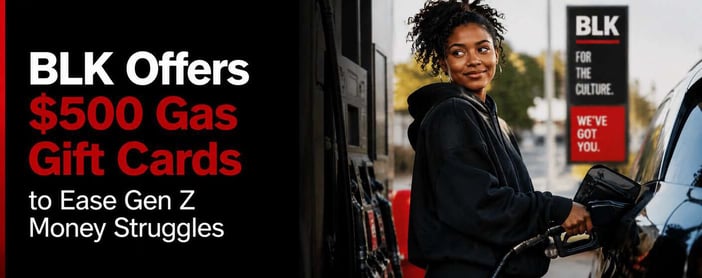
The dating app BLK is getting to the root of Gen Z’s reluctance to date — rising prices and inflation — by giving out $500 gas gift cards to 10 lucky people. But there’s a catch (sort of): Only users who download the app and tag three friends on BLK’s social media channels will be eligible to win.
“Dating should not have to compete with the price of a full tank,” said Amber Cooper, Head of Brand at BLK. On Instagram, BLK put it even more simply: “Sir i WANT to come see you but my tank said ‘pick a struggle.’”
The campaign, #FuelingBLKLove, speaks to a very real barrier to dating: 87.9% of BLK survey respondents say they would date more often if money weren’t a factor.
BLK is realizing that value is often found in the most basic places — namely, our wallets. Instead of only finding ways to improve the online dating experience, it’s also trying to make dating itself more accessible for real people.
87.9% of BLK survey respondents say they would date more often if money weren’t a factor.
This is not the first time BLK has attempted to make dating more financially feasible for Black daters. In 2022, the app partnered with The Gathering Spot to foot the bill for users’ dates at Black-owned businesses.
“Every year, Break the Bank lets us speak directly to the financial realities our users are living,” Cooper said of BLK’s annual campaign series focused on easing financial barriers to dating for Black Americans.
“In 2022, it was inflation. In 2023, it was the Black Tax. This year, it’s the cost of getting from Point A to Point B – and we’re stepping in to help make sure a gas receipt doesn’t stand between a great match and a great date,” she added.
Giving away free gas may seem simple, but it’s a surprisingly meaningful gesture. In an industry where an increasing number of platforms and professionals are vying for high-earning clients, an app that appeals to the average dater and their accompanying financial needs can make a truly meaningful impact, indeed.
Why Does BLK’s Campaign Resonate with Gen Z?
“Why is Gen Z so antisocial?” is a common headline these days, and has almost certainly been uttered inside a few dating industry boardrooms. But the reason behind Gen Z’s reluctance to date is not some big mystery. It’s the simplest reason of all: money — more specifically, a lack thereof.
BMO Real Financial Progress Index found that Americans are, on average, spending 12.5% more on dates in 2026 than in 2025, and this includes money spent on gas. This doesn’t necessarily mean that people are dating more frequently, but that they’re shelling out more money on dates. There’s even a word for this phenomenon: Date-flation.
Source: BMO
Dateflation could be the not-so-secret force behind Gen Z’s antisocial tendencies. Nearly half (47%) of the singles surveyed by BMO said that dating was not “financially worth it” anymore.
“Singles can feel priced out of love,” Paul Dilda, Head of U.S. Consumer Strategy at BMO, explained. “Whether it’s a long-term relationship or a first date, it has never been more challenging to ensure the path to love is also the path to real financial progress.”
No amount of celebrity endorsements or AI innovations can change the fact that young daters don’t have the funds to interact with dating apps and the dating industry the way they used to. And as subscription costs climb, platforms have had to brainstorm new ways to introduce real value to users.
Valuing Daters’ Needs Is the Campaign’s Core Strength
As difficult as it is for singles to afford dating, it has also never been more difficult for dating platforms to convince users that apps are worth the cost. BLK saw this challenge as an opportunity to make a tangible impact on users’ everyday lives.
BLK’s approach shows how powerful it can be when a company meets users where they are — in this case, in need of a real financial boost.
Sometimes, the most insurmountable obstacle preventing someone from dating is as simple as a flat tire, movie tickets, or a decent cup of coffee. These everyday expenses are suddenly out of our price ranges. BLK posits that those eye-popping gas prices we’ve been contending with are the same kind of obstacle.
Sometimes, the insurmountable obstacle preventing someone from dating is as simple as a flat tire, movie tickets, or a decent cup of coffee.
It’s not exactly shocking that BLK chose this particular moment to give out $500 gas gift cards (cue jokes about how $500 is barely enough to fill up a tank). As of writing, the average gas price in the U.S. is $4.50, with prices soaring to $6 in parts of California and Hawaii.
It’s no wonder BLK’s Instagram post about the gift card campaign garnered thousands of likes and comments. But the appeal of simple cost-saving campaigns like this goes beyond the money itself.
It’s also about convenience, and about sending users a message that says, “We understand dating is expensive right now, and we want to help make it more accessible.”
This is the real value daters are craving. It sounds cliché, but this kind of campaign goes a long way to making users feel less like profiles and more like humans.
Are Daters and the Dating Industry at a Financial Impasse?
Wired suggests that this kind of campaign verges on the dystopian, and I can’t argue with that. Young singles competing for free gas or basic provisions does conjure up some Hunger Games-esque images. The rise of choremancing even brought daters from romantic restaurants into fluorescent-lit grocery stores — a spine-tingling sight if there ever was one.
And yet, subscription prices continue to rise. Everyone has a bottom line; there’s no getting around that. But there’s also no getting around the fact that daters simply won’t leave their homes if they can’t afford to. Are daters and the dating industry at an impasse?
More dating apps should “introduce affordable one-time options, instead of expensive monthly subscriptions.” — Hayley Folk
Not necessarily. DatingNews’ resident editorial writer, Hayley Folk, recently made a bold suggestion to dating apps: “Build a free version that is actually good.”
“Instead of charging for basic functionalities, consider offering lower-cost memberships for younger users,” she added. “Create free community-based features or, in the event that they can spend a little money, introduce affordable one-time options, instead of expensive monthly subscriptions.”
Asking dating platforms to simply charge less for their product may sound naive, but… is it? AI innovations and national ad campaigns have their place, but what daters actually want is something much more simple: To go out on dates.
When money is the only consistent obstacle preventing them from achieving that goal, it’s up to dating platforms to remove that obstacle. This is the way to create real value that lasts.