Key Takeaways
- Tennessee teen Kaelyn Lunglhofer is suing hookup app Meete after the platform allegedly used her TikTok in a sexually suggestive ad without her consent.
- Lunglhofer claims Meete used her likeness in a sexually suggestive ad, and geolocation-targeted the ad to people on her college campus.
- Questions remain about Meete’s operations, with Lunglhofer’s case highlighting concerns over unverifiable profiles and potential use of AI-generated imagery.
- Lunglhofer’s lawsuit invokes Tennessee’s ELVIS Act to test emerging AI-era identity protections beyond those of celebrities.
- As AI use grows and regulation struggles to keep pace, more lawsuits are emerging over the alleged nonconsensual use of people’s images on dating apps.
University of Tennessee college freshman Kaelyn Lunglhofer’s life was turned upside down when she received a Snapchat from a guy in her dorm. “Is this you?” he asked, and sent her an accompanying video ad for a hookup app.
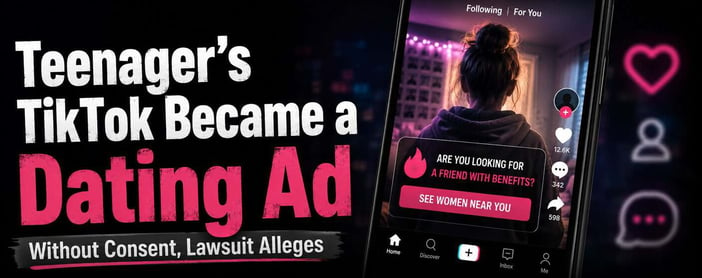
It was her — she’d filmed a cute lip-syncing video to TikTok a few months earlier, on the day of her high school graduation — but the voice speaking over her TikTok definitely was not her voice, and it said something she definitely wouldn’t say: “Are you looking for a friend with benefits?”
The now-19-year old Lunglhofer is accusing the hookup app, Meete, of turning her innocent lip-sync TikTok into sexually suggestive marketing without her permission, raising new questions about how platforms use young women’s content in the race for attention.
Lunglhofer’s attorneys claim that the offshore companies behind Meete — Guangzhou Yuedong Interconnection Technology and Starpool Data Limited in China, and Quantum Communications Development Limited in the British Virgin Islands — violated the state of Tennessee’s ELVIS act, as well as Lunglhofer’s natural rights to her own identity.
This is not a question of whether Meete used AI to alter Lunglhofer’s image, but whether it broke the law using her image at all.
What Was in The Ad?
According to the lawsuit, Lunglhofer’s TikTok video plays while a female narrator says, “Are you looking for a friend with benefits? This app shows you women around you who are looking for some fun. You can video chat with them.”
“They’re making me look like a prostitute,” Lunglhofer told WATE 6 News. She described Meete as a “nasty hookup app” that used her TikTok video, and therefore her likeness, without her permission.
“That was horrible,” she said. “I felt so embarrassed and mortified.”
Lunglhofer’s attorney, who the teen’s family hired after they found out about the situation, told WATE 6 News that Meete used geolocation tech to target the ad to men in Lunglhofer’s vicinity, including her college campus.
“For what this app is selling, to sort of enlist a teenager as an involuntary spokesperson for their product without consent, without permission, and then to target people around her with that ad to try to deceive them, is about as bad as it gets,” attorney Abe Pafford said.
Meete claimed it didn’t know that Lunglhofer’s TikTok was featured in its promotions until it was notified of the lawsuit. The company uses third-party marketing agencies, but “did not conduct a review of all the materials, and this was indeed our oversight,” Meete said in a statement to Reuters. “We sincerely apologize to Ms. Lunglhofer.”
DatingNews reached out to Meete for comment but has not heard back.
What Kind of App is Meete?
Questions remain about what Meete really is and how exactly it operates.
Meete’s website is bright, colorful, and seemingly devoid of men (at least on the outside). Instead, you’re greeted by what looks like AI-generated or altered photos of smiling women and the invitation to “Browse photos, see everyone’s insterests [sic] and decide who deserves to be liked!”
There’s a carousel of what appear to be social media pics of real women, but they all seem to be named Judite Sacola, are listed as being 22, and enjoy hiking and rap music. These profiles are repetitive and difficult to verify.
“Those connotations that can come with [this type of app] is … an unsafe feeling.” — Kaelyn Lunglhofer
But the fallout Lunglhofer experienced as a result of Meete allegedly using her image is very real — and potentially dangerous.
For Lunglhofer, the ad doesn’t only put her personal reputation at risk, but her physical safety, too. “Those connotations that can come with [this type of app] is a terrible feeling, and that’s an unsafe feeling,” she added.
If apps are willing to advertise with young women’s images without getting their consent, are they just as willing to use images of minors? Pafford seems to think this is a distinct possibility. “They could’ve as easily taken a similar video from someone 17 or 16 or 15, and as long as it served their purposes, I think they would use it,” he said.
What Does The Law Say?
Tennessee’s ELVIS act — or the Ensuring Likeness, Voice, and Image Security (ELVIS) Act — is one of the first legislations enacted in the U.S. to prevent identity theft via deepfakes and other types of AI-generated images, primarily when these images are used for commercial benefits.
The ELVIS act was borne from necessity, or at least from the growing sense of unease surrounding deepfakes of music figures like Elvis Presley and Taylor Swift. By making it a major part of her case, Lunglhofer’s attorneys are bringing the debate over digital identity rights into the lives of non-celebrities — and onto a national stage.
According to the lawsuit, Lunglhofer is seeking damages of $750,000. Her father told Reuters that the money is secondary to the potential benefits of having Lunglhofer’s case become precedent. He also hopes that the lawsuit will result in Meete being removed from the App Store and Google Play.
What Does This Mean for Dating Apps?
Dating apps are grappling with a future where AI-use is at an all-time high, while trust is at an all-time low. As Tinder seemingly attempts to use AI to safeguard the user’s identity, the fact remains: AI is evolving faster than apps, users, and especially public policy can keep up.
Of course, this is not the first time someone has claimed that their image was involuntarily altered and/or sexualized for commercial purposes. Earlier this year, three Arizona women filed lawsuits claiming that their social media images were altered by AI and used to advertise for pornography sites.
More lawsuits like Lunglhofer’s will result if platforms and AI companies continue to operate without strong, nationally recognized regulation.