Key Takeaways
- Tinder is partnering with World to test World ID as a way to verify real users and strengthen trust as AI makes it harder to distinguish humans from bots.
- World ID turns an iris scan into a privacy-preserving digital credential that signals humanity without sharing biometric data.
- World may be developing tiered human verification with World ID, ranging from high-assurance Orb scans to lighter options like selfie-based checks.
- Tinder is adding tools like World ID and Face Check to reduce fake accounts and strengthen ever-important user trust through visible verification signals.
The World project describes itself as “a new standard of trust for the internet”, and Tinder is one of the first major dating platforms to put this claim to the test. The catch? Verifying humanity with the World project involves an Orb, an ID card, and your eyes.
Tinder Introduces AI Eye Scan Verification With World ID
AI has evolved so quickly and so effectively in the last year alone that merely assuming humanity, even with the added security layer of CAPTCHAs, is no longer going to cut it. The World project (I’ll call it ‘World’ going forward) is attempting to get ahead of AI’s fast-paced evolution with its new product, World ID.
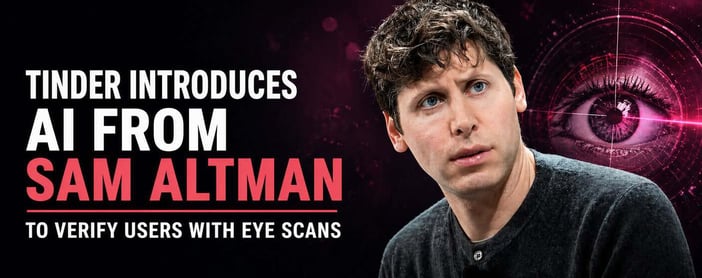
Mr. OpenAI himself, Sam Altman — who co-founded the World project — announced World’s collaboration with Tinder at its recent “Lift Off” live event.
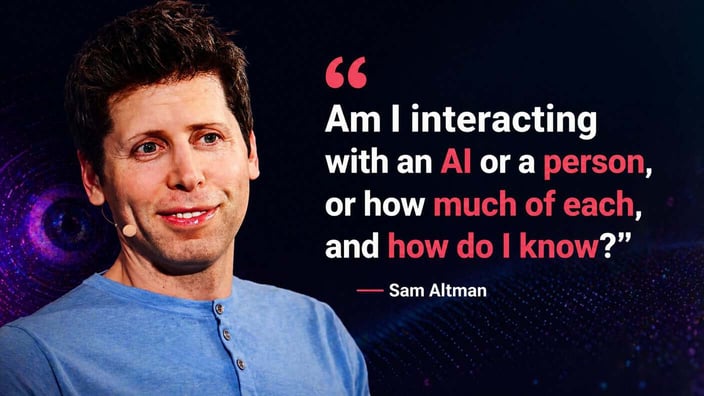
“The world is getting close to very powerful AI, and this is doing a lot of wonderful things,” he said. “I’m sure many of you [have had moments] where you’re like, ‘Am I interacting with an AI or a person, or how much of each, and how do I know?”
“Am I interacting with an AI or a person, or how much of each, and how do I know?” — Sam Altman
Tinder recognizes a clear shift: Users are more invested than ever in proving their humanity, drawing a sharp line between “helpful AI” and “controlling AI,” and expecting platforms to carefully balance both. Its partnership with World and its iris-scanning tech proves Tinder is willing to get experimental if it means enhancing user trust.
Can AI Iris Scans Verify Users Without Storing Biometric Data?
At Tinder, World ID is an optional add-on that provides an additional layer of human verification to the onboarding process. What makes World so unique is its claim that it can prove authenticity without exposing or sharing sensitive data or raw biometric information.
If you’re as wary of new AI tech as I am, then you’re probably wondering how this is possible. The answer is complex, involving zero-knowledge proofs (ZKP), an open-source protocol called Semaphore, encrypted user files, and other big tech words this writer isn’t qualified to speak on.
(You can check out World’s FAQ page for more information about how it handles biometric data and user privacy.)
Imagine putting your eye an eyelash-width away from a basketball-sized white orb, and you get a very general idea of how World scans users’ irises.
This is especially impressive considering what World uses to confirm a user’s humanity: a scan of their iris pattern. Imagine putting your eye an eyelash-width away from a basketball-sized white orb, and you get a very general idea of how World scans users’ irises.
The Orb is a physical device, which means you’d have to find a World Orb location somewhere near you to scan your irises. When World verifies your humanity, you can get a World ID, which naturally acts as a digital “I’m a real human” credential for World-supporting platforms.
Tinder wouldn’t deal with the Orb directly; it would most likely ask if you already have a World ID. Having an ID would signal strong trust and humanity to other users on the app.
World ID Verification Tiers: Iris Scans to Selfie Checks
If this sounds like a labor-intensive way to prove your humanity, you’re not alone. I already get frustrated by those stop sign CAPTCHAs; now you want me to go to some random place so a mysterious orb can scan my eye?!
An Orb scan seems to be the gold standard for human verification at World. Getting a World ID from an Orb scan sends the strongest message of trust to your fellow app users. But this doesn’t mean that users will always have to receive an iris scan from the Orb to get a World ID.
It’s possible that World will continue to innovate to make high-level human verification less labor intensive, but more accurate than the average CAPTCHA.
Getting a World ID from an Orb scan sends the strongest message of trust to your fellow app users.
World’s chief product officer, Tiago Sada, told TechCrunch that the company is working on creating different verification tiers, including less friction-heavy tiers for those of us who’d rather not stick our eye near a white orb.
At Lift Off, Sada introduced a lower-level tier called Selfie Check, which he said is “private by design” to maintain the high privacy standards World is known for while verifying the user’s humanity.
But this lower tier is exactly that: a less intensive, and potentially less secure, version of the gold standard Orb verification.
Tinder Expands AI Verification to Combat Bots and Build User Trust
It’s important to note that providing a World ID will not be mandatory for Tinder users. For now, it’s just another part of Tinder’s layered system of defenses. And this system seems to get more complex with every passing quarter. Last year’s Face Check integration helped decrease the visibility of bad actors by nearly 60%.
Like the Orb, Face Check relies on getting the user’s consent to scan their face, which it compares to the photos on their profile to ensure consistency. With Face Check and World ID at play, a user would theoretically prove beyond a shadow of a doubt that they’re a real life human being — again, theoretically.
With Face Check and World ID at play, a user would theoretically prove beyond a shadow of a doubt that they’re a real life human being.
It’s easy to read about all of these security innovations and think, “Is this all really necessary?” But in the age of AI scammers and bots, trust has never been such a hot commodity on dating apps. Apps that provide as many security layers as possible have the best shot at garnering real user trust, and therefore, real user engagement.
Look no further than those little blue checkmarks on X to see how visible verification signals in all their forms go a long way. Users value authenticity more than ever, especially on dating platforms, where the main goal is to establish authentic connections.
In fact, visible authenticity signals could make verified users more desirable than others, and ultimately more likely to get matches.
An iris-scanning Orb and human-verification ID card may seem like something out of a sci-fi movie, but it’s probably an accurate glimpse at how dating platforms will ensure human-only users going forward.