The past year has brought massive change to the dating app, including a new look, innovative safety tools, and major product overhauls. But no change has been quite as unexpected as Tinder’s foray into IRL events.
In late July, Tinder announced that its in-app Events feature, which shows users in-person social events in their area, is going global. This marks a major philosophical change for the dating app. Is Tinder, the dating app that once said love “starts with a swipe,” embracing a swipe-less future?

As Tinder’s Resident Relationship Expert Devyn Simone told us, the Events feature isn’t only about helping daters overcome swiping fatigue. It’s about meeting them where they already are: in crowded bars, cozy craft nights, and dynamic sporting events, to name a few.
At DatingNews, we wanted to know more about what this brave new world for dating apps could look like, so Simone broke it down for us.
DatingNews: Tinder says more singles are moving away from the traditional first date. What changes are you seeing in dating behavior that led to the development and expansion of Tinder Events?
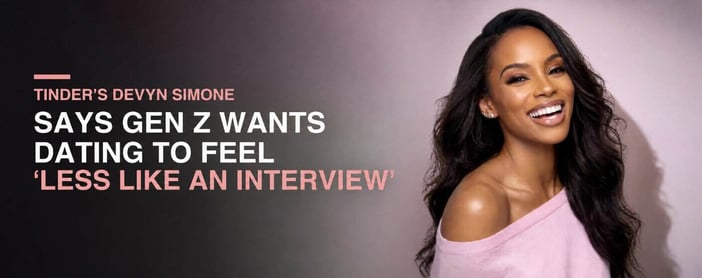
Devyn Simone: We’re seeing singles, especially Gen Z, want dating to feel less like an interview and more like real life. They’re looking for more natural, lower-pressure ways to connect, and increasingly gravitating toward shared experiences, a class, a hike, a game night, where connection happens organically while you’re doing something together instead of feeling like it’s the only thing you’re supposed to accomplish.
That’s the thinking behind Events. Events was built to expand what’s possible with swiping, bridging the journey from online dating to real-life sparks. As we see dating become more social, authentic, and experience-driven, Events gives singles more ways to connect both on and off the app.
We piloted it in Los Angeles in March, and the response confirmed what we’d been seeing all along: singles are looking for lower-pressure, more natural ways to meet. 66% of eligible active users in that market engaged with the feature, and more than half came back for more.
DN: The Los Angeles pilot showed strong engagement. Beyond participation, what surprised Tinder most about how people actually used Events?
DS: What surprised us the most wasn’t just what people signed up for—it was how intentionally people chose experiences where conversation could happen naturally. We expected things like live music and trivia to perform well, and they did, but a 60-person candlelight ceramics class sold out within a day. That told us people don’t just want something to attend—they want something to actually do together.
Adoption also skewed notably young: 71% of 18–24-year-olds engaged with Events, compared to 63% of users 25 and older. That reinforced what we’ve been hearing all along: this generation is looking for ways to meet that feel more natural, more social, and a lot less intimidating than a traditional first date.
DN: Many of the most popular Events are things like walks, game nights, creative classes, and DJ nights. Why do you think these lower-pressure environments resonate with today’s singles?
DS: Because they take the spotlight off the two of you and put it on something you’re both experiencing in real time. When you’re learning a skill in a ceramics class or just vibing at a DJ night, you’re not forcing small talk, you’re reacting to something together, and that’s when people tend to relax and actually be themselves.
There’s also less pressure for every interaction to feel like it has to lead somewhere. At a group hike or a game night, you still had a good time even if romance wasn’t part of it, and that built-in sense of ease is a big part of why these formats are resonating right now.
DN: Do you think group settings make it easier for people to form genuine romantic connections than traditional one-on-one first dates? Why or why not?
DS: I think they help people be themselves faster. Traditional one-on-one dates can sometimes feel a little like interviews—you’re both aware you’re being evaluated. Group and activity-based settings take a lot of that pressure away, so people relax, show more of their personality, and you get a much more authentic sense of whether there’s chemistry.
That doesn’t mean they replace one-on-one dates—they simply change how people get there. One of the things I love about Events is that they create a natural, low-pressure starting point, so if there is a spark, the date that follows feels like a continuation of something genuine instead of a cold start.
DN: What advice would you give someone attending a Tinder Event for the first time who hopes to make a meaningful connection?
DS: Go in with zero pressure to make something happen. The moment you feel like you have to leave with a match, you lose one of the biggest benefits of the experience. Instead, show up because the activity genuinely interests you and let conversation happen naturally along the way.
I’d also recommend checking out the Interested list before you go so it doesn’t feel like you’re walking into a room full of strangers. And because Photo Verification is required for full access to Tinder Events, you can feel more confident knowing everyone attending has completed an extra layer of verification, helping create a safer and more trusted experience.
Bonus tip: If you’re feeling a little nervous about your first Tinder Event, bring a friend. You’ll have a familiar face to kick things off with, and chances are you’ll both end up meeting new people along the way.
Afterward, don’t overthink the follow-up. If you connected with someone, send a Like or Super Like and reference something specific you shared at the event. It’s an easy, low-pressure way to keep the conversation going.
DN: What does success look like for Tinder Events? Is it measured by attendance, conversations after the event, matches, relationships, or something else?
DS: Success starts with people wanting to come back because they genuinely enjoyed the experience. If someone leaves thinking, “I’d absolutely do that again,” that’s a really good sign.
Of course, we’re also looking at repeat engagement, conversations after the event, and post-event matches because those help us understand whether people are continuing the connections they started. But to me, success is really about whether we’re helping make meeting people feel easier, more natural, and a little more fun. If people walk away feeling more confident about putting themselves out there, that’s a win.
DN: Looking ahead, do you think event-based dating experiences will become a permanent part of how people use dating apps, or do you see them as complementing traditional online matching?
DS: I definitely see it as complementing traditional matching, not replacing it. Swiping is still a great way to discover someone new, and that’s not going anywhere. Events simply give people another path to turning that first spark into a real-life connection.
I don’t think this replaces swiping—I think it expands what’s possible. People still need a place to discover someone new, and Tinder does that incredibly well. Events simply give people another way to turn that first spark into something real.