Key Takeaways
- 38% of survey respondents say they have passed on dating someone because of distance.
- Nearly 1 in 3 Americans (29%) have ended a relationship because distance made dating too difficult and inconvenient, with 36% citing a partner who always expected them to make the trip as a key reason why.
- A stark gender divide: 82% of men say they drive themselves to dates versus 59% of women. Yet 1 in 5 women still depends on a date for a ride, compared to 3% of men.
Technology has made us more connected than ever, erasing the limitations of distance and access in almost every area, even dating. Yet while singles can match with anyone, quite literally anywhere, geography remains one of the most important filters in modern dating.
That’s probably because most people live by the 30-minute rule. What is this rule you may ask?
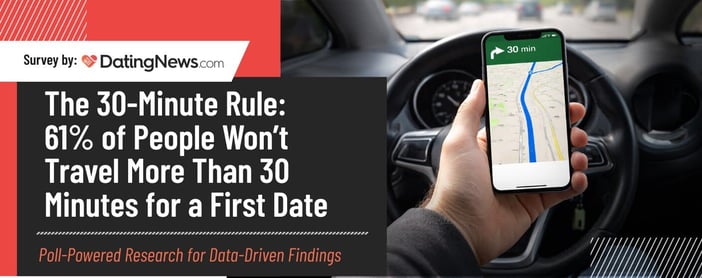
The DatingNews Distance & Dealbreakers Survey reveals that 61% of respondents won’t travel more than 30 minutes for a first date, with the 20 to 30 minute travel band being their most common threshold of willingness. Only 12% said they would travel more than 45 minutes for a first date.
Many people aren’t willing to accommodate distance or travel to get to know someone. So much so that daters have created a self-imposed limit on their dating pool. This shows that geographic desirability isn’t just shaping how far daters will travel; it’s also shaping who people pursue.
In fact, 38% of people said they have passed on a potential match because of distance. That means, for many daters, a significant share of potential matches are filtered out on distance alone — before any chemistry, compatibility, or conversation has a chance.
Nearly 1 in 3 Respondents Have Ended a Relationship Because Location Made Dating Too Difficult
We may be more connected than ever because of technology. But it’s clear that close, in-person connections still trump connections made online or over the phone.
Nearly 1 in 3 (29%) people said they have ended things with someone because their location or transportation made dating inconvenient. Another 12% considered leaving their long-distance relationship but stuck it out. This suggests that distance can influence whether a couple calls it quits.
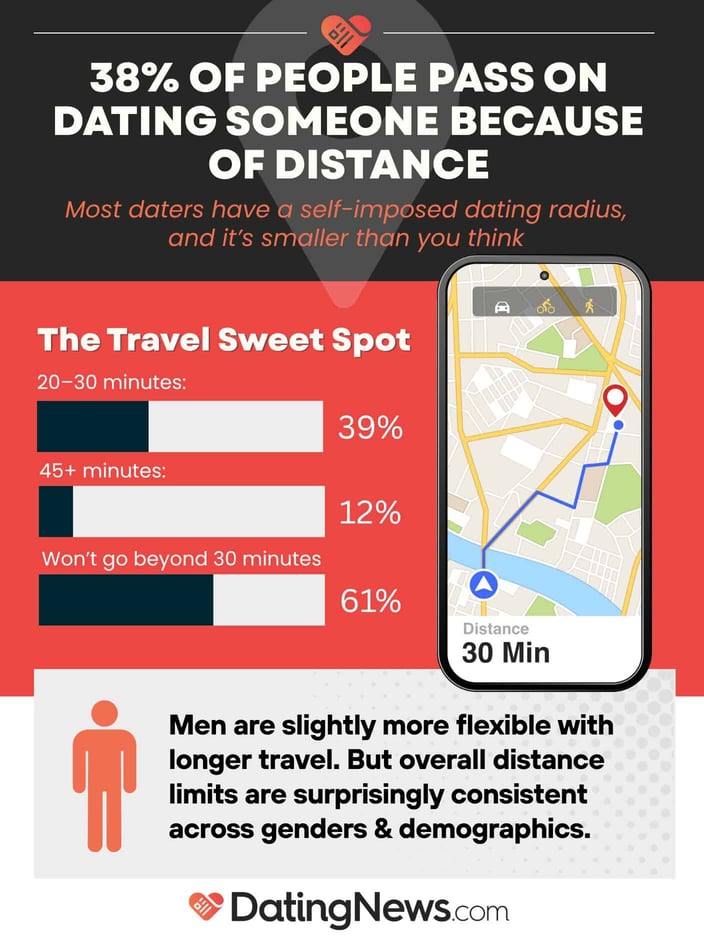
For many people, location is a major non-negotiable. In fact, about 9 in 10 daters have set a distance limit on who they’ll consider in dating apps, and only 12% of people are open to long-distance dating at all.
Our study also shows that opinions on distance are universal. Almost all demographics agree that distance isn’t ideal in early dating, underscoring the need for proximity and in-person interactions.
While online dating may be popular, daters don’t want to stay online. They desire to make real connections through in-real-life meetups and dates. And without proximity, this isn’t always possible, whether due to scheduling conflicts or transportation limits.
Getting to know someone new already has its pressures. And for many, adding distance only complicates this process, highlighting why online daters may feel the need to draw a hard line on geography while swiping.
Why Couples Call It Quits Over Distance
Location is everything, not only when finding the perfect date spot, but also the right partner. When asked why they ended or considered ending a long-distance relationship, respondents simply said that they lived too far away from their partner.
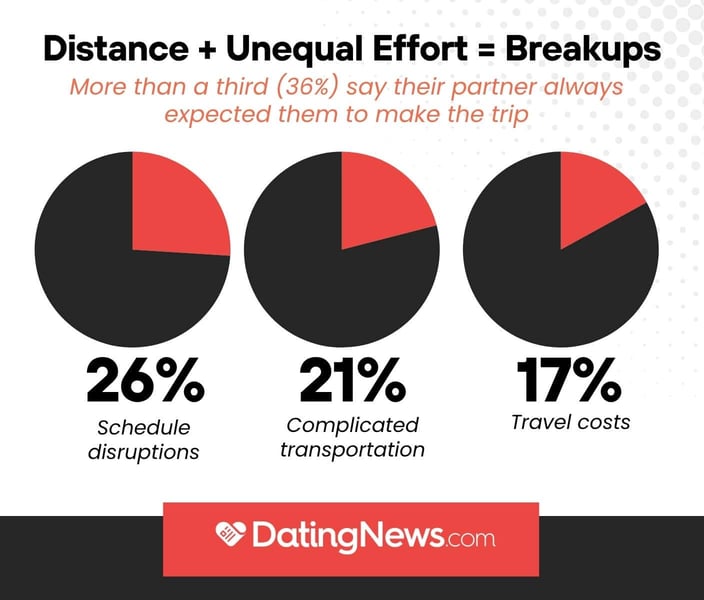
Yet, distance isn’t the only reason relationships end over geography. Here are some of the other top reasons these relationships falter:
- 36% said their partner always expected them to make the trip
- 26% said it disrupted their schedule
- 21% said transportation was too complicated
- 17% said transportation costs were a factor
These results show that while distance is the main culprit, the complications that come with it are also a problem for couples. Mismatched schedules, unequal effort, and costs can all cause challenges in these relationships.
We also found a clear gender divide when it comes to date transportation. Men were more open to longer travel times and more likely to drive themselves to dates than women (82% v.s. 59%).
Some older traditions still hold up as well, with women more likely to ride in a date’s car than men (20% v.s. 3%). Overall, 71% of all respondents drive themselves to dates.
Proximity Still Wins in the Digital Age
While some may view long-distance dating as out-of-state relationships or hours-long drives, our study shows that even a 40-minute commute can prove to be too long a distance for many daters.
Geography is more than just a backdrop; it influences who daters pursue in their search for love. In an era of limitless digital connection, physical proximity is still gold, and many are curating their dating pools to achieve it.
While it’s clear that long-distance dating isn’t for everyone, these types of relationships are still possible for those who are willing to go the distance.
Methodology
This survey was conducted by DatingNews and Prodege and includes responses from 1,498 U.S. adults ages 18 to 79 across a range of relationship statuses, including single, in a relationship, and married. The sample reflects a broad distribution across gender, age, and U.S. regions. Fieldwork was completed in March 2026. The theoretical margin of error for a probability sample of this size is ±2.5 percentage points at the 95% confidence level.

![7 Best Hookup Sites for Married People[updated_month_year before=" (" after=")"]](https://www.datingnews.com/images/uploads/2023/07/hookup-apps-married-people.jpg?width=342&height=135 "7 Best Hookup Sites for Married People[updated_month_year before=\" (\" after=\")\"]")