Key Takeaways
- As Pride becomes more commercialized, some question whether the celebration still resonates with the community it was created to represent.
- For many LGBTQ+ adults, Pride is increasingly seen as a marketing opportunity for brands rather than a meaningful expression of community and visibility.
- Corporate branding is increasingly shaping how LGBTQ+ people experience Pride, with many reporting discomfort, distrust, or avoidance of brand-sponsored spaces.
- Brands that pair LGBTQ+ visibility with thoughtful products and sustained support are more likely to earn trust and a meaningful place in Pride spaces.
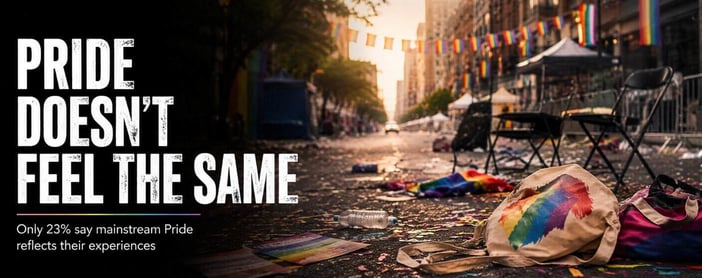
Of the more than 1,000 LGBTQ+ adults surveyed by the dating app Taimi, only 23% said that mainstream Pride events accurately reflect their experiences. As Taimi put it, this startling statistic suggests that “A growing number of LGBTQ+ people are starting to feel disconnected from the version of Pride being sold back to them.”
“Sold” is the operative word here. In 2025, nearly 70% of LGBTQ adults surveyed by Pew Research said companies that support Pride only do so for their own business interests. In doing so, Pride Month has gone from a social movement to a business opportunity, with some companies giving the bare minimum to show support.
And the 77% of respondents who don’t feel fully represented by mainstream Pride would probably tell you the same thing: The bare minimum isn’t going to cut it.
Pride Month has gone from a social movement to a business opportunity, with some companies giving the bare minimum to show support.
When I say “commercialization,” I’m talking specifically about stores that sell rainbow-covered T-shirts but discriminate against LGBTQ+ employees behind the scenes; Pride events that exclude certain identities; LGBTQ+ community members feeling pressured to celebrate Pride despite growing political, economic, and social uncertainty.
I know — this is kind of a buzzkill. But these complicated feelings are just as valid during Pride Month as they are the rest of the year. At its core, Pride Month is about celebrating the LGBTQ+ community’s freedom to exist, but it’s also about its freedom to grow and change.
And community members are telling Taimi that the Pride Month they once knew has in some ways become a plasticized version of itself — something bright and shiny that’s sold for a limited time only.
Has Pride Become Commercialized and “Meaningless”?
Thirty-two percent of Taimi respondents still genuinely enjoy celebrating Pride, but the disillusionment Taimi noted is starting to spread. Thirty-three percent say they now prefer celebrating Pride privately, and 37% said that Pride has become “a commercial event that’s lost its meaning.”
To understand why this is, look no further than Meg Stalter’s viral “Hi gay!” video. Who could’ve guessed that a casual skit would become a defining statement on the commercialization of Pride?
“We’ve been making butter since 1945, and we’ve been accepting all people since the last four months,” she jokes, playing the role of a business owner attempting to appeal to the LGBTQ+ community during Pride.
Appealing to the LGBTQ+ community solely to sell sunglasses and T-shirts is to be expected of American corporations, but that doesn’t make it feel any less slimy, especially when these corporations become the Pride equivalent of a groundhog: They celebrate LGBTQ+ identities for 15 minutes and then disappear again for 11 months.
Source: Taimi
Target, once known (and gently mocked) for its a-rainbow-threw-up-in-here Pride section, has scaled back its LGBTQ+ merch in recent years, reportedly due to pressure from right-wing political groups. In early 2025, the retailer — along with McDonald’s and Walmart — rolled back its DEI initiatives completely.
Luke Hartig, president of Gravity Research, told CNN that corporate Pride engagement decreased a whopping 60% between 2023 and 2024, due in part to the Trump Administration's DEI crackdowns and alleged anti-LGBTQ+ sentiments.
As industry leaders, stores like Target and Walmart play a vital role in shaping trends and signifying what the “average” American consumer is looking for from their retailers.
So when these corporations roll back their support for the LGBTQ+ community, it sends a message: LGBTQ+ visibility is welcome when it's profitable, but expendable when it becomes controversial.
Those 37% of respondents who think Pride has become too commercialized reflect a growing number of LGBTQ+ community members who get more out of small, intimate, intentional, and authentic gatherings than huge, corporate-sponsored, rainbow-hued Pride celebrations.
Corporate Spaces Are Not Always LGBTQ+ Friendly
Hot take alert: Corporate-sponsored Pride events do, actually, play an important financial role. In fact, they even provide essential financial support for LGBTQ+ organizations. And according to CNN, corporate sponsorship can be the difference between high-quality security at Pride and no security at all.
But Taimi’s research makes it clear that there’s a line between corporate allyship and corporate exploitation, and when this line is crossed, it affects how LGBTQ+ daters feel in these spaces. Perhaps Taimi said it best:
“The research showed corporate branding is not just changing how people feel about companies. It is also changing how people feel inside Pride spaces themselves,” Taimi explained in its report.
Although 34% of surveyed respondents said that brand-sponsored Pride events have no effect on their love lives, and 16% said they have a positive effect due to visibility, the other half of respondents were less convinced.
23% of surveyed LGBTQ+ daters said they “don’t trust spaces that are brand sponsored,” and 19% said brand-sponsored spaces make them “uncomfortable” because “it feels performative.”
Twenty-three percent of LGBTQ+ daters in the study said they “don’t trust spaces that are brand sponsored,” and 19% said brand-sponsored spaces make them “uncomfortable” because “it feels performative.” And 9% said they “actively avoid brands or venues doing Pride campaigns.”
These stats make it clear that a growing demographic sees mainstream Pride as a candy-coated celebration of something that no longer exists: inclusivity and unconditional support for all identities within the LGBTQ+ community.
Real Allyship Goes Deeper Than Rainbows
A company’s inauthentic attempts to appeal to LGBTQ+ consumers is only part of the problem. Pride merch, one of the most visible aspects of Pride Month, has become a cultural signal of whether a company's allyship is genuine or simply another marketing strategy.
It’s disappointing when the most culturally insightful representation of LGBTQ+ Pride a billion dollar company can come up with is a rainbow-covered tank top. I doubt this is the queer art Megami wanted us to protect (if you know, you know).
Remember Target’s vibrant Pride section of years past? For as surface-level and cringy as some people found the rainbow products to be, there were other products of genuine value — the “tuck friendly” swimsuits for trans people, for instance.
"[LGBTQ+ people] still want joy, visibility, flirting, connection, and community. They just want it to feel real again." — Taimi
This product had the potential to spark truly productive conversations and connections, if only Target hadn’t pulled the swimsuits after right-wing backlash. Corporations can’t seem to decide whether they want to support LGBTQ+ consumers, and their noncommittal attitude only leaves a community of paying customers feeling isolated.
Taimi’s research sheds light on the growing number of LGBTQ+ people seeking more nuanced, educated, and insightful corporate support. A rainbow sticker isn’t going to cut it anymore.
When brands and corporations are committed to visibly supporting LGBTQ+ identities, and make this commitment clear with intentional merch, those corporations are more likely to be welcomed into LGBTQ+ spaces — including Pride.
"LGBTQ+ people are not done with Pride," Taimi said. "They still want joy, visibility, flirting, connection, and community. They just want it to feel real again."