Key Takeaways
- Successful rural dating apps don't just offer different features; they recognize that rural daters face fundamentally different challenges than their urban counterparts.
- Rural daters navigate tighter-knit communities and lifestyle-specific challenges that mainstream dating advice often overlooks.
- The success of rural-focused content and dating platforms shows that underserved communities can become thriving markets when their unique needs are addressed.
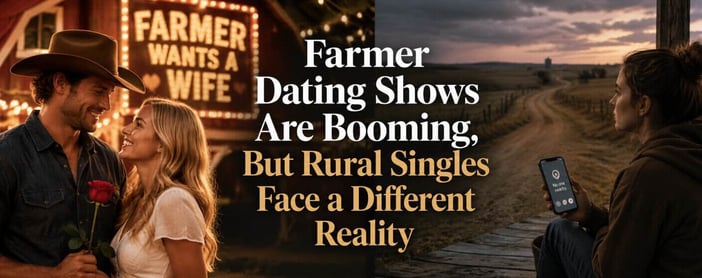
The hit FOX show “Farmer Wants a Wife” wrapped its fourth season last night, applications recently closed for the upcoming U.K. series “Farming for Love,” and the New Zealand dating app Howdy just launched with thousands of users already on the app. I think it’s safe to say that romantic farmers are having a moment.
But why? Why are we so fascinated with farmers and, more specifically, their love lives? Maybe because so many of us are farmers: People are more likely to live in urban areas than rural areas, but there are still billions of rural-living people around the world — 3.47 billion, to be exact — who are looking for connections.
These farming shows and dating apps have cultural relevance now more than ever, making them unexpectedly rich sources of growth for the dating industry. But just ask anyone in a rural area, and they’ll tell you that the dating industry is not built with them in mind.
If the dating industry wants to strike while the iron is hot, it has to reevaluate who its dating apps are built for, and how they can better meet the specific needs and values of farming folk.
Apps Have Innovated for Urban, not Rural, Daters
If your neighbor is a person and not a tumbleweed, then you probably know and have experienced one of the biggest problems with dating apps today: How easy it is to get overwhelmed by potential matches.
“The sheer number of potential matches can create a sense of opportunity, but also of transience,” MillionaireMatch noted. Dating apps have tried to make matches more accurate and personalized in order to address this problem; take Hinge’s detailed prompts and Feeld’s new “reflections” tool, for instance.
Tinder, Hinge, and Bumble, which depend heavily on location-based matches, are built for urban daters, not for people living in rural areas.
But all the innovation modern apps have put into streamlining the dating process means zilch to rural daters. Tinder, Hinge, and Bumble, which depend heavily on location-based matches, are built for urban daters, not for people living in remote areas. Instead of making the pool more shallow, these daters want to widen the net.
And you can tell these apps were built for remote daters from their functionalities alone. FarmersOnly, for example, allows daters to filter by “farming” or “ranching” and as if to prove it knows its demographic, the app specifically tells users to show their face in profile photos, “no hidin’ behind sunglasses or hats, now.”
“I genuinely believe I’m filling a crucial gap in the rural and regional market by offering a straightforward platform for like-minded people to connect.” — Mia Ryan, founder of Howdy
These alternative functionalities and tones may seem insignificant or even hokey, but they get to the heart of the billions of rural daters around the world. They say, “I understand you better than Tinder” — a powerful statement, indeed.
Rural Dating Has Never Followed the Big-City Playbook
In a rural dating scene, “Everyone knows everyone,” MillionaireMatch said. “This familiarity creates an environment where people are more likely to form long-lasting, meaningful relationships.”
This is an important signal to the dating industry: Rural daters may be more receptive to in-person dating events than urban daters. They understand that getting set up on a date with your Great Aunt Linda’s dentist is not an inconvenience, but a reality of a dating environment in which everyone literally knows everyone.
After all, there’s some truth to the stereotype that country folk tend to be more conventional and more traditional, especially when it comes to romance.
But there’s a downside to this, too. When dating traditions are shaped by the people in your vicinity, it’s easy to get lost in what the people you care about what you to do, instead of doing what you want to do.
After all, there’s some truth to the stereotype that country folk tend to be more conventional and more traditional, especially when it comes to romance. There’s generally less experimentation, less sowing of wild oats (at least not in a social sense) in remote environments.
And without experimentation, it’s more difficult to know what, exactly, you do and do not want out of love, sex, and relationships. This is a key area of need that dating platforms and professionals can fill for rural daters.
Namely, farming isn’t just a nine-to-five — it’s a lifestyle. And dating gets significantly easier and more emotionally fulfilling when you can easily match with someone who just gets it.
And if and when you do find someone you vibe with, there’s that classic hurdle of, “Are they prepared for my way of life?” Because people with laborious careers, particularly farmers, do live much differently than the average salesperson or accountant.
Namely, farming isn’t just a nine-to-five — it’s a lifestyle. And dating gets significantly easier and more emotionally fulfilling when you can easily match with someone who just gets it.
Apps like Howdy Fulfill a “Crucial Gap” in the Market
Everyone knowing everyone else is a gift — and a curse. It’s a curse apps like FarmersOnly and Howdy are trying to break.
There may be fewer people in rural areas, but these regions are still rich with potential for dating apps. Look no further than Howdy, the New Zealand dating app for rural daters that has already garnered over 30,000 users since 2024.
FarmersOnly says it has welcomed over 10 million people since 2005, and AgriMatching, a connection platform for farmers in the Netherlands, boasts over 30,000 profiles.
Howdy’s founder, Mia Ryan, highlighted the classic pitfalls of dating in a remote area. “Rural life can mean having neighbours who are hundreds of kilometres away and, if you are in a small town, chances are you know everyone already,” she told The New Zealand Herald.
These reasons alone are enough to warrant a dating app built by and for farmers and other rural daters. “I genuinely believe I’m filling a crucial gap in the rural and regional market by offering a straightforward platform for like-minded people to connect,” Ryan said.
This “gap” exists everywhere, from New Zealand to the U.S. American app FarmersOnly says it has welcomed over 10 million people since 2005, and AgriMatching, a connection platform for farmers in the Netherlands, boasts over 30,000 profiles.
Connection is a universal need, and rural singles are a market too often overlooked.
Fox’s reality dating show “Farmer Wants a Wife” is, on average, viewed by over 1.5 million households. There’s a demand for farmer romance content across the U.S., U.K., and pretty much anywhere you can think of.
The concept is so popular that versions of the “dating farmers” show exist in Australia, Croatia, France, South Africa, and many other countries.
Yes, farmers really do want wives, and they also want husbands, spouses, life partners, friends, and business partners.
We’ve explored this world for entertainment purposes, and now the dating industry is finally acknowledging what rural communities have known all along: Connection is a universal need, and rural singles are a market too often overlooked.