Key Takeaways
- While 40% of singles report having dated across political lines, 30% say they have never and would never date someone with opposing political views.
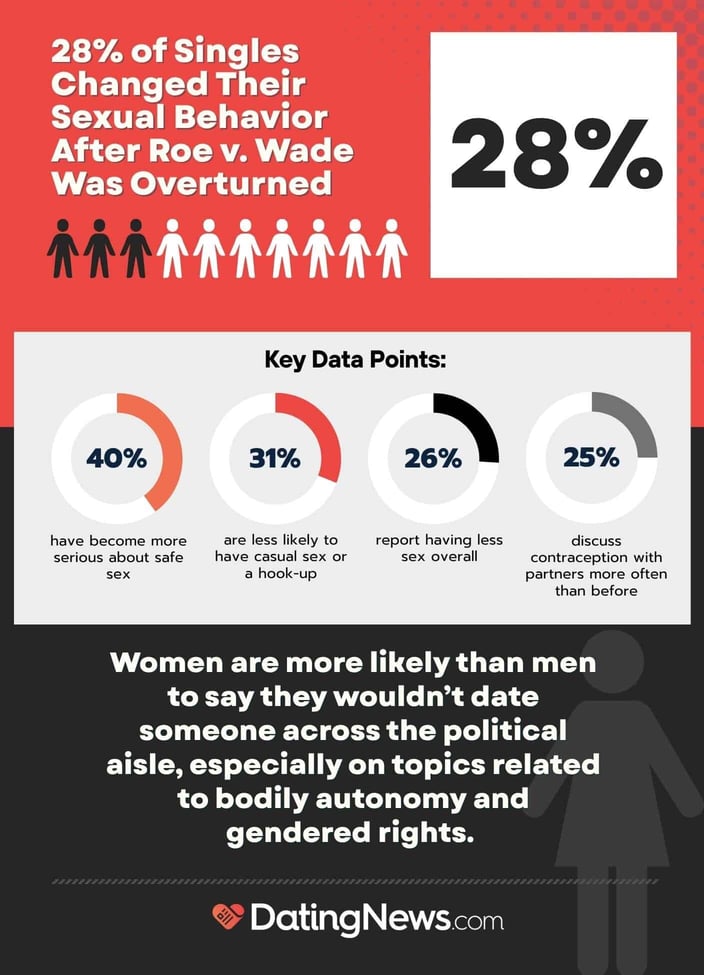
- Nearly 1 in 3 (28%) singles report changing their sexual behavior following the reversal of the Roe v. Wade ruling.
- About half (42%) of U.S. singles try to determine a potential partner’s political affiliation before going on a date with them.
What if I told you that a Democrat and a Republican could put their differences aside, connect on similarities, and potentially find love? To some, this may seem “impossible,” especially in a time when Americans seem more divided on political issues than ever.
Yet, according to a DatingNews and Kinsey Institute study, the State of Us: National Study on Modern Love & Dating in 2025, 40% of surveyed singles have admitted to dating across party lines. And most say they would do it again.
“People are getting past the initial resistance around dating someone from a different political party by leaning in to emotional connections. They may feel locked in before they even discover whether their date is a Republican or Democrat,” said Kinsey Institute Research Scientist Dr. Amanda Gesselman.
So we pose this question: Is it time to reframe the cultural perception that suggests Americans are too divided to date, or is dating across the aisle just wishful thinking?
Men Most Likely to Date Across Party Lines; Gen Z Women Least Likely
While popular culture may present a different view on dating and politics, our study finds that singles are willing to cross or have already crossed political lines for love and romantic connection.
And, it turns out, men are the most open to it. No matter their age, men surveyed were more likely than women to say they would cross party lines romantically, with Gen X and boomer men showing the most support.
However, our research also reinforces the cultural perception that, for some singles, opposing political views can be a major dealbreaker.
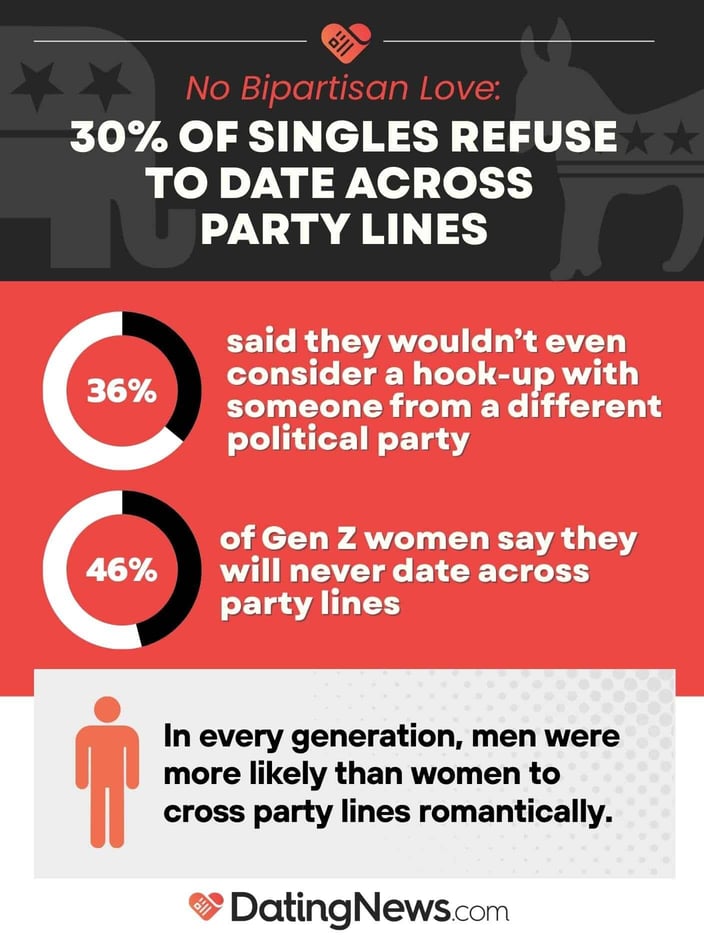
According to our survey, 30% of singles said they have never nor would they ever date a person with opposing political views, with Gen Z women leading the charge on this sentiment. About 46% of Gen Z women reported that they would never date someone from across the aisle.
Casual sex isn’t exempt either in this discussion. We found that 36% of singles said they wouldn’t even consider a hookup with someone from a different political party, showing how deep political rifts have become for many American singles.
28% of Singles Changed Their Sexual Behavior After Roe v. Wade Was Overturned
The political climate isn’t just affecting singles’ dating lives; it is also shifting how singles approach sex. Our study reveals a significant shift in singles’ sexual behavior. And the key turning point event in this matter? The reversal of Roe v. Wade.
Our findings show that following the overturning of Roe v. Wade, 28% of singles reported changing their sexual behavior as a result. Of those who’ve changed their sexual behavior in response to Roe v. Wade:
While the Roe v. Wade reversal may help explain the downturn in sexual activity among U.S. singles, it isn’t the only thing muddying the waters of their sex lives. Differences in political backgrounds have also influenced how people engage in hookups.
When asked about their emotional reactions to the idea of having sex with someone from a different political party, our respondents were divided:
- 28% said they would feel interested
- 24% would feel disgusted
- 21% would feel anxious
- 20% would feel excited
This range of reactions indicates that political identity now plays a role in shaping comfort and interest in sexual contexts. For some singles, the novelty could be thrilling, while others would feel ill at the thought of those connections.
42% of Singles Check Political Views Before a First Date
While some daters don’t focus much on political affiliation early on in their dating journey, others try to get ahead of any differing beliefs even before the mention of the first date, showing how the political divide is reshaping the dating landscape.
Nearly half of singles surveyed said they try to determine a potential partner’s political affiliation before agreeing to go on a date or have sex, either by asking directly (18%) or by trying to assess subtle cues (24%).
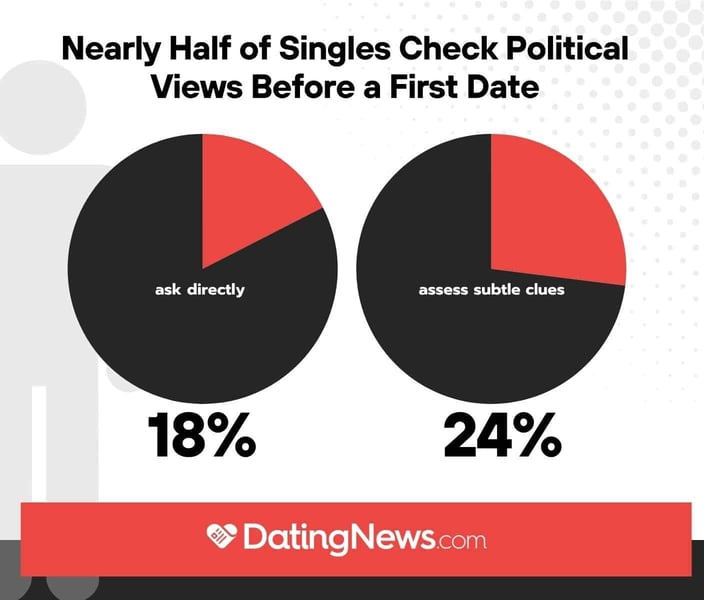
We may have found that only 7% of respondents view political alignment as a top-three desirable trait in a romantic partner, but it’s clear from our results that political differences are often a secondary filter for many singles.
When it comes to relationship dealbreakers, the numbers speak volumes for political significance:
- 52% said they wouldn’t date someone who didn’t support abortion rights
- 45% said they wouldn’t date someone who voted for a different presidential candidate in the last election
- 43% said they wouldn’t date someone who supported different political policies
- 41% said they wouldn’t date a registered Republican
- 26% said they wouldn’t date a registered Democrat
Beliefs surrounding bodily autonomy and gendered rights may explain why women were more likely than men to reject the idea of dating across party lines. Abortion was a key issue for women on both sides: 44% of Republican women and 69% of Democratic women say that it’d be a dealbreaker if their partner didn’t support abortion rights.
“Our data shows that political alignment isn’t prioritized above more traditional markers of compatibility and attraction, like emotional intelligence, shared values, or physical chemistry. However, political differences are a turn-off for 1 in 3 singles or more. This suggests that there are tiers of traits that people evaluate in potential partners,” said Dr. Gesselman.
For many singles, politics isn’t just about a difference in opinion; it’s an indicator of shared values and identity. How people align politically is more than just a talking point to cover over a dinner date; it has the power to determine the fate of a relationship.
Yet, political differences don’t have to be the be-all end-all. Singles can still find love across party lines by prioritizing emotional connection. Real compatibility can still come down to mutual respect and communication above all else.
Methodology
The State of Us: National Study on Modern Love & Dating in 2025 was conducted by DatingNews.com and the Kinsey Institute, led by Dr. Justin Lehmiller and Dr. Amanda Gesselman.
Data was collected by Prodege.com among a nationally representative sample of 2,000 single U.S. adults ages 18 to 91 via an online survey from April 29 to May 8, 2025. The sample was balanced for age, gender, household income, geographic region, and race/ethnicity. Margin of error: ±3 percentage points at the 95% confidence level.
Media inquiries can be sent to Colleen@datingnews.com.