Key Takeaways
- U.S. singles averaged just 1.74 in-person dates last year, revealing a dating deficit.
- Men went on nearly 50% more dates than women, showing higher interest and investment in the dating scene.
- While 55% of daters said they spent nothing on dating in the past year, those who did averaged $400 spent, with men outspending women across every category.
If it seems that more and more people are pressing pause on dating, you may be keen on your observations.
In the past year, U.S. singles averaged fewer than two in-person dates with other singles, according to a new DatingNews.com and Kinsey Institute study, “State of Us: National Study on Modern Love & Dating in 2025.”
The dating scene appears to be losing traction. Our study reveals that fewer people are expending energy on finding love — investing less time, effort, and money in dating. But those who are putting in significant effort are seeing positive results, reporting higher satisfaction while dating.
Our study, conducted in partnership with scientists at Kinsey Institute, explores this dating deficit and what those who are still consistently dating are doing to maintain their drive and find meaningful connections.
Men Go on 48% More Dates Than Women
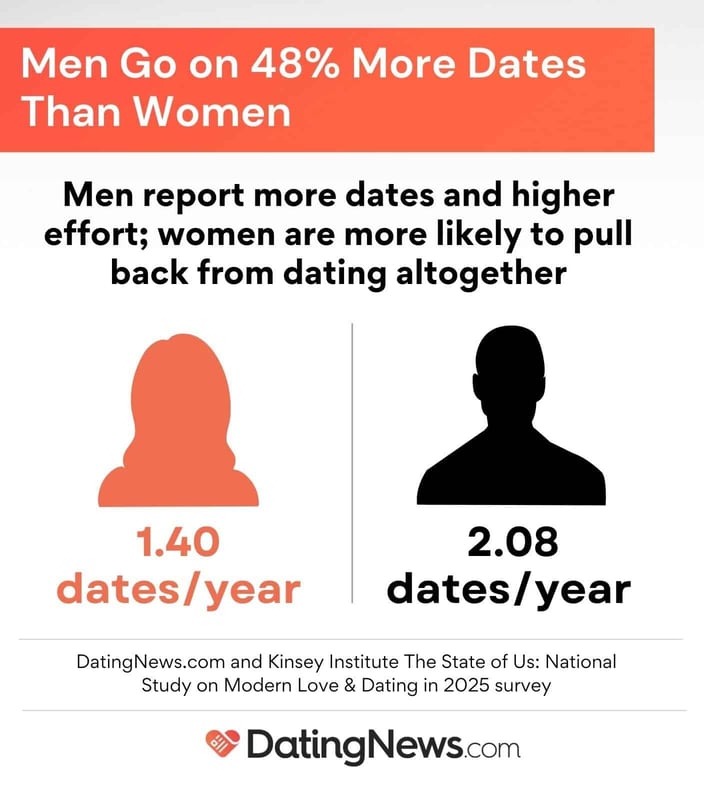
Our study found that men went on more dates than women in the past year. While women said they went on 1.40 dates last year, men said they went on 2.08 dates. That number may not seem significant on the surface, but it represents a 48% increase.
These findings reveal a contrast in how men and women have approached dating. It’s a tale of two stories: While men are raking in slightly more dates, women have shown a higher likelihood of pulling back from dating altogether.
But our survey shows a broader trend of dating hesitation. Half of surveyed singles said they’re not investing much at all into dating, revealing a wider break from dating across all groups. Only 9.4% of surveyed singles say they’re investing a great deal into exploring connections.
Singles are reporting decreased motivation and effort when it comes to dating. But the question is: Is dating losing its appeal? Or are other factors at play impacting the experience? Our results suggest that singles may be looking for more from the modern dating experience.
We also can’t ignore factors such as financial stress, politics, and other outliers that influence how singles approach dating. Together, these factors can make it all more difficult for singles to find joy and success while dating or see the experience as worthwhile.
Dating Budgets Are Bare-Bones: Most Spent Nothing, the Rest Averaged $400
It’s no surprise that finances are inextricably linked to the dating journey. As it happens, our study hints that singles may be putting their dating life on hold to save on costs and take control of their spending.
We found that over half (55%) of singles haven’t spent anything on dating or romance in the past year. However, among those who did, the average annual spend was just over $400, with men consistently outspending women across every category.
Whether it’s a dating app subscription or a grooming appointment, dating expenses can accumulate quickly over time. Our study explores the true cost of dating by asking respondents about their top dating investments.
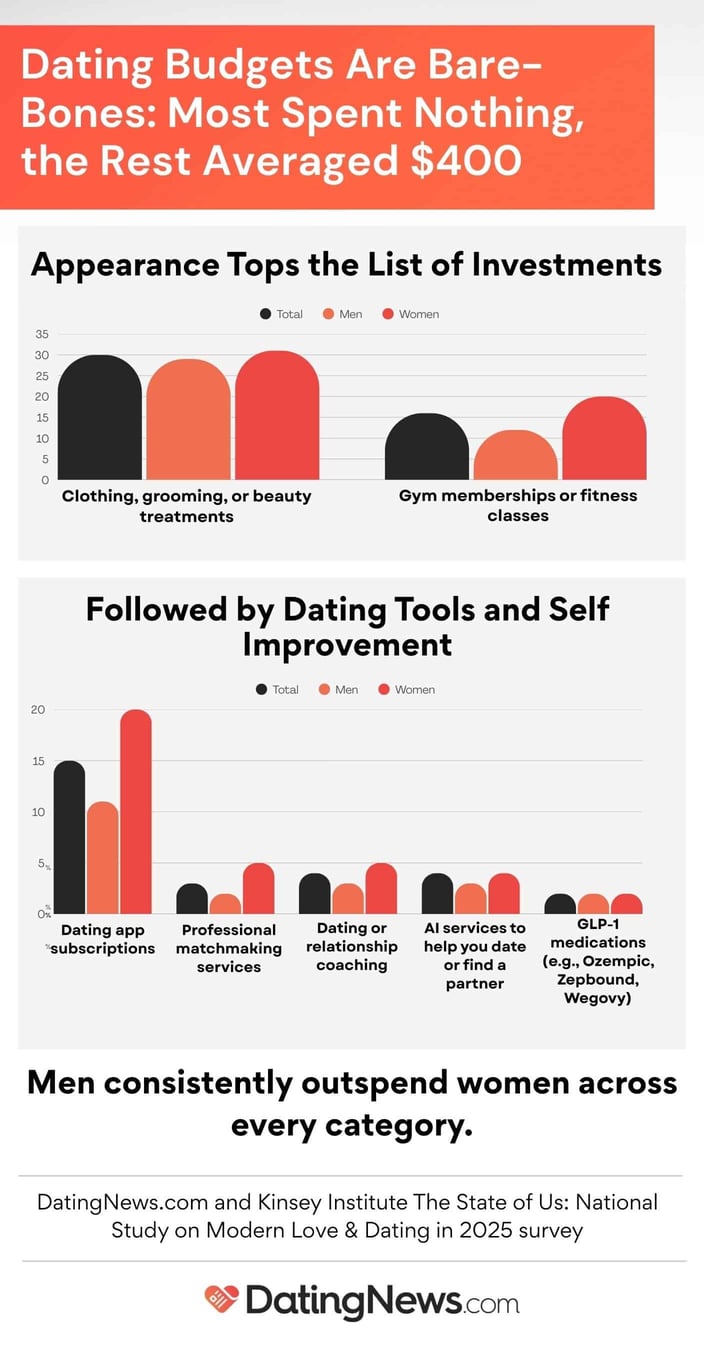
Unsurprisingly, appearance-related spending topped the list. Almost a third (30%) of respondents said they spent money on clothing, grooming, and beauty treatments — the highest of all categories. Gym memberships and fitness classes came in second, with 16% of respondents saying they tracked these expenses in their budgets.
Men (31%) and women (29%) were fairly equal in their spending on clothing, grooming, and beauty treatments. But they were split on gym and fitness costs: Male daters (20%) were far more likely to spend money on this category than women (12%).
Dating and self-improvement tools also made the list, with dating apps seeing the highest spend. Here is how these costs broke down among respondents:
- Dating app subscriptions: 15% (11% women; 20% men)
- Dating or relationship coaching: 4% (3% women; 5% men)
- Professional matchmaking services: 3% (2% women; 5% men)
- Artificial intelligence dating services: 4% (3% women; 4% men)
- GLP-1 medications: 2% (2% women; 2% men)
Our results reveal how the value of money and spending shapes the dating experience. With most singles forgoing spending on dating altogether, it’s evident that stress is building, not just in dating itself, but also within daters’ finances.
70% of Singles Don’t Track Dating Costs
As for those who are spending their hard-earned cash on dating, the majority aren’t exactly managing their budgets.
About 70% of surveyed singles said they don’t track dating costs at all. Nearly 1 in 5 (19.3%) said they had a general idea of how much they were spending, while only 11% said they track their expenses closely.
But one group stood out again. While most daters admitted to not monitoring their dating budgets, men showed a bit more financial awareness than their female counterparts.
In fact, men were twice as likely as women to say they track their costs closely — 14% vs. 8%. Additionally, fewer men (61%) reported not tracking their costs than women did (78%).
46% of Singles Say Their Spending on Dating Was Worth It
Few are investing a great deal into dating, yet those who are say they’re reaping the benefits. When asked whether their spending for love was worth it, nearly half (46.7%) of surveyed singles responded “yes.” Another 31% said no, while 21% said they were unsure.
About half of daters are seeing their spending pay off, and those who are putting in more effort are reporting higher satisfaction in their dating journey. While the trend is to save and not spend, many singles are finding value in going all out as they date, suggesting that the quality of effort matters more than the dollar amount.
Whether singles choose to date or not, it’s clear that singles are shifting their dating habits to keep up with today’s world. The cost of love isn’t cheap, and forgoing dating altogether may seem like a better option for many people than searching for a connection.
Singles are being stretched in every direction, including in politics, finances, and commitment. And for many, their response to this growing strain is to hit the pause button on romance for the foreseeable future. The feeling of love may be priceless, but the journey to it is a whole other story.
Methodology
The State of Us: National Study on Modern Love & Dating in 2025 was conducted by DatingNews.com and the Kinsey Institute, led by Dr. Justin Lehmiller and Dr. Amanda Gesselman.
Data was collected by Prodege.com among a nationally representative sample of 2,000 single U.S. adults ages 18 to 91 via an online survey from April 29 to May 8, 2025. The sample was balanced for age, gender, household income, geographic region, and race/ethnicity. Margin of error: ±3 percentage points at the 95% confidence level.
Press inquiries: Colleen@datingnews.com