Key Takeaways
- With dating coach Grace Lee at the helm, the Datingverse is a signal of the dating industry’s desire for innovative coaching tools that prioritize humanity.
- In the Datingverse, VR serves as a cutting-edge coaching tool where human insight — not algorithms — guides singles through skill-building experiences.
- The VR experience trains clients in “soft” social skills, encouraging the type of authenticity modern daters crave.
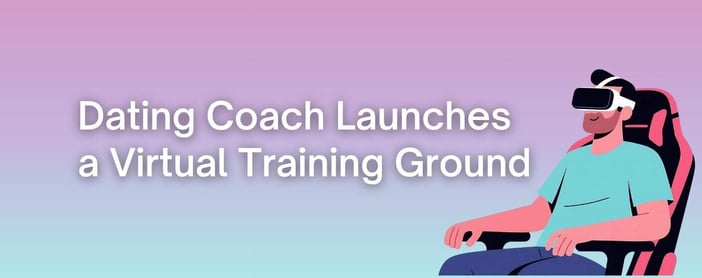
What does one do in a virtual universe dedicated solely to the art of dating? According to dating coach Grace Lee (A Good First Date), who has partnered with Foretell Reality and The Glimpse Group’s VR Date Coaching experience The Datingverse, one becomes a more confident dater.
“[Young people are] being told to ‘get off the apps’ and meet people organically — but without the confidence or practice to do it well,” Lee told DatingNews. Between Singledom and Happily Ever After, the Datingverse is where downcast daters go to hone their skills.
The Datingverse is Lee’s way of getting to the crux of her clients’ dating challenges. “The industry keeps treating symptoms instead of the disease,” she explained. “The AI and VR are my diagnostic and practice tools.”
Her clients’ experience on the VR date is like an X-ray: It simply shows Lee where the problem is so she knows how to best help her clients. And singles have never needed more help than they do now.
Lee pointed to the rise of “front end” AI tools and IRL dating events as signs that the industry is searching for unique and cutting-edge solutions to dating app fatigue.
It doesn’t get more cutting-edge than VR and AI, two technologies that have the potential to transform dating coaching as we know it — with the Datingverse leading the charge.
VR is a Cutting-Edge Coaching Tool for Singles
The average Datingverse consumer is someone who, for example, just can’t nab a second date. They’re someone who would benefit from an outsider’s analysis of their dating skills. But VR and AI aren’t dispensing wisdom — Lee is.
With Lee in control, the dating skills honed in the Datingverse are shaped by human hands. She not only uses the technology as a diagnostic tool, but as a low-stakes training ground for clients.
For a Diagnostic Date, Lee sets two clients up with VR headsets and has them interact on a virtual date.
After she “disappears” into the background (VR allows her to be a fly on the wall in a way she can’t IRL), Lee picks up on the skills her clients have mastered, and which they need more practice with, including “body language, conversational flow, [and] how they handle awkward moments.”
Meanwhile, the AI/VR practice sessions allow each client to practice dating in a low-pressure setting. “They enter a virtual environment and meet an avatar I’ve prompted to help them practice a specific skill — anything from how to start a date to how to break up with someone,” Lee explained.
She programs the AI to look out for key skill-building moments. Does the client maintain eye contact? How strong are their questions and responses? “These metrics inform my coaching, but they don’t replace it,” Lee said. “I review the sessions, identify patterns, and guide the client through what to improve.”
With virtual reality as a backdrop, Lee crafts customized training modules for each individual client. “Now I can see the problem and give clients a safe, low-stakes environment to practice solutions,” she said.
The Datingverse is a Tool — Not a Replacement for Humanity
Whispers of “AI is taking over!” can be heard in virtually every office space and cramped cubicle across the working world. But VR coaching tools present a unique opportunity for professionals in the dating industry: They allow dating professionals to harness AI and VR’s power while remaining in control.
The Datingverse is a carefully-constructed skill-building tool — not a replacement for human experience. It’s a prime example of how it’s possible to use AI and modern tech to one’s advantage, rather than being steamrolled by quick AI “solutions” and shortcuts.
“The coaching itself is never outsourced to AI,” she assured us. “AI and VR simply give me tools I’ve never had before to help clients get better at real life.”
The VR technology that brings the Datingverse to life, Foretell Reality, is already being used in educational and therapeutic settings, Lee told us. “I’m the first to apply it to dating coaching, to make it consumer-facing,” she explained.
She knows the VR coaching experience has been a success when the client is able to go on a real life date with confidence.
Ironically, VR and AI Can Encourage Authenticity
The VR experience doesn’t give clients standard scripts to rattle off on dates. Instead, it helps them hone the type of skills that often define a relationship’s success: communication, vulnerability, and confidence, to name a few.
Perhaps most importantly, it encourages clients to get more comfortable living within the moment, instead of being distracted by mistakes of dates’ past and future. The goal is for the client to “respond authentically while maintaining focus on building connection.”
Lee acknowledges that the Datingverse is “early stage,” and is still working on building qualitative proof that the VR coaching experience is a useful tool:
“The initial feedback has been overwhelmingly positive, but I’m working with small numbers. To truly validate this approach and refine the experience, I need scale.”
To this end, the Datingverse’s next step is to partner with an established dating app, like Bumble or Hinge. “The apps have the matches and the user base,” Lee explained. “I have the methodology to help those matches convert into real relationships.”
The intersection of VR coaching, AI, and dating apps remains largely untapped, offering a rare opportunity for synergy in a market currently craving innovation. “This is where AI and VR can transform dating — not by delivering more matches, but by helping people turn those matches into meaningful relationships.”


![5 Best Gay Black Dating Apps[updated_month_year before=" (" after=")"]](https://www.datingnews.com/images/uploads/2023/09/black-gay-man-apps.jpg?width=342&height=135 "5 Best Gay Black Dating Apps[updated_month_year before=\" (\" after=\")\"]")