Actively online dating can mean many different things. It could be casually swiping through profiles while waiting in a checkout line. Or it could mean dedicating hours each week to reading profiles and finding the perfect match.
The success of online daters is partially a matter of how much effort they put in. I say partially because luck plays a role too, of course. The casual dater might find more luck than the dedicated dater in some cases. And for those who throw themselves into online dating only to come up empty, the experience can be confusing and frustrating.
To make sense of the difficult landscape of online dating success, I put together some stats that might clarify how much effort it takes to find a match and why it might be trickier for some people than others.
1. It Takes Nearly 4k Swipes on Average to Find a Partner
Most people don’t find their soul mate immediately on dating apps. According to a study by Shane Co., the average dater takes 3,960 swipes to find a partner online1.
Online dating is great because you get the opportunity to cross paths with plenty of people you wouldn’t have otherwise, and as a result, most people don’t settle for the first profile they find.
Considering how quickly people are swiping through profiles on apps like Tinder or Bumble, reaching thousands of swipes is a matter of a couple weeks or months for the typical dater.
2. Daters Spend 5.93 Hours Per Week Looking for Love
Dating shouldn’t feel like a job, but sometimes it takes a part-time job amount of work. The same study found that successful daters spend an average of 5.93 hours per week on dating apps before they find a partner2.
In some cases, it might be necessary to take that much time to sift through profiles and message matches to make sure you’ve given yourself the best chance of a genuine connection. But it’s also important to transition into IRL dates as soon as you can. Try to spend more time going on dates than you are swiping.
3. On Tinder, Men Average 835 Right Swipes Per Date
Getting into a relationship might be a matter of individual connection, but how quickly people are able to move their matches offline tells us a lot about how easily people find success in online dating. On Tinder, the average man swipes right 835 times for every date he gets3.
After swiping right, the person a man swipes on has to swipe right as well for the connection to move forward. At that point, they need to actually start messaging back and forth. And finally, he needs to be able to move their messaging to an offline date. After all of those steps, very few matches result in an IRL connection.
4. It Takes Male Daters 8.63 Months to Get in a Relationship
Most men don’t simply decide they want to be in a relationship one day. Even for intentional daters, getting into a relationship takes time — the average man takes 8.63 months to get into a relationship4. Women start relationships slightly sooner, at 7.93 months.
Don’t be surprised if it takes weeks or months to find your person.
Over that time — about three-quarters of a year — singles have the space to go on dates with different matches and get a sense of who is the best fit. There’s usually some trial and error before they actually get into a relationship.
If you’ve decided you want to start online dating, be patient. Don’t be surprised if it takes weeks or months to find your person.
5. Over Half of Dating App Users Go on at Least 1 Date
Moving the connection offline takes work, but most people can do it. Over half of dating app users go on at least one date with someone they met online5.
It’s good to keep in mind that not everyone who joins a dating app is ready to go out in real life. They might just be these to look around, maybe get an ego boost, and move on.
Online dating has its lurkers, but if you’re willing to put in the work, odds are you can make something happen online.
6. About 40% of U.S. Couples Who Met Online Met on Tinder
Not all dating apps are created equal. Choosing the right dating app for your priorities can make a huge difference in whether online dating leads to a relationship for you. The highest percentage of people — 40% — who met their partner online did so through Tinder6.
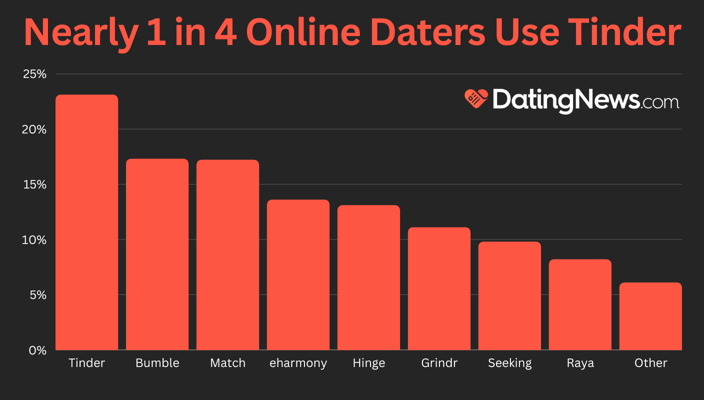
Tinder is by far the most popular dating app in the United States, making it easier for people on the app to see as many people as possible. At the same time, the app is general enough that you may not get the level of specificity in your matches that you would like from the app.
7. At 5.8 Months, Gen Zers Find Online Dates the Fastest
Not all generations find success with online dating in the same time frame. Gen Z finds partners much faster than older generations, at 5.8 months, almost three months faster than the total average7.
As younger daters, Gen Z might be looking for more casual relationships than older generations. They may also be less set in their ways than older daters, making it easier for them to connect more quickly. And since younger daters tend to be in higher demand, they often have more choices than their older counterparts.
8. Men Initiate 76% of Dating App Messaging
Even the most progressive among us can sometimes fall into traditional gender roles, especially when it comes to dating. According to survey data, men initiate an overwhelming 76% of all dating app messaging8. Times are changing, but many women will still never reach out first.
The exception to this trend is, of course, Bumble, the app where women have to message first. In doing so, women get more comfortable taking the initiative with their matches, and they get to set the tone so that they feel safer while online dating.
9. Men on Tinder Match 1-3% of the Time They Swipe Right
Now for the bummer news: Men on Tinder only get a match for 1% to 3% of the time they swipe right9. While individual men might have better (or worse) odds than that, the average man needs to put in a lot of swipes to even have a chance of moving to messaging, let alone meeting up offline.
Women have much better odds of getting matches. In the end, the difference between men’s and women’s match rate success might have more to do with how much weeding out men and women do at this phase of dating. Women are more choosy about their partners on the front end, while men wait until further along in dating.
10. Half of Matches Result in a Conversation
If you match with someone on a dating app, it’s a coin flip whether you’ll ever actually talk. A study found that half of matches result in a conversation of two or more messages10.
Unfortunately for those who are excited about their matches, some people simply enjoy the process of matching on a dating app and don’t want anything beyond that. Swiping and getting matches can be fun, but actually getting to know someone is where the real work comes in.
11. Most Reciprocal Chats Start Within 8 Hours of Matching
The longer you wait, the less likely you are to actually have a conversation with a match. Half of all reciprocal conversations on dating apps — those where each party said at least one thing — started within 8 hours of matching11.
Many begin immediately after, when the second person is notified that their match went through.
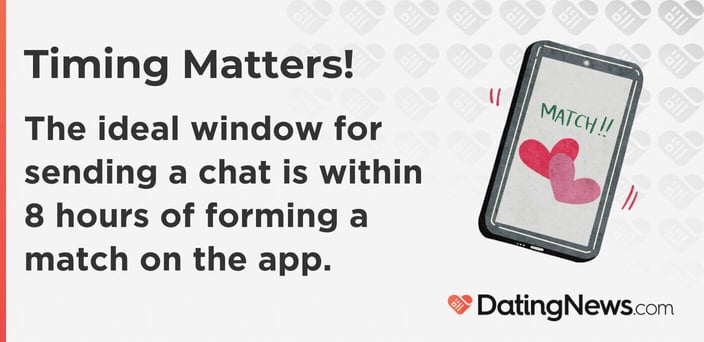
Dating moves fast, and you don’t want to get left behind. If you wait days or weeks to message someone, they could’ve deleted the app, started dating someone else, or begun messaging a more recent match. Recency bias is real, so seize the day and send a chat.
12. First Messages Get a Response 61% of the Time
Worried that your match won’t message you? You can improve your odds of having an actual conversation by being the one to message first. A study found that if someone sends a first message, they’ll get a response 61% of the time12.
Confidence is attractive, and most daters like to see that you’re putting in effort. Reaching out can be scary, but it’s much more likely to result in a real connection than sitting back and hoping a great match falls in your lap.
13. The Mean Paid App User Found 3.14 Offline Contacts (Free Users Found 1.91)
If you’re considering paying for the premium version of a dating app, it might just help you move more matches to offline dates. According to one study, the mean paid dating app user met 3.14 people offline, compared to 1.91 people for free users13.
That could be the difference between meeting your future spouse and staying home alone and missing out on a love story.
Still, take those numbers with a grain of salt. People who pay for premium memberships may already be more serious about finding someone online than those who don’t. And they might have a bigger budget to go on many first dates without worry.
14. Most Users (58%) Who Pay to Upgrade Say It's Worth It
When it comes to premium dating apps, 58% of those who paid think it was worth it14.
What makes premium apps worth the money is different for everyone. For some, it’s simply having fewer limitations on their likes and messages. Others are results-oriented and judge it based on how many quality connections they made.
While most people thought the purchase was worth it, keep in mind that 42% didn’t. If you’re watching your wallet, the free version of an app might be enough on its own.
15. Paid Tinder Users Get 60% More Right Swipes
It’s hard to argue with the numbers. The numbers are solidly in support of paying, at least for Tinder. According to CupidAI, Tinder Gold users got 60% more right swipes than free Tinder users15.
Tinder Gold upgraded features include:
- See Who's Liked You
- Now Top Picks Every Day
- Weekly Super Likes
- Free Monthly Boost
- Unlimited Likes
- Unlimited Rewinds
- Tinder Passport
- Incognito Mode
It’s unclear what parts of Tinder Gold gave them better odds. My hunch is that using the Tinder profile boost, which highlights your profile in the swipe carousel, has the biggest effect.
I’d also theorize that wealthier people tend to upgrade more often than poorer people, and wealth is an attractive quality in the dating scene.
16. Hinge Users Are Twice as Likely to Land a Date
Hinge markets itself as the app “designed to be deleted,” and that just might be true. One study found that Hinge users are twice as likely as swipe-based app users to actually go on a date with someone in the real world16.
Hinge prides itself on turning online matches into IRL dates. After that, it’s up to you. In that sense, I’d say Hinge has a pretty high success rate as an app.
17. At 72%, Daters Aged 43-58 Have the Highest Dating App Success Rate
Dating apps might be associated with Gen Z, but the data says that Gen X and older millennials are actually using them best. A solid 72% of online daters between 43 and 58 reported relationship success from online dating, the highest percentage of any age group17.
Older daters may be more eager to move the connection offline. They see online dating as a tool for in-person connection, while younger daters may be more comfortable using apps to chat and flirt without actually trying to meet up in person. They’re in less of a hurry, and they’ve had less time to hone their strategy.
Gen Z might be outpacing other generations in terms of getting matches, but for relationship success, older daters seem to have the right strategy.
Dating is More Than a Numbers Game
It can be easy to see a bunch of statistics about dating success – even those that are hopeful – and feel like the odds are against you. You may wonder if online dating is ever going to work for you. But stats can only tell you so much about the landscape of dating for you personally.
All it takes to turn your online dating life into a success is one person – the right person – to take a chance on you. That will always be the case, whether you meet at a bar, in the classroom, or even on Tinder.
- https://www.shaneco.com/theloupe/articles-and-news/how-many-swipes-does-it-take/ ↩︎
- https://www.shaneco.com/theloupe/articles-and-news/how-many-swipes-does-it-take/ ↩︎
- https://getcupid.ai/blog/editorial/dating-app-success-rate-statistics ↩︎
- https://www.shaneco.com/theloupe/articles-and-news/how-many-swipes-does-it-take/ ↩︎
- https://getcupid.ai/blog/editorial/dating-app-success-rate-statistics ↩︎
- https://www.shaneco.com/theloupe/articles-and-news/how-many-swipes-does-it-take/ ↩︎
- https://www.shaneco.com/theloupe/articles-and-news/how-many-swipes-does-it-take/ ↩︎
- https://arxiv.org/pdf/1607.03320 ↩︎
- https://getcupid.ai/blog/editorial/dating-app-success-rate-statistics ↩︎
- https://getcupid.ai/blog/editorial/dating-app-success-rate-statistics ↩︎
- https://arxiv.org/pdf/1607.03320 ↩︎
- https://arxiv.org/pdf/1607.03320 ↩︎
- https://pmc.ncbi.nlm.nih.gov/articles/PMC9916160/#sec3-ijerph-20-02101 ↩︎
- https://www.uniondemocrat.com/lifestyle/article_8a7f0012-bddc-11ed-84fc-f3500b97cf40.html ↩︎
- https://getcupid.ai/blog/editorial/tinder-match-rate-statistics ↩︎
- https://getcupid.ai/blog/editorial/hinge-match-rate-statistics ↩︎
- https://www.swipestats.io/blog/dating-statistics-by-age ↩︎