
No two couples are exactly alike. We all know that one couple who are constantly on the verge of breaking up, just as we all know the couple who act like giddy teenagers together 20 years in.
Relationships encompass a broad spectrum of happiness, and they can ebb and flow over the course of life.
What does being satisfied in a relationship look like for most people? And how do you become satisfied in a relationship yourself? Read on to learn a bit about how satisfied people are with their relationships, really.
1. Globally, 76% of People Feel Loved
Love isn’t an anomaly. It happens to most of us and is the most universal of human experiences. According to a relationship quality study by IPSOS, about three out of four people feel loved around the world1.
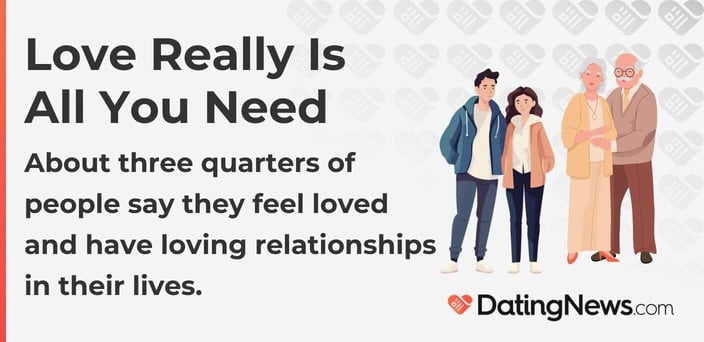
While the percentage varies between countries, nowhere did less than half the population say they felt loved.
For those who are single, that number should come as a relief. Even if your love comes from nonromantic relationships, you likely have people who care about you.
2. At 82%, More Married People Feel Loved Than Singles
While single people still overwhelmingly feel loved, the same study found that a higher percentage of married people do – 82%2.
This makes sense. While most single people have significant, loving relationships in their lives, married people by definition have someone to come home to.
3. A Healthy 62% of People Feel Happy With Their Romances
While you can feel loved through many different types of relationships, sexual and romantic connections only come from a few places. 62% of people around the world say they are happy with their romantic and/or sex lives3.
While fewer people were happy with their romantic lives than those who felt love, 62% is still a pretty respectable number when you consider how many people are dating or struggling in their relationships. Nearly two-thirds of people being happy with their love life is pretty respectable odds.
4. Nearly Two-Thirds of Couples Maintain High & Stable Relationship Satisfaction Over a Decade
Love does last. A recent 10-year study of heterosexual couples found that 65% of couples maintained stable and high relationship satisfaction4. This meant they started pretty happy with their relationships and more or less stayed that way the whole time.
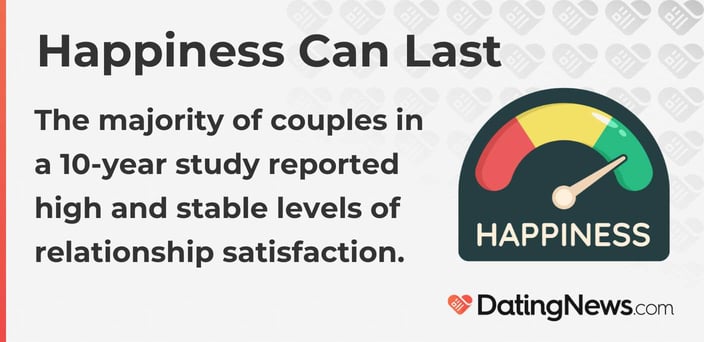
It’s common to hear that relationships will inevitably be hard or go through difficult patches. And while hardship is inevitable in life, these couples suggest that chronic animosity with your partner might be avoidable.
5. Over Time, 17% of Couples Start Unsatisfied & Get Happier
Just because the relationship is rocky now, doesn’t mean it will stay that way. Encouragingly, 17% of couples who participated in the study started with low relationship satisfaction and actually saw themselves become more satisfied and stable over the 10 years of the study5.
If a relationship is truly beyond repair, you don’t have to stick around. But if you think there’s a chance of working through your issues, it could work. Couples’ therapy is a good option for working out your problems in a safe, supportive environment.
6. Relationship Satisfaction Hits Lowest Point at Age 40
Midlife is often a time of reassessment, and that’s especially true for relationships. One Berkeley study found that relationship satisfaction declines between the ages of 20 and 40, bottoming out at a self-reported satisfaction rate of 77%. That may be worse than at your peak satisfaction, but it’s still pretty high.
Many people find their early 40s to be a time of intense responsibility. You might have kids or be at a defining moment in your career. At the same time, many couples are around a decade into their marriages by then, which can bring up questions of whether your personalities and values are still aligned.
7. After 40, Satisfaction Climbs Back Up Around Age 65
The good news? Midlife conflict doesn’t last forever. While couples reached their least satisfied at age 40, they steadily began to get happier again up to age 65, where they more or less plateaued through their golden years6.
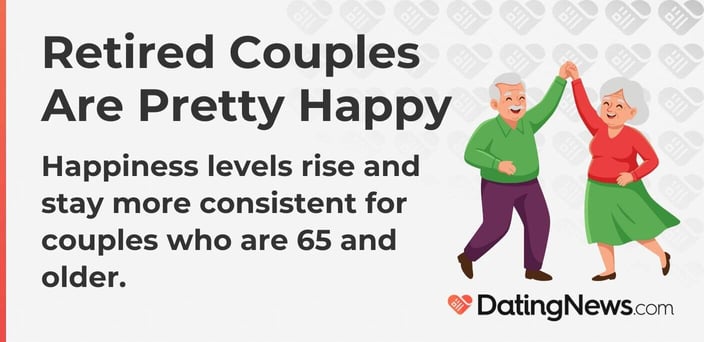
It seems like if you get through those tricky years with your partner in your early 40s, you’ve set yourself up for a happier, stabler relationship in the years to come. And if you do split, the relationships you have going forward will be more positive.
8. Perceptions Explained 45% of Satisfaction Disparity
If you think you’re happy, then congratulations, you are. A study that used machine learning to compile 43 data sets found that up to 45% of relationship satisfaction could be explained by how partners perceived the relationship to be7.
The factors varied from their sense of how their partner expressed appreciation to how they judged their own conflict management.
Two couples may have the same issues – they fight at the same frequency, they have similarly different personalities – but one couple might view that as the normal course of a relationship and be satisfied with it, while the other may see their struggles as a fundamental flaw.
9. Only 21% of Relationship Satisfaction can be Explained by Personality and Demographics
Differences matter, but not as much as you might think. In the same study, only up to 21% of relationship satisfaction could be explained by the personality traits of partners or their demographics8. And once relationship perception was factored in, they didn’t influence satisfaction at all.
Someone with a negative personality, for instance, might be more likely to see the bad parts of their relationship. But once this perception skew is taken out, they’re no more or less likely to actually have a satisfying relationship.
10. Women With High Neuroticism Experienced a 25% Drop in Relationship Satisfaction
Here’s another reason to consider therapy: Women high in neuroticism had a 25% drop in relationship satisfaction. For men, the drop was 14%9.
The study compared the relationship between Big Five personality traits and relationship satisfaction.
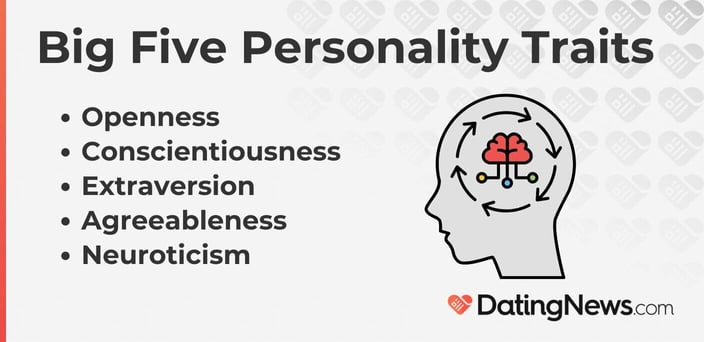
The researchers found that the strongest impact of a personality trait on relationship satisfaction was for women with high levels of neuroticism – a propensity toward negative emotion, including anger, irritability, and anxiety, and low stress threshold. These women have a tough time staying satisfied in their relationships.
11. For Men, Conscientiousness Boosted Relationship Satisfaction by 30%
While neuroticism drops relationship satisfaction, conscientiousness does the opposite. The study found that high conscientiousness was linked to a 30% boost in relationship satisfaction for men and a 25% increase for women10.
Conscientious people are organized, reliable, hard-working, and goal-oriented. In relationships, this can mean prioritizing your commitment to your partner and taking steps to nurture your relationship into the future.
Conscientious partners take on responsibility and show up where it counts.
12. About Half of People in Relationships Say Their Partner is Extremely Important to Their Happiness
You’ve probably heard the saying “Happy wife, happy life.” That actually seems to be true for a lot of people. For about 54% of people who are married or in a committed relationship, their partners are extremely important to their happiness11.
While it’s true that you can’t pin all your joy and self-actualization on your partner, they’re generally a big part of your emotional well-being, for better or worse. There’s no feeling better than being deeply, happily in love, just as there are just a few things worse than going through a painful breakup or divorce.
For many people, relationship quality can truly make or break their happiness.
13. Just 41% of Unmarried Cohabitating Adults Say Things are Going “Very Well”
As a cohabitator myself, I know that cohabitation can sometimes feel like it’s no different from marriage. But there is a difference in happiness.
According to a study by the Pew Research Center, unmarried adults living with their partners were much less likely to say their relationships were going “very well” – just 41% compared to 58% of married people12.
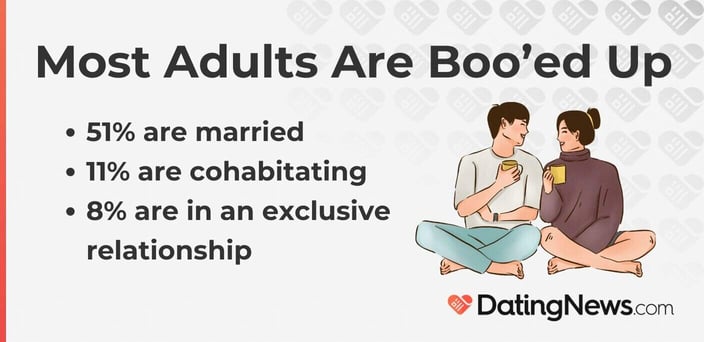
There are some potential factors that could make cohabitators less likely to be happy in their relationships. These couples may disagree about when or if they should get married.
Cohabitating couples are, by definition, in a less formal relationship than a marriage, so it’s possible that some of these relationships will end before they ever get to the point of lifelong commitment.
14. Only 6% of Cohabitators in Unserious Relationships Believe Things Are Going Very Well
Being in an unserious live-in relationship may intuitively seem like a bad idea, but here’s some concrete data: Only 6% of cohabitators who say their relationships are not very serious believe it’s going well13.
This is, again, pretty intuitive. Anecdotally, the only people I’ve known in this situation were either heading for a breakup or ended up living with their partners because they couldn’t afford to live on their own. Neither is an ideal situation, or particularly well-suited for a happy relationship.
15. Over Three Quarters of Married Adults Say They Feel Closer to Their Spouse Than Any Other Adult
For most married people, their spouse really is their best friend. Pew Research Center found that 78% of married adults say they’re closer to their spouse than any other adult14.
The next most popular answer is their mother, at just 6% – suffice to say that marital relationships seem to trump the rest.
It’s still important to have other close relationships in your life, even when you’re married. But for most people, they simply spend too much time with their partners relative to anyone else – save maybe their coworkers – to have that close of a bond. And that’s not even taking the love they share into account.
16. About Two-Thirds of Married People Feel Very Satisfied When They Split Domestic Labor Equally
For many couples, the division of labor is a huge stressor in relationship satisfaction. The solution sounds pretty simple: Split domestic labor equally. But in practice, it gets complicated.
Among partners who said they split their household chores and responsibilities about equally, 68% of women and 63% of men said they were very satisfied with their division of labor, according to Pew Research Center15.
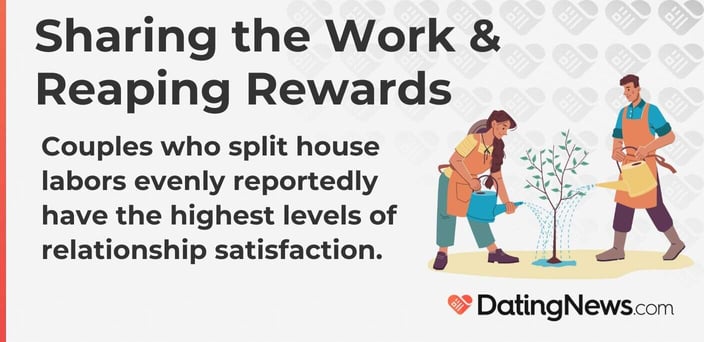
Sometimes, it can be difficult to root out the differences between perceived and real labor contributions in your relationship. Your partner might feel like they contribute more, while you feel the opposite.
All you can do is try to show up for your partner where possible… and voice your needs respectfully when things feel unbalanced.
17. Love Predicts About 50% of Relationship Satisfaction
Love might not conquer all, but it conquers a lot. One study looking at Brazilian adults found that the presence of love in a relationship accounted for up to 50% of relationship satisfaction in established relationships16.
It mattered about 30% in less serious relationships and hookups.
A relationship can still be turbulent even if the two people love each other. But it’s even more difficult to come back from a loveless relationship.
18. Suicide Rate for Married Adults Is a Third of What It Is for Divorced Adults
If you’re already struggling with your mental health, going through a big stressor – like divorce – can exacerbate the problems you already have. According to the Same American Institute for Boys and Men article, the suicide rate is three times higher for divorced people than for married people17.
Divorce can be a major source of pain. It can have horrible financial consequences, and it may leave divorcés on their own for the first time in a long time. This makes mental health crises a lot more likely to occur.
19. Roughly 60% of Married Fathers Say Their Lives Are Meaningful
People can find meaning in a lot of aspects of life. But for married fathers, many find it meaningful to be a parent and raise a child.
A good 60% of married fathers said their lives felt meaningful most of the time, compared to just 38% of single and childless men18.
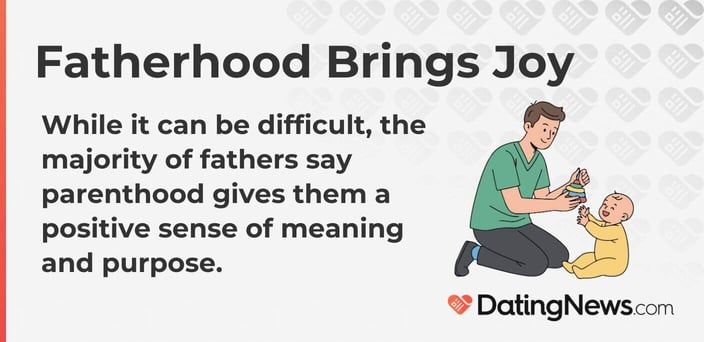
When you’re on your own, it can be difficult to identify what your purpose is. If you don’t feel passionate about your work or your community, you may wonder what it’s all for.
But when you have people who depend on you – be they your spouse or your kids – it’s a lot easier to identify what you contribute to the world.
20. Men Are Happier With Partners At Least 7 Years Younger
Some age-gap relationships can be questionable, but others can be perfectly fine. I’m not here to judge that. I’m here with the facts. And the statistics make one thing crystal clear: Men like dating younger partners.
One study found that both straight and gay men reported substantially higher relationship satisfaction when they were dating someone 7+ years younger than them19.
The same was not true for women dating younger, nor was it true for the younger partners dating older people.
21. Two-Thirds of Couples Experience a Decline in Relationship Satisfaction After Having a Child
Having children may bring you joy, but it also brings chaos. According to the Gottman Institute, about two-thirds of couples experience declines in relationship satisfaction after having a child20.
The transition to parenthood is huge. You’re experiencing the biggest responsibility of your life, while sleeping in hour-long spurts, changing endless diapers, and dealing with new financial pressures. That would make anyone irritable.
Experts remind us to look at our partner as our teammate, not the enemy.
22. After Marriage, About 75% of Same-Sex Couples Reported Higher Life Satisfaction
For LGBTQ+ people in the United States, marriage equality is not a given. It has really only been around for a decade or so.
The ability to marry has had tangibly positive effects on the lives of same-sex couples. According to one study, 74.6% of people in same-sex marriages reported higher life satisfaction after they married21.
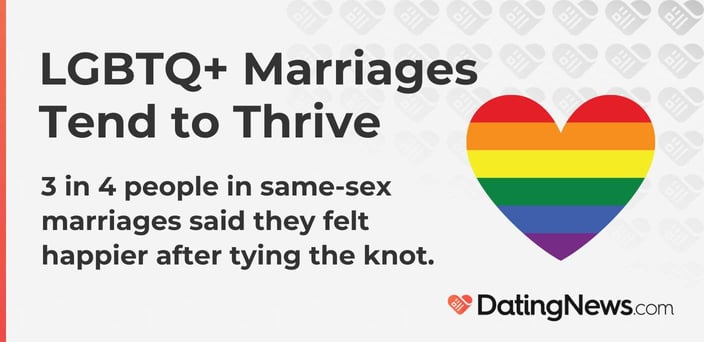
Marriage was a hard-fought right, and one that positively impacts the overall well-being of many LGBTQ+ couples.
Anyone Can Achieve High Relationship Satisfaction
Whether you’re single, dating, or married, your connections to the people in your life are likely a huge component of your overall happiness.
You don’t need to be in a relationship to be happy, but you do need to have positive relationships with the people who are closest to you.
Fortunately, most people are pretty happy with the relationships they have. And if you’re unsatisfied with your current relationships, just know that there are probably plenty of people in your world who truly love and care about you.
- https://www.ipsos.com/sites/default/files/ct/news/documents/2025-02/Ipsos-valentines-day-final-2025.pdf ↩︎
- https://www.ipsos.com/sites/default/files/ct/news/documents/2025-02/Ipsos-valentines-day-final-2025.pdf ↩︎
- https://www.ipsos.com/sites/default/files/ct/news/documents/2025-02/Ipsos-valentines-day-final-2025.pdf ↩︎
- https://pmc.ncbi.nlm.nih.gov/articles/PMC11611981/ ↩︎
- https://pmc.ncbi.nlm.nih.gov/articles/PMC11611981/ ↩︎
- https://greatergood.berkeley.edu/article/item/how_relationship_satisfaction_changes_across_your_lifetime ↩︎
- https://www.pnas.org/doi/epdf/10.1073/pnas.1917036117 ↩︎
- https://www.pnas.org/doi/epdf/10.1073/pnas.1917036117 ↩︎
- https://www.sciencedirect.com/science/article/pii/S0191886924003477 ↩︎
- https://www.sciencedirect.com/science/article/pii/S0191886924003477 ↩︎
- https://www.monmouth.edu/polling-institute/reports/monmouthpoll_us_020722/ ↩︎
- https://www.pewresearch.org/social-trends/2019/11/06/how-married-and-cohabiting-adults-see-their-relationships/ ↩︎
- https://www.pewresearch.org/social-trends/2019/11/06/how-married-and-cohabiting-adults-see-their-relationships/ ↩︎
- https://www.pewresearch.org/social-trends/2019/11/06/how-married-and-cohabiting-adults-see-their-relationships/ ↩︎
- https://www.pewresearch.org/social-trends/2019/11/06/how-married-and-cohabiting-adults-see-their-relationships/ ↩︎
- https://link.springer.com/article/10.1007/s43076-023-00333-4#Sec16 ↩︎
- https://aibm.org/commentary/why-marriage-is-good-for-men/ ↩︎
- https://aibm.org/commentary/why-marriage-is-good-for-men/ ↩︎
- https://www.psychologytoday.com/us/blog/the-asymmetric-brain/202506/in-major-age-gap-relationships-which-partners-are-happier ↩︎
- https://www.gottman.com/blog/how-children-impact-a-relationship-struggles-insights-and-strategies/ ↩︎
- https://williamsinstitute.law.ucla.edu/publications/marriage-equality-in-2024/ ↩︎