Key Takeaways
- Tai is Three Day Rule’s attempt at an AI-enabled app that lowers the company’s price tag without sacrificing high-quality matchmaking skills.
- More than 60 of Three Day Rule’s matchmaking experts contributed to Tai’s design, ensuring an AI experience backed up by humanity, not solely by codes and algorithms.
- Three Day Rule makes it clear that Tai is no replacement for a human matchmaker, who can intuitively understand emotion and relationship needs.
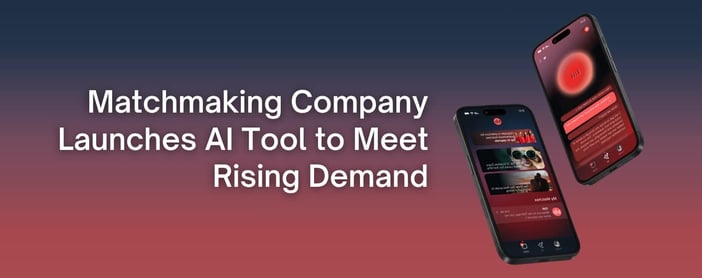
Three Day Rule prides itself on providing a human-first service, a rarity in a world long dominated by online dating platforms, virtual shortcuts, and app fatigue. So it came as a surprise when Three Day Rule launched Tai, its new AI matchmaking app.
By offering its own AI matchmaker, is Three Day Rule sacrificing its most valuable strength — its humanity? If Three Day Rule CEO Adam Cohen-Aslatei wants people to know anything, it’s that both Tai and Three Day Rule have humanity to spare — yes, even the AI-enabled matchmaking app.
“Our core offering is still and will always be white-glove service with a human matchmaker,” Cohen-Aslatei told DatingNews. “Our app simply expands access, giving millions a lower-cost, lower-touch way to experience the same intentional approach we are known for.”
Three Day Rule’s eye-popping in-person price tag — up to $100,000 — makes it undeniably unattainable for the average person. Three Day Rule hopes that an AI matchmaker will provide the best of the company’s real-life matchmaking skills without requiring such a high fee.
Cohen-Aslatei told DatingNews how Three Day Rule refined Tai’s abilities, enhanced its matchmaking skills, and trained it to be almost as skilled as the company’s real-life matchmakers — emphasis on almost.
AI Puts Matchmaking “Within Reach For Everyone”
Any other matchmaking service might call an AI matchmaker a job-killer. But Three Day Rule designed Tai to be a tool, not a replacement for the genuine human intuition necessary for successful matchmaking.
In a press release, Cohen-Aslatei explained how he wants Tai to “[solve] for the X factor” that makes Three Day Rule’s customer satisfaction score an 84% while other apps barely achieve 10%.
“Our AI Matchmaker vets every introduction, collects real feedback, and supports daters with coaching, which is everything dating apps fail to do,” he said. “This technology finally brings real matchmaking within reach for everyone.”
Cohen-Aslatei told us how Tai allows Three Day Rule to help more people from more diverse backgrounds while giving the company’s real-life matchmakers the freedom to focus on their paying clients.
The average Three Day Rule client isn’t wishy-washy about their search for love. They’re willing to commit to the matchmaking process — and spend money on it. Tai is an opportunity for less committed daters to familiarize themselves with the matchmaking process and take a more casual approach to finding love.
It’s worth noting how Tai is available for free, but a premium tier ($99/month) offers more AI-enhanced features, such as AI-vetted matches and AI-generated conversation prompts and intros.
The First Matchmaking App Trained By Experts
But Tai is meant to be more than the average AI chatbot. It’s what Three Day Rule calls “the first and only matchmaking app trained directly by professional matchmakers.”
This allowed Three Day Rule’s experts to continuously improve the AI’s abilities throughout the design process and to identify moments where the AI could stand to delve deeper.
“When AI and our matchmakers disagree, we learn,” Cohen-Aslatei explained. “Those moments pushed us to probe the ‘why’ behind answers, add follow up questions, and tune the system to weight values, life stage, and readiness.”
Everything from Tai’s tone to the types of questions it asks the client is shaped by the more than 60 dating experts who contributed to the app’s design.
Using input from real matchmakers during Tai’s design stage makes the AI chatbot a rarity in the dating world: Its intuition was shaped by human experience, not solely by code or algorithms.
They wanted Three Day Rule’s AI to be able to think deeper than the surface filters used by other matchmaking apps — to provide a genuine matchmaking service that gets as close to the real thing as possible.
Nothing Compares to Real Human Connection
Still, Three Day Rule establishes a clear difference between what it calls “white glove service” and the matchmaking facilitated by Tai.
“We designed Tai to do scale and speed. Humans do nuance,” Cohen-Aslatei pointed out. It takes an intuitive understanding of humanity and emotion to be a successful matchmaker, something even the most advanced AI models have not yet mastered.
Cohen-Aslatei told us how Tai’s training was a two-year process with plenty of hit-or-miss moments. The real challenge was getting the AI to dive deep enough into a user’s responses to get an accurate idea of who they are, and what kind of relationship they’re looking for.
“A matchmaker can feel energy and readiness that data may miss,” Cohen-Aslatei said. “We used those clashes to retrain prompts, add tone checks, and reweight criteria so Tai captures the spark, not just the stats.”
While “the app screens and coaches in real time”, matchmakers “handle recruiting, deep vetting, and the holistic guidance that only people can provide,” he added.
Three Day Rule urges clients to think of Tai as a matchmaking tool, or as a helpful go-to guide if the process gets overwhelming, and not as a replacement for human connection.
In the press release, Cohen-Aslatei assures users that Tai’s matchmaking process is “informed by the same proven methodology that has made Three Day Rule a trusted leader in the matchmaking industry for more than a decade.”