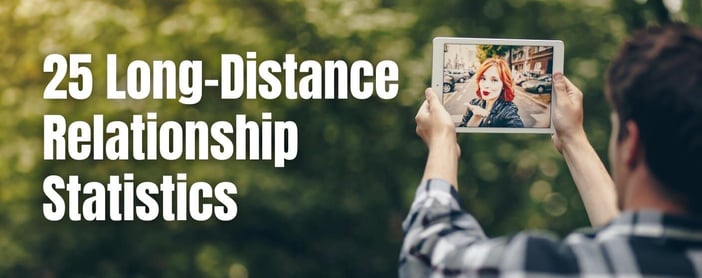
Every relationship has its complications. Some couples struggle with navigating conflict. Others find it difficult to trust each other. And many have a tough time just making time to go on a date and fit a new person into their busy lives.
For couples in long-distance relationships, any existing issues are exacerbated by another factor: distance.
Communication becomes more complicated. Trust is more important. Scheduling is essential.
Still, many couples thrive in long-distance relationships and find that time apart strengthens their love (at least, that’s what happened to me). Read on to learn what actually goes into long-distance relationships and how couples feel about them.
1. Around 14 Million Americans Are in Long-Distance Relationships (LDRs)
If you’re in a long-distance relationship, you definitely are not alone. According to a study by Survive LDR, a whopping 14 million Americans say they’re in some level of long-distance relationship1.
As I’ll discuss later, some phases of life — like college or your early career — make long-distance relationships more likely.
There are plenty of reasons that people get into long-distance relationships or transition their relationships to being long-distance.
2. The Average Distance in LDRs Is 125 Miles
Any distance that limits your contact with your partner throughout the week may feel like a long distance. But according to Survive LDR, the average long-distance couple is separated by about 125 miles2. That’s about two hours of highway driving.
It makes sense that the average long-distance couple is around two hours apart. Many people who live in the same geographic region might look for jobs further out of their cities or set their dating pools wide on dating apps.
And in the scheme of long-distance relationships, two hours is pretty manageable — a distance where partners can do their own things throughout the week, then reconnect on the weekend.
3. Just 24% Reported Having Been Long-Distance
Long-distance relationships may be pretty common, but they’re still the road less traveled. A study by SexualAlpha found that of 7,392 survey respondents, just 1,814 said they had been in a long-distance relationship3.
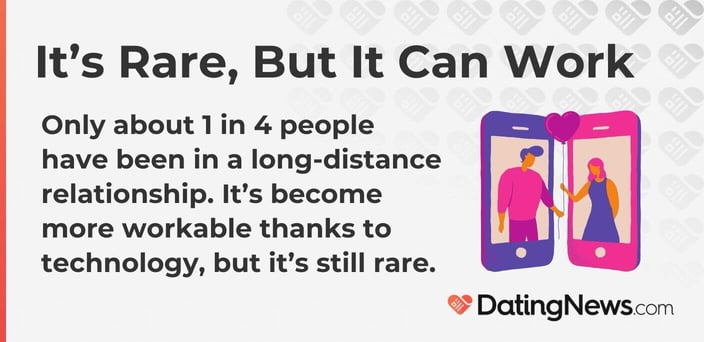
For many people, being in a long-distance relationship just never comes up. They find it easy to date people in their area, and life circumstances never pull them in different directions.
And, of course, some people avoid long-distance relationships intentionally. They may refrain from starting a relationship with someone far away or end a relationship once they or their partner needs to move.
4. Around 40% of Long-Distance Couples Are in College…
At no time in life is it more normalized to move far away than in college. Incoming college students move around the country — and sometimes the world. Their relationships make up about 40% of all long-distance relationships4.
Some college LDRs come from students staying together with their high school partners, while others still involve students starting to date new people at school who then graduate and move elsewhere for work.
My own college long-distance relationship started when I was introduced to the hometown friend of my college roommate.
Regardless of the origin, LDRs test the relationship skills of students who are still fairly new adults.
5. …And 75% of College Students Have Been in a Long-Distance Relationship
Not only do student-relationships make up a sizable chunk of long-distance relationships, but students also overwhelmingly participate in long-distance relationships. According to GoodTherapy, 75% of students5 enter long-distance relationships at some point during college.
When I went off to college, I thought that I had dodged the bullet of entering a long-distance relationship because my high school boyfriend and I had broken up a few months before. Little did I know that I would fall in love with someone far away during college. Your college years are the easiest time to meet people from far away, and few people get out of college without navigating romantic distance at some point.
6. Long-Distance Relationships & Short-Distance Relationships End at Similar Rates
According to the Annals of Emergency Medicine, over any given six-month period, 40% of all non-married couples will break up, regardless of distance. Long-distance relationships are no more likely to end than short-distance ones6.

It’s a common misconception that long-distance relationships are doomed to fail. The journal authors explain that this might be due to our impulse to find a cause for our breakups outside of our own personalities and behaviors in a relationship.
When long-distance relationships end, it’s easy to blame their dissolution on the distance and go forward believing that all long-distance relationships are flawed rather than to look inward.
7. Cheating Is 3% Less Common in LDRs
It may be easier for long-distance partners to cheat, but that doesn’t mean they will. The same study from SexualAlpha found that 22% of respondents reported cheating occurred in their long-distance relationships. Cheating occurs in about 25% of marriages overall7.
The similarity in rates of cheating regardless of distance should offer some reassurance for those who struggle with trusting their partners. Your partner won’t cheat just because they have independence and opportunity.
8. About 5% of Long-Distance Relationships Are Open
Non-monogamy might seem more appealing in a long-distance relationship, but most couples still keep their relationships closed despite the distance. SexualAlpha found that just 5.1% of respondents reported opening up their long-distance relationships8.
For couples who are monogamous, keeping the relationship closed is probably the safest bet. Non-monogamy isn’t as simple as casually deciding to sleep with other people when you can’t see your partner.
It requires a mindset shift in how you view your relationship and think about partnership.
For people already interested in non-monogamy, being long distance can be a great motivator to open the relationship up. But if you would never open up your short-distance relationship, mixing it up with your long-distance one is a recipe for chaos.
9. Long-Distance Couples Spend 8 Hours Per Week Talking on the Phone
If you think that going long-distance will save time, that might not be quite accurate. A study by Kiiroo found that the average long-distance couple spends 8 hours per week talking on the phone9.
Eight hours might sound like a lot (and it is). But think of it this way: If you were spending time with your partner in person, you’d probably be hanging out at least 2-3 times a week for multiple hours at a time. When you’re long-distance, that time together becomes virtual.
And while these calls lack the physical contact of being in person, they do offer more time to connect deeply and actually talk with your partner than you might have IRL. You probably aren’t watching a movie or going ax-throwing; you’re talking face-to-face.
10. And They Exchange Nearly 350 Texts Per Week
Texting is a necessary part of everyday life, and it’s absolutely essential for long-distance couples. The same study found long-distance couples exchange 343 texts per week on average10.
At first, I thought that sounded like way, way too much, but then I went scrolling through my chats with my partner, and yeah, we can talk a lot sometimes.
11. Over Half Say the Distance Made Them Closer
It’s popular wisdom that couples bond through shared hardship, and going long-distance is one hardship that fits the bill. The Kiiroo study found that over half of respondents felt that their long-distance relationships made them closer to their partner in the long run11.
This may in part be due to all that time spent getting to know your partner better on the phone. I found that clearer communication was a necessity in my LDR.
I know that my long-distance relationship made my now-fiancé and me get serious about our relationship sooner than we might have if we didn’t need to drive five hours every time we wanted to see each other.
12. A Stubborn 51% of Daters Want to Avoid Long Distance
Long-distance is doable, but that doesn’t make it easy. A study by Pew Research Center found that 51% of daters either definitely or probably would not date someone who lives far away (14% and 37% respectively).12
This stat suggests that half of singles would never even consider a long-distance relationship. While it’s probably true that many singles aren’t open to starting a long-distance relationship, many would likely consider continuing an existing relationship should distance become an issue.
13. Intimacy Issues Arise in Two-Thirds of LDRs
Distance might make the heart grow fonder, but that doesn’t make up for the physical connections that couples enjoy IRL.
Kiiroo found that 66% of respondents reported lack of intimacy as an issue in their long-distance relationships — the biggest issue out of any problem they offered13.
Even for the 95% of long-distance couples that stay monogamous, there are ways to deal with a lack of physical intimacy — masturbation, phone sex, sexting. But oftentimes, that simply can’t beat in-person intimacy.
LDRs can make individuals feel starved for even the small, non-sexual physical contact you get from being around your partner.
14. The 4-Month Mark is the Hardest Point in Going Long-Distance
It does get easier…but it gets harder first. Kiiroo found that long-distance couples struggled most around the 4-month mark of being long-distance.14 For students, this might be the tail-end of the first semester away from your partner, where the stress of studying for finals merges with your sadness at being far from home.
And because popular wisdom holds that the honeymoon phase of a relationship lasts about 3 months, it’s the point where your true colors are beginning to show. You can’t just carry the relationship on home much you already like each other — you have to actually put the work in.
15. Texting Increases Satisfaction in Long-Distance Relationships
Always on your phone? In a long-distance relationship, that’s probably a good thing. One study found that in long-distance couples, higher rates of texting were correlated with higher relationship satisfaction15.
Interestingly, this only held true for long-distance couples. General population couples didn’t see the same advantages.
The study also found that long-distance couples tended to use technological communication more effectively. They reported their partners were more responsive and engaged during calls and texting.
16. Long-Distance Couples Get Sounder Sleep
Sleeping with your partner might be cozier, but you’re probably getting better sleep on your own.
In a study measuring the health of long-distance couples, researchers found that partners in long-distance relationships reported less fatigue and disturbances during sleep than partners who lived near each other16.
Anyone who’s shared a bed with their partner can probably guess at a few reasons for this. Having another person in your bed (which is more convenient for couples who share a home or live close by) creates a lot more movement and potential disturbance throughout the night.
17. About 3 Million Married Couples Are Long Distance
Long-distance relationships aren’t just for high school sweethearts trying to make it work through college. One study found that 3 million married couples are in long-distance relationships, too17.
Most of these couples are likely living separately for the short term. They may be living in separate places until one can find a job near the other or while one partner attends university.
It’s rare but some couples choose to live apart on a more permanent basis. Perhaps due to work or family constraints. They decide to maintain their independence and come together with their spouse when time allows.
18. Women in LDRs Are 6% Less Likely to Be Unemployed
Long-distance couples are go-getters. A high percentage are pursuing their education, and most of those remaining are gainfully employed. And compared to couples overall, long-distance couples are less likely to be unemployed.
One German study found that just 6.7% of women in long-distance relationships were unemployed, compared to 12.4% of women in short-distance relationships18.
It makes sense: Most couples enter long-distance relationships because of an external obligation (like school or work) that takes them away from each other. Without those obligations, few couples have the motivation to move apart.
If one partner needs to move to another state and the other is unemployed, it’s much easier to follow that singular career path without separating.
19. Long-Distance Couples Are Less Likely to Start Living Together
The data is mixed on whether long-distance relationships are any more or less likely to last. But the same German study found that long-distance couples were significantly less likely to move in together than short-distance couples.
It makes sense that long-distance couples are less likely to move in together19. They have to decide not only to take that step; they also have to decide to live in the same town in the first place.
For me, being in a long-distance relationship actually made it more likely for me to move in with my partner. Since I was moving to a new city to be with him, I had little impulse to get my own place. But moving to the same city in the first place is a big if.
20. A Staggering 75% of Engaged Couples Have Been Long-Distance
Here’s some proof that long-distance works: 75% of engaged couples have been long-distance at some point in their relationship20.
Over the course of a relationship, chances are, something will come up that might require you and your partner to live apart. When couples are a good match, they can usually weather those difficult times by finding ways to communicate, trust each other, and keep the romance alive.
I’m part of that 75% of engaged people who have done long-distance with my partner, and I wouldn’t have it any other way.
Our relationship is so much stronger because of the skills we worked on early on. That laid the foundation for us to become a really solid team, and as we enter our marriag,e I’m so much more confident in what we can handle than I would have been if our relationship had started a bit more conveniently.
21. For 85% of Long-Distance Couples, Trust is Most Important
I’ve never seen a solid relationship that wasn’t built on trust. But if you don’t have trust in your long-distance relationship, there’s almost no point in trying. Fortunately, most long-distance couples agree, with 85% of long-distance couples reporting trust as the very foundation of their love.21
If you trusted your partner before, there’s no reason not to trust them when there’s distance. Since long-distance couples actually cheat at a lower rate than the general population (see stat 7), trust should be more about who you are than where you physically are.
22. Sadly, 1 in 3 Couples Split Within 3 Months of Reuniting
For some couples, being apart is actually better than being together. One study found that while long-distance couples had stabler relationships than short-distance couples, that only lasted until they moved back to the same place.
After that, about one-third of long-distance couples called it quits within three months22.
In any relationship, couples get into rhythms. Whether it’s who cooks on which nights or when you talk on the phone before bed, you get used to the relationship you have.
Going from long-distance to short-distance — or even living together — it’s a big transition. Suddenly, you’re dealing with conflicts that never came up before. Perhaps you have incompatible routines. Some couples work through it, while others decide to go their separate ways.
23. Of Long-Distance College Couples, 4 Out of 5 Say Yes to Marriage
Long-distance couples have more faith in their relationships than short-distance couples. One study found that 80% of college students in long-distance relationships expected to marry their partners, while only 62% of short-distance couples said the same23.
There are a lot of reasons long-distance couples might have more faith in their relationships. Going long-distance generally selects for a level of confidence that the relationship is worth the effort. If you didn’t see marriage as an option, the far easier choice would be to break up.
If you’re dating someone long-distance, you’re thinking about your future together. That selects for a college student who’s a bit more serious about their relationships in general.
24. About a Third of Long-Distance Couples Have Anxiety About Reunion Plans
Many daters struggle with the uncertainty of it all. You could feel like you’re in the most loving relationship in the world, and your partner could still leave you. That’s hard to wrap your brain around.
But in long-distance relationships, it’s even worse. You don’t just have to worry if you’ll continue to date; you worry about the logistics to move for each other. For about 34% of long-distance couples, reunion logistics are a significant source of anxiety24.
When my partner and I were long-distance, our plans for moving together were a big source of anxiety for me. Fortunately, we’re now engaged and have been happily living together for almost four years, so I can confidently say that if it’s meant to work out, it will.
25. For 67% of International Couples, Time Zones Cause Scheduling Issues
International long-distance couples face unique relationship difficulties that simply don’t factor in for couples who live a few hours away. One of those issues is missing virtual dates due to time zones.
About 67% of international long-distance couples reported that time zone mismatches had resulted in scheduling errors in their relationships25.
This is one area where technology can definitely be your friend. Get a time-zone conversion app, or set your Google Calendar to the time zone of your partner. With all the factors you have to juggle in a long-distance relationship, don’t let scheduling create problems.
Long Distance Works (With a Bit of Effort)
One thing is clear in the data on long-distance relationships: Many of them are happy and healthy.
Like most external relationship factors, the distance between partners is a whole lot less important than the substance of their bond and how they feel about each other.
When you really want to be with someone, you can usually make it work. Long-distance couples may have some difficult logistics stacked against them, but they also have an opportunity to prioritize their partners and prove their relationships for long-lasting love.
- https://surviveldr.com/long-distance-relationship-statistics/ ↩︎
- https://surviveldr.com/long-distance-relationship-statistics/ ↩︎
- https://www.prnewswire.com/news-releases/only-31-of-relationships-survive-long-distance-new-study-by-sexualalpha-finds-301460498.html ↩︎
- https://surviveldr.com/long-distance-relationship-statistics/ ↩︎
- https://www.goodtherapy.org/blog/are-long-distance-relationships-happier-0802137 ↩︎
- https://www.annemergmed.com/article/S0196-0644(01)97304-4/fulltext ↩︎
- https://www.hli.org/resources/percentage-of-relationships-that-work-after-cheating/ ↩︎
- https://surviveldr.com/long-distance-relationship-statistics ↩︎
- https://nypost.com/2018/10/31/long-distance-relationships-are-more-successful-than-you-think ↩︎
- https://nypost.com/2018/10/31/long-distance-relationships-are-more-successful-than-you-think ↩︎
- https://nypost.com/2018/10/31/long-distance-relationships-are-more-successful-than-you-think/ ↩︎
- https://www.pewresearch.org/social-trends/2020/08/20/personal-experiences-and-attitudes-of-daters/ ↩︎
- https://nypost.com/2018/10/31/long-distance-relationships-are-more-successful-than-you-think/ ↩︎
- https://nypost.com/2018/10/31/long-distance-relationships-are-more-successful-than-you-think/ ↩︎
- https://pubmed.ncbi.nlm.nih.gov/34924671/ ↩︎
- https://pubmed.ncbi.nlm.nih.gov/38369304/ ↩︎
- https://www.goodtherapy.org/blog/are-long-distance-relationships-happier-0802137 ↩︎
- https://pmc.ncbi.nlm.nih.gov/articles/PMC6241008/ ↩︎
- https://pmc.ncbi.nlm.nih.gov/articles/PMC6241008/ ↩︎
- https://www.luvlink.com/blogs/news/surprising-long-distance-relationship-statistics-ldr-101?srsltid=AfmBOootO4bxJn1Mj5F9fGxNYwKsSxAkaj8vtnlFGAYl32VXU_ltnVnU ↩︎
- https://www.luvlink.com/blogs/news/surprising-long-distance-relationship-statistics-ldr-101?srsltid=AfmBOootO4bxJn1Mj5F9fGxNYwKsSxAkaj8vtnlFGAYl32VXU_ltnVnU ↩︎
- https://www.tandfonline.com/doi/abs/10.1080/01463370701658002 ↩︎
- https://www.jhunewsletter.com/article/2022/10/opposing-viewpoints-long-distance-relationships-have-the-most-potential ↩︎
- https://www.joinreframeapp.com/articles/long-distance-relationships-anxiety-2025-statistics-attachment-security ↩︎
- https://www.joinreframeapp.com/articles/long-distance-relationships-anxiety-2025-statistics-attachment-security ↩︎