

Key Takeaways
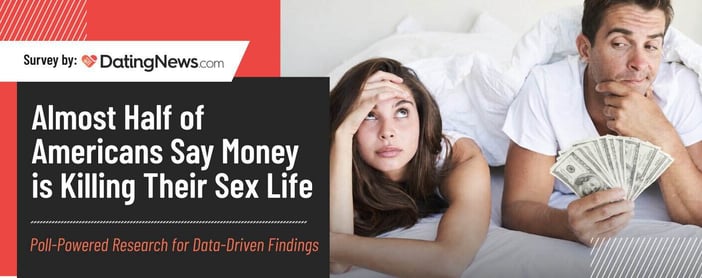
- 47% of surveyed Americans say financial stress negatively impacts their sex lives.
- Gen Z (50%) and millennials (51%) feel the impact the most, compared to their older counterparts, Gen X (41%) and baby boomers (40%).
- Over a third (35%) of respondents believe the higher earner in the relationship has more sexual power, or confidence to speak about their needs.
Most people can agree that money is tightly intertwined with modern dating. From dictating first-date spots and dealbreakers to shaping relationship status and satisfaction, finances can influence every step of a relationship’s timeline.
Yet it’s also a barrier for something far less discussed in modern dating: sex.
According to our DatingNews Pay Gap and Sex Life Survey, 47% of Americans say financial stress has negatively impacted their sex life, with 14% saying it happens frequently. And it’s affecting the generations that are supposed to be in their sexual prime the most.
Gen Z (51%) and millennials (50%) are hit the hardest by money stress in the bedroom, compared to Gen X (41%) and boomers (40%), revealing a slight generational gap.
“As a sexologist, it’s especially striking to me that Gen Z and millennials — the generations who are both the least financially stable and the most actively dating — are also the ones feeling it most acutely. This highlights how money can act as a major brake on desire and intimacy,” said Natassia Miller, a certified sexologist with the American Association of Sexuality Educators, Counselors and Therapists (AASECT).
35% Believe the Higher Earner Has More Sexual Power
Most Americans know financial stress can bleed into their relationships. But how does it affect how they perceive sexual confidence in a relationship?
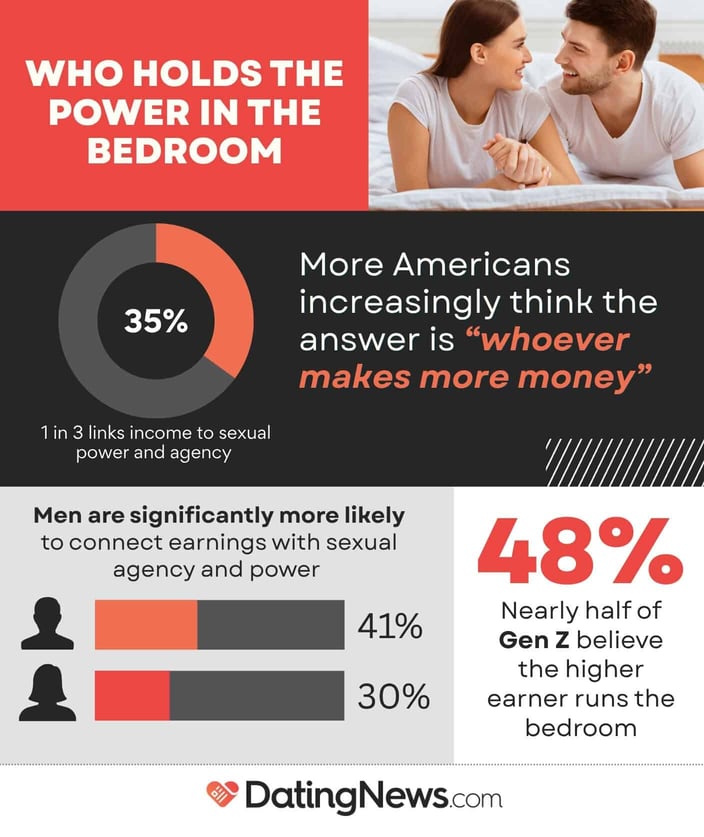
According to our study, over 1 in 3 (35%) surveyed Americans believe the person who earns more in the relationship holds more sexual power and agency, revealing how financial status can influence sexual confidence.
Interestingly, men are far more likely to internalize this belief than women — 41% vs. 30%. This 11-point difference doesn’t just point to a gap in perception; it points to differing worldviews.
“This data shows just how tightly financial status is still tied to men’s sense of self-worth. What’s even more striking is that when men are actually the lower earner, their sense of empowerment is almost identical to women’s (15% vs. 14%), meaning the gap lies in the cultural script men have absorbed about money and power,” said Natassia.
Yet men aren’t the only group affected by this belief. In fact, 43% of Gen Z respondents also believe the higher earner has more power in the bedroom, making them the most affected demographic group.
These results reveal how financial status can shape sexual confidence in ways couples may not even realize, with Gen Z and men feeling that link most acutely.
Does Your Paycheck Affect Your Performance in Bed? 1 in 5 Americans Say “Yes”
Being transparent about sex isn’t always an easy thing. But according to our respondents, it may be easier for some to express their needs than others, and finances play a bigger role than most couples realize.
In fact, 34% of respondents believe economic inequality between partners can impact sexual satisfaction. And the data suggests it shapes who feels comfortable speaking up in the first place.
Over 1 in 5 (21%) of surveyed Americans say earning more than a partner makes them feel more empowered to express their sexual needs. Conversely, 14% say earning less makes them feel less able to communicate those same needs.
The confidence gap isn’t felt equally. Men feel the empowerment boost from out-earning a partner almost twice as strongly as women — 28% vs. 15% — while women and younger respondents are more likely to feel the disempowering side of this dynamic.
Similarly, Gen Z reports the strongest link between earning more and feeling sexually confident, more so than any other generation.
Sex and Finances Are Tightly Linked
Financial stress, income gaps, and earning dynamics are quietly reshaping Americans' intimate lives, and many Americans are feeling the pressure.
While we’ve seen how bills, inflation, and debt can impact dating behavior, financial strain can also impact sex drive just as strongly. Natassia puts it plainly:
“We talk about sex as if it’s a basic drive, but it isn’t. A drive is something we need to survive, whereas sex is part of an incentive motivation system. If you’re worried about making ends meet, your nervous system is in survival mode, not seduction mode.”
How people view income and sexual empowerment can influence how satisfied they are with their sex lives. It’s clear that the pay gap is no longer just a workplace story; it’s also a bedroom one — and one not enough people are talking about.
Methodology
The DatingNews survey was conducted with Prodege among 1,000 U.S. adults ages 18 to 79 across a range of relationship statuses. The sample includes a broad distribution across gender, age and U.S. regions. Fieldwork was completed in April 2026. The theoretical margin of error for a probability sample of this size is approximately ±3.1 percentage points at the 95% confidence level.
Media inquiries, please contact colleen@datingnews.com.




![18 Online Dating Scam Statistics[updated_month_year before=" (" after=")"]](https://www.datingnews.com/images/uploads/2026/07/online-dating-scam-statistics.jpg?width=342&height=135 "18 Online Dating Scam Statistics[updated_month_year before=\" (\" after=\")\"]")