When most people get married for the first time, they imagine it will be the only time they walk down the aisle. But life can be more complicated than that.
Spouses grow apart. They betray each other. Some even pass away. And while it’s hard to picture that before your first marriage, you can absolutely find love and marry again later in life. This is the story of many happily remarried people.
Second (and third, fourth, and fifth) marriages look different in some ways. Read on to learn about what remarriage looks like for American couples.
1. In 2022, 23% of Marriages Were Remarriages
If you think that remarrying is relatively uncommon, think again. According to research from Bowling Green State University, 23% of total marriages in 2022 were remarriages1. That means nearly a quarter of couples tying the knot involved either one or both spouses who had been previously married.
When most people picture a wedding, they picture young adults getting married for the first time. But the reality looks different for many people. Between divorces and deaths, there are many reasons a marriage might end, but love and life don’t stop at that point.
2. Between 1990-2022, the Remarriage Rate Fell by 50%
While remarriage is still very common, it seems to have peaked. Between 1990 and 2022, Bowling Green State University found that the remarriage rate had fallen from 50 per 1000 to 24.2 per 10002.
As of today, far fewer marriages are remarriages.
These numbers make some sense when you look at the stats for divorces, which peaked in the early 1980s3. The theory that makes sense to me is that marriages were rocked by the changes around gender roles and labor that came to American households at the end of the 20th century.
A feminist wave broke up many marriages that had started in a more traditional and conservative time. People who divorced during this period likely would have remarried in the late ‘80s and ‘90s, which could explain why remarriages have slowed down now.
3. White Americans are Most Likely to Remarry at 60%
Norms around marriage and divorce vary between ethnic and racial groups, and this is especially true when it comes to remarriage.
According to the Pew Research Center, as many as 60% of white Americans marry more than once.
Some groups are less likely to marry in the first place, while others have stronger taboos around divorce. White Americans have a higher likelihood of marrying, which makes it understandable that they also have a high marriage rate.
4. The Remarriage Rate is Highest for 20- to 24-Year-Olds
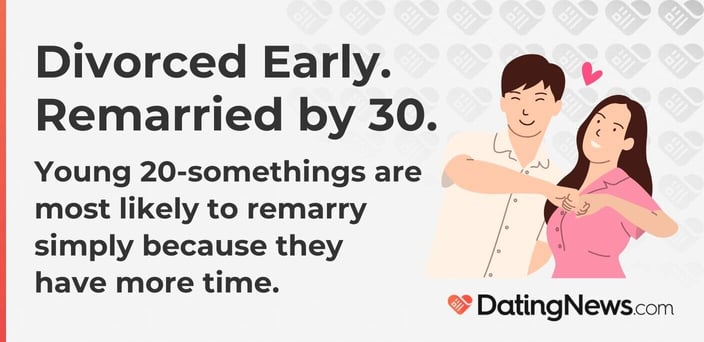
No one sees themselves getting divorced in their early 20s, but it happens. And when it does, divorced young people are much more likely to bounce into a new relationship.
Of any group, 20-24-year-olds are the most likely to remarry, with a remarriage rate of 101.8 per 10004.
It’s easy to understand why this group might remarry more often than their older peers. Young divorcés are entering a dating market where plenty of eligible partners have never married. They’re often coming out of relationships that were short and somewhat juvenile to begin with. They may not have children or palimony to worry about.
While no remarriage is simple, ones that start at a younger age are more likely to have a clean slate and far less emotional baggage.
5. Among Newlyweds, 33% of Those Over 55 Were Married 3 Times or More
As Americans age, it becomes fairly likely that they’ll marry not just twice, but three or more times. Pew Research Center found that of newlyweds who were over 55, 33% were on their third marriage or higher5.
Not only do those over 55 have a higher likelihood of having had a spouse die or go through a divorce, but they’re also closer to the age group that would have been married around the peak of divorces in the United States.
As one ages, there’s more opportunity to have had multiple marriages, and the baby boomer generation seems to be more likely to divorce and thus remarry in the first place.
6. A Quarter of Remarriages End in the First 5 Years
Unfortunately, many remarriages are not exactly the happily-ever-afters couples dream of. According to one study, 25% of remarriages end within the first five years, compared to just 20% of first marriages that end in this time frame6.
No shade here. People on their second marriage may have underlying issues or challenges with commitment. They may be more open to the idea of divorce in the first place. And especially for those who already have children from a prior relationship, they have more complications in their lives that may strain their new marriages.
7. After 10 Years, 81% of Women Under 25 Get Remarried
Divorce is devastating for anyone. But for women who divorce young, it can be particularly painful. They often deal with shame and guilt over the end of their relationships, and they may fear the prospect of living the rest of their lives solo.
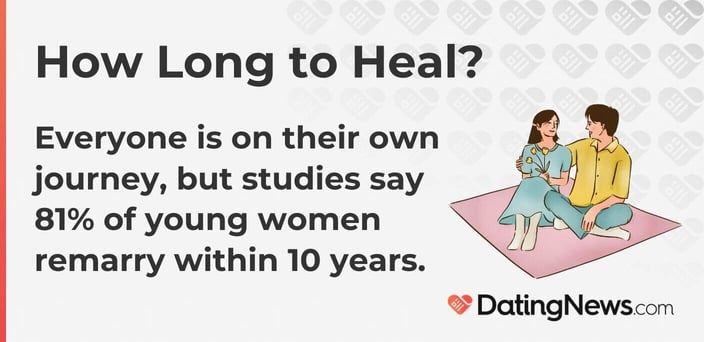
But they should feel assured that if they want to marry again, they can. After 10 years post-divorce, 81% of women who divorced under age 25 will remarry7.
And compared to the general population of women, this suggests that women who divorced under 25 are actually more likely to be married in their 30s.
By ages 35-39, 63% of women generally are married8. Even after accounting for women who divorce again after their first marriage ends, that still leaves a sizable number of young divorced women remarried by their mid-30s.
8. About 40% of Remarriages Involve Children From Previous Relationships
Remarriages can be more complicated than first marriages, especially if children are involved. In around 40% of remarriages, one or both partners have children from a previous relationship9. This means navigating stepparent dynamics becomes a huge part of whether a new relationship will thrive.
In some ways, it can be easier to work through if both partners have kids. That way, parenthood isn’t a sudden lifestyle change. But these families also have to consider step-sibling relationships, which can be tense. Just ask the Brady Bunch!
9. A Whopping 61% of Widowed Men Remarry Within 2 Years
After a spouse dies, there’s no clear answer to when “the right time” to move on is. Everyone has a different pattern of grief. But one thing is clear: most men move on shortly after their spouses die.
According to one study, 61% of men remarried or entered a new relationship within 25 months following the death of their spouse10.
The same is not true at all for women. In the same time period, just 19% of widowed women had entered a marriage or new relationship.
10. In About 40% of Marriages, at Least 1 Partner Was Previously Married
Everyone comes into their marriages with their own baggage and stories. Few people have no trauma or complicated history before entering their marriage.
According to one study, 40% of all marriages are a remarriage for at least one partner11.
For anyone worried about whether they can expect to find love again post-divorce, this should be good news. Remarriages are common; they make up a significant portion of marriages in total.
Don’t count yourself out just because one relationship ended. Life is long, and there’s plenty of love to go around.
11. Rural Americans are 15% More Likely to Remarry
Living in the country? You’re actually more likely to remarry post-divorce. One study found that rural Americans are 15% more likely to remarry than urban Americans12.
It may seem like dating is easier in cities, but this isn’t always the case. Rural singles have fewer choices, but that can actually make it easier to pair off.
Rural life can make partnership seem more appealing. It gets lonely in the country.
On top of that, urban divorcés may feel less desire and pressure to remarry. Being newly single in the city can be pretty fun. They may have less incentive to give that up.
12. Among Remarried Women, 4% Live With a Stepchild
Stepmothers aren’t actually that common — at least not ones who live with their stepchildren. Pew Research Center found that just 4% of remarried women live with a stepchild, compared to 9% of men13.
While these numbers seem low, they make some sense. Not every divorced person gets remarried — or remarried to somebody with kids — custodial parents often have less time to date.
13. Age Gaps Over 10 Years Increased the Divorce Rate of Remarriages by 39%
The fact of it being a second marriage doesn’t mean it will automatically end in divorce. Certain factors outside of it being a remarriage influence its success.
Being close in age with your new spouse seems to have a strengthening effect on relationships. When the age gap in a remarriage is over 10 years, your odds of divorce increase by 39%14.
Age gaps can always be tricky to navigate in relationships15, but in remarriages, this is particularly true.
Age-gap remarried couples face extra judgment from their friends and family, who may think that the younger partner is a rebound, a gold-digger, or ill-equipped to deal with the older partner’s life. They may worry that the older partner is taking advantage of an emotionally vulnerable person.
This isn’t to say you shouldn’t enter a remarriage with a large age gap. Just be aware of all the risks and challenges going into it.
14. Within Stepfamilies, 86% Involve a Biological Mother & a Stepfather
Custody agreements often favor mothers16, which means it’s more likely that moms would get custody than dads. This makes for, on average, more stepdads than stepmoms living with the kids.
According to a classic study from CLASP, 86% of stepfamilies involve a biological mom and a stepdad17.
But many families have split custody, where one parent may be the primary custodial parent and the second parent is involved. In these cases, new partners from a remarriage are still stepparents, even if they aren’t full-time caretakers. Their relationships with their stepchildren matter.
15. More Than Two-Thirds of Stepchildren Don’t Experience Serious Emotional Issues From Living Situation
When going through a divorce and then entering a remarriage, it’s a great idea to check in with your kids emotionally and consider putting them in therapy. Most kids adjust pretty well to changing family situations.
Between two-thirds and three-quarters of stepchildren experience no behavioral or significant emotional issues from their new family structure18.
Kids are resilient. But most of all, while they need stability, they can tell when they’re loved and cared for. As long as their family continues to do that, they’ll usually be okay.
16. Widowed Men Remarry 5X More Often Than Widowed Women Do
Widowed men enter new relationships faster than widowed women, and they also do it more of the time. According to one study, 17.6% of widowers remarry, compared to 3.6% of widows19.
There’s nothing wrong with remarrying. For many widows, entering a new relationship actually helps them heal and move forward with their lives.
But it is striking how much more difficult or less desirable it seems to be for widowed women to enter new relationships than for widowed men. Whether women find new relationships too painful or simply prefer life on their own is unclear.
17. Third-or-Higher Marriages Account for 8% of New Marriages
While second marriages are pretty common, third marriages are pretty rare. According to the Pew Research Center, third-or-higher marriages (fourth marriages, fifth, and so on) make up 8% of new marriages20.
Some older individuals really don’t want to be single, and they’ll keep trying until they get it right.
Third marriages may not be common, but they can be desirable for older individuals who have loved and lost and want to love again.
Go Ahead & Give Yourself a Second Chance
Real talk: No one wants their relationship to end in divorce – or worse – the premature death of their spouse. But unfortunately, these things happen, and life keeps going.
Second marriages aren’t a bad thing. They’re a fresh start. Even if your first love story didn’t work out, another great love might still come your way.
If you’re hoping to start over, I hope these statistics have proven to you that it’s not only possible to succeed, it’s likely.
Just keep a positive outlook, and if you want to marry again, go after it with open eyes and a healed heart.
Data Sources:
- https://www.bgsu.edu/ncfmr/resources/data/family-profiles/FP-24-09.html ↩︎
- https://www.bgsu.edu/ncfmr/resources/data/family-profiles/FP-24-09.html ↩︎
- https://www.pewresearch.org/short-reads/2025/10/16/8-facts-about-divorce-in-the-united-states/ ↩︎
- https://www.bgsu.edu/ncfmr/resources/data/family-profiles/FP-24-09.html ↩︎
- https://www.pewresearch.org/social-trends/2014/11/14/chapter-2-the-demographics-of-remarriage/ ↩︎
- https://www.healthymarriageinfo.org/wp-content/uploads/2017/12/Remarriage-Trends-in-the-United.pdf ↩︎
- https://www.healthymarriageinfo.org/wp-content/uploads/2017/12/Remarriage-Trends-in-the-United.pdf ↩︎
- https://www.bgsu.edu/ncfmr/resources/data/family-profiles/brown-manning-relationship-status-trends-age-gender-fp-21-25.html ↩︎
- https://www.healthymarriageinfo.org/wp-content/uploads/2017/12/Remarriage-Trends-in-the-United.pdf ↩︎
- https://pubmed.ncbi.nlm.nih.gov/8807029/ ↩︎
- https://www.pewresearch.org/social-trends/2014/11/14/chapter-4-marriage-and-remarriage-among-newlywed-couples/ ↩︎
- https://gitnux.org/remarriage-statistics/ ↩︎
- https://www.pewresearch.org/short-reads/2025/10/16/8-facts-about-divorce-in-the-united-states/ ↩︎
- https://gitnux.org/remarriage-statistics/ ↩︎
- https://www.datingadvice.com/studies/age-gap-dating-statistics ↩︎
- https://www.census.gov/content/dam/Census/library/publications/2016/demo/P60-255.pdf ↩︎
- https://www.clasp.org/sites/default/files/public/resources-and-publications/archive/0028.pdf ↩︎
- https://www.clasp.org/sites/default/files/public/resources-and-publications/archive/0028.pdf ↩︎
- https://www.psychologytoday.com/us/blog/the-state-of-our-unions/202304/what-happens-after-a-gray-divorce-or-death-of-a-spouse ↩︎
- https://www.pewresearch.org/social-trends/2014/11/14/chapter-2-the-demographics-of-remarriage/ ↩︎