
Tinder says sustained conversations on the app increased 2% year over year in August, following a July change to its recommendation algorithm. The metric had been down 4% in the second quarter and 1% in July.
The update, labeled as Queue Unification v2 in the image below, combined Tinder’s previously separate recommendation systems into one. Tinder Chief Technology Officer Vinay Kuruvila explained the change during Match Group’s Sept. 3 CEO Connection Series, “Inside Tinder Product Velocity.”
Kuruvila said “the only objective that our machine learning algorithms optimize on is sparks.”
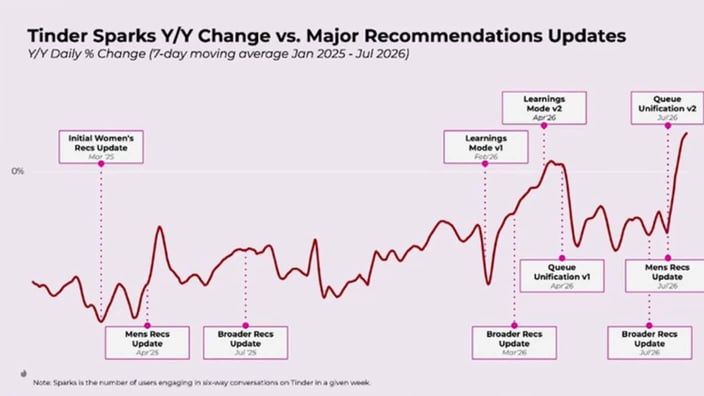
“Sparks” is Tinder’s term for conversations that go back and forth six or more times. In plain English, Tinder’s recommendation system is now ranking potential matches around the likelihood that they will reach that level of conversation.
Previously, Tinder’s recommendation systems balanced different objectives, including likes, retention and revenue. Match Group CEO Spencer Rascoff said the unified system instead reorders recommendations based on what will maximize the chance that two users not only match but go on to reach a Spark.
Then, on Sept. 8, Rascoff shared fresh numbers showing that metric improving.

Sparks increased 2% year over year in August. They had been down 4% in the second quarter and down 1% in July.
Spark coverage, the percentage of users who reach a Spark, also improved. It was up 2% year over year in the second quarter, 5% in July and 6% in August.
Tinder’s daily active user numbers moved in the same direction. Daily active users were down about 1% year over year in August, compared with a 4% decline in the second quarter and a 2.5% decline in July. Rascoff said the trend improved further during the first week of September.
Rascoff said Tinder’s recommendation improvements, along with Events and other social features, “are having the intended effect.”
The recommendation overhaul is still underway. Kuruvila said Sept. 3 that the unified system had not yet been rolled out across every segment of Tinder’s user base.