





Matchmakers are a force to be reckoned with in the dating industry, even — and especially — as dating apps continue their quest for dominance. So when matchmaker April Beyer announced she’d be taking her matchmaking company, LEVEL™️, to Tech Week NYC, I was intrigued.
I admit I don’t always associate matchmaking firms with advanced technology. In fact, some matchmakers would probably argue that tech is often a hindrance to effective matchmaking. But for Beyer and a growing number of her peers, matchmaking is no longer just about heart — it’s also about technological innovation.

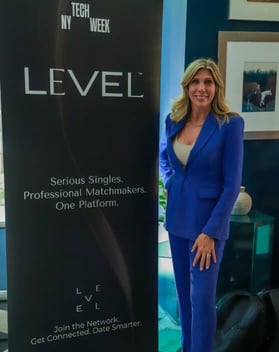
Beyer’s SaaS, LEVEL™️, takes the traditional role of the matchmaker into the 21st century. When DatingNews spoke to Beyer about her experience turning LEVEL into a SaaS, she emphasized how it has become a collective — a “global community of professional matchmakers who share a common, standardized framework for evaluating compatibility,” she put it.
LEVEL™️takes collaboration a step further by establishing an entire platform on which matchmakers can hone their skills and streamline their businesses.
“This is a platform I’ve been using for my own company, collecting data for all these years,” Beyer told us. “I turned it into SaaS because I realized that [LEVEL™️] would be beneficial to the matchmaking industry, and help singles.”


LEVEL™️is not just about the matchmaker experience, but about the customer experience, too. Beyer described her proprietary Emotional Values Traits quiz as a profile-building process that goes deeper into emotional needs than any app or AI bot ever could.
In fact, Beyer makes it clear that LEVEL™️is a careful balance of AI and HI — human intelligence — and that it’s the decades of human experience behind LEVEL™️that makes it so innovative in the first place.
LEVEL’s presence at Tech Week NYC isn’t just about showing interest in tech, but about making a statement: Matchmakers do belong in tech-dominant spaces, and they aren’t going anywhere.
DN: LEVEL™️hosted an event during Tech Week NYC, a space typically associated with startups, investors, and technology companies. Why did you want matchmaking represented there?
AB: We wanted Tech Week attendees to see that the future of dating isn’t just another app. It’s a combination of 25 years of human expertise, a values-driven approach, intentionality, data insights, and technology working together. Tech Week felt like the perfect place to introduce that conversation.
While I’m here at Tech Week, I’m seeing a lot of engineers and people from Silicon Valley getting into the matchmaking space. But they’re outside in — [LEVEL is] inside out.
DN: How does a SaaS like LEVEL™️fulfill the modern matchmaker’s most pressing needs?
AB: For years, I watched talented matchmakers operate in isolation. Everyone had their own database, their own process, and their own network. The industry has become very collaborative, but this has proven to be time-consuming and often inefficient.

Imagine if every real estate agent worked from a completely separate list of homes. Or if every recruiter had access to only their own candidates. The matchmaking industry needed its own infrastructure. We needed an MLS for matchmaking.
That’s what LEVEL™️ was built to become. A shared ecosystem where professional matchmakers and growth-minded singles come together in one unified network. One profile. Multiple opportunities. Better collaboration. Better matches.
We created a platform where singles complete our proprietary EVT™ (Emotional Value Traits) process, an insightful, educational, profile-building experience rooted in more than two decades of matchmaking intelligence. It’s been likened to “The Myers-Briggs for the heart.”
Singles gain exposure to multiple professional matchmakers, while matchmakers gain access to shared insights, collaboration tools, and a growing global network through The LEVEL Collective™.
DN: Many people frame AI and human matchmaking as competing visions of the future. You don’t seem to see it that way. What role should technology play in matchmaking, and where does human expertise remain irreplaceable?
AB: We didn’t start with technology and ask how relationships fit into it. We started with 25 years of relationship data and built technology around what actually works. LEVEL™️was built by a matchmaker for matchmakers.
Technology can surface possibilities, identify alignment, and help professionals make better decisions. But it still takes human expertise to understand chemistry, timing, readiness, emotional availability, and the countless nuances that make relationships work.
LEVEL™️does not replace matchmaker intuition and talent, because there’s only so far technology can take us.
The future isn’t AI versus matchmakers. The future is matchmakers equipped with better tools, better data, and larger, expertly created networks.
DN: Matchmakers today face growing competition, rising acquisition costs, and increasing pressure to grow their networks. What advice would you give industry professionals trying to stay competitive in this environment?
AB: Rising acquisition costs and increasing competition make it difficult to grow through effort alone. The matchmakers who thrive will be those who leverage streamlined collaboration, technology, and collective intelligence to expand opportunities for their clients.
The goal isn’t to work harder, it’s to become part of a smarter, more connected ecosystem.
LEVEL™️is the ground floor. It sets everything up so that we have the information we need to move with speed — better matches, faster matches — delivering what our clients need the most quickly.
Because their goal is to find a relationship, and most matchmakers struggle with finding enough matches for their clients. There’s a little bit of scarcity there. So with our unified network, they can access that.
We’re unifying and elevating the industry through LEVEL™️. How we unify people is through our standardized EVT questionnaire, which is a customer journey. It’s not a profile people fill out, [and] it’s not static.
It’s a guided customer journey that leaves people feeling seen, heard, valued, [and] understood … they learn about themselves, and it creates trust between client and matchmaker immediately.
DN: What will separate the matchmaking businesses that thrive from the ones that struggle over the next five years?
AB: The future belongs to professionals who understand that their expertise becomes more valuable, not less valuable, when supported by the right technology and community.

