


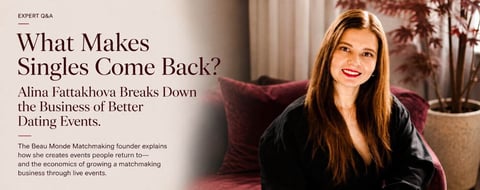


Would you rather send a “like” to a stranger on a dating app, or lock eyes with a stranger across a crowded room? Matchmaker Alina Fattakhova, founder and chief matchmaker of Beau Monde Matchmaking, is betting that modern singles will choose the latter.

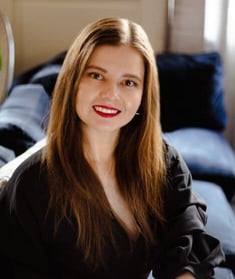
She’s not wrong: A 2025 Hims survey found that 82% of respondents in a relationship met their partners in real life, and not on an app. And with more daters seeking out IRL connections, it’s only natural for matchmakers and other dating professionals to meet this need.
No one knows more about the magic that comes from live events than Fattakhova, who has made it her mission to turn IRL events, like bar hangs and singles mixers, into major matchmaking opportunities. And as the host of many of these events, Fattakhova has a unique perspective on the highs and lows of IRL events.
DatingNews spoke to Fattakhova about how she blends her matchmaking and event hosting skills, how she’s cracked the marketing code, and perhaps most importantly — how she gets people to return.
How to Build Events That Keep People Coming Back
DatingNews: One of the most interesting trends you’ve shared is that more people aren’t just attending [IRL events] — they’re coming back. Why is repeat attendance such an important signal, and what do you think is the key to getting people to return?
Alina Fattakhova: Repeat attendance is one of the clearest signals of trust and satisfaction we get. When someone comes back [to an IRL event] — even after a long pause — it tells us they connected with the feeling of it, they found something worth returning to. The reasons why this is happening now more than ever are swiping exhaustion and craving authenticity.
People step away for all kinds of reasons: some get into relationships and life takes over for a while, some get pulled into work or other priorities, some just need a break. But what I’ve noticed is that even when they’re gone, they don’t let go of the hope of finding their person. And when they’re ready again, they come back to us.
That, to me, is the real marker of success is building something people want to return to. The key is making sure the experience feels like a community: a place where people feel seen, where the vibe is genuine rather than performative, and where showing up again after a long break doesn’t feel like starting over. If we can keep that consistent, people will keep coming back, no matter how long the gap.
DN: How do you keep repeat attendees engaged without making events feel repetitive?
AF: Variety is everything. I keep the experience fresh by deliberately changing venues, formats, and themes so that no two events feel like a rerun of the last one.
I run two distinct lanes. One is more accessible and casual, often hosted on a beautiful rooftop or at a stylish bar, designed to feel effortless and welcoming. The other is more elevated in the sense that we take over private galleries or high-end properties across Manhattan, with tickets that include small bites and drinks, creating an experience that feels intimate and refined.
Format is just as important as venue. We’ve hosted dance events at a dance studio, which brought out a playful, high-energy side of the community, and we’ve celebrated New Year’s together with a full countdown experience. Each format draws out a different kind of connection and energy, so even our most loyal attendees always have something new to look forward to.
DN: How do you measure whether an event was successful? Are you looking at the number of matches made, repeat attendance, signups, or something else?
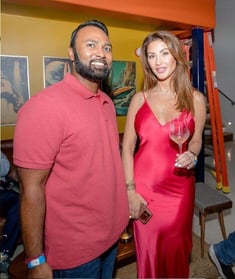
AF: For me, success isn’t measured in headcounts — it’s measured in connections made. I structure the event around small groups and actively encourage people to step outside their comfort zone, to talk to someone they wouldn’t normally approach on their own. I’ll even get on the microphone and remind everyone: you’re welcome to exchange numbers, go on a date, or simply make a friend. I use warm introductions to make people feel comfortable, and it’s a key difference between a standard singles event and what I curate.
What I love hearing afterward is that people actually follow through with what they planned to do with someone they met or were introduced to at one of my events. Attendees go on first dates, some end up in relationships, others walk away with genuine, lasting friendships. And when things don’t work out romantically, that’s not a failure either. When someone comes back to try again, it tells me they still trust the process and still believe something better is out there for them. That trust, that willingness to keep showing up with hope, is the real measure of whether what we’re building actually works.
DN: Have marketing adjustments played a role in the growth of IRL connections, or do you think this is a continuation of trends like dating app fatigue that matchmakers can capitalize on?
AF: A lot of this growth comes down to dating app fatigue finally reaching its breaking point. Some people in their 30s-40s have been swiping for a decade or more, and that kind of prolonged searching wears on you emotionally. It’s exhausting to keep evaluating people through a screen, and we’re seeing the collective result of that exhaustion: people are craving something more human.
That’s where in-person events have a real advantage. In the span of one evening, you can gauge whether someone genuinely sparks your interest without committing to a two-hour dinner date to find out. There’s an efficiency to it, but also an authenticity, since you’re reading real chemistry instead of a curated profile.
What makes events hosted by a matchmaker like myself different, though, is the caliber of the community itself. The people who show up aren’t casually browsing to see what’s out there, I find they’re growth-oriented, intentional, and genuinely committed to finding a long-term partner. That shared mindset changes the entire energy of the room.
Strategic partnerships have also played a real role in our growth. I love collaborating with dating coaches, fellow matchmakers, and matchmaking tech platforms like LEVEL, because each of them brings their own vibrant community into the mix. When those groups blend together, something wonderful happens — matches occur that might never have happened within just one network alone.


Marketing & Growth Strategies Continue to Evolve
DN: Has your marketing strategy changed as interest in in-person dating has grown?
AF: My marketing strategy has evolved right alongside the growing appetite for in-person connection. Rather than relying solely on traditional advertising, I’ve focused on embedding myself within communities that are already engaged and aligned with my audience by partnering with dating coaches, dance studios, and initiatives like Tech Week to reach people organically.
I’ve also leaned into visibility through major cultural moments, showing up alongside brands like South by Southwest in Austin and Art Basel in Miami. This approach is very intentional: a large portion of my clientele comes from the tech and art worlds, so rather than trying to draw them to me, I follow them to where they already are. When my clients travel for these marquee festivals, I make a point of hosting events there too—meeting them in spaces where they’re already present, engaged, and open to new experiences.
DN: How much of your attendance comes from existing matchmaking clients versus people who are completely new to your business? Are your events primarily designed to serve current clients or attract new ones?
AF: The majority of my matchmaking clients attend our events, as events give them access to additional potential matches beyond the curated introductions I make for them individually. Since I intentionally cap my matchmaking client list at ten at a time, this group represents only a fraction of the room. The larger share of attendees is made up of prospective clients exploring whether matchmaking is right for them, along with a loyal following of people who simply love the experience and return event after event. Naturally, we also welcome a steady stream of brand-new faces at every gathering.
Ultimately, my events are designed to serve both goals simultaneously. They deepen the experience for my existing clients by expanding their pool of connections, while also serving as a genuine, low-pressure introduction to my work for those who may become clients down the line. It’s less about choosing one purpose over the other and more about creating a space where both objectives naturally reinforce each other.
DN: What advertising or promotional tactics have consistently delivered the best ROI for driving attendance?
AF: A mix of channels has worked well for us, but if I had to rank them, word of mouth consistently delivers the strongest return by far. There’s an inherent trust that comes with a personal recommendation. When someone hears about the event from a friend or colleague they respect, they show up already feeling comfortable and curious, rather than skeptical.
Online recruiting has also proven valuable, particularly for our existing clients. As we search for potential matches on their behalf, some of those candidates become genuinely curious about the community itself and end up attending an event, even before any formal introduction is made.
Beyond that, Eventbrite has been a significant driver of discovery. It’s a platform used by millions, and a meaningful number of our attendees have found us organically through it. And of course, Meta ads round out the strategy, helping us reach new audiences with more targeted, intentional messaging.
DN: If another matchmaking business wanted to increase repeat attendance specifically, what are the first three things you’d tell them to focus on?
AF: If another matchmaking business wanted to boost repeat attendance, I’d point them toward three fundamentals:
First, invest in an engaging, warm host. People need to feel like there’s someone they can lean on the moment they walk in. Someone who sets the tone, makes introductions easier, and ensures no one feels lost or invisible. That sense of being genuinely welcomed is often what determines whether someone has a good time or simply endures the evening.
Second, create at least one touchpoint before the event itself—a quick email, a short call, or even a personal text. That small gesture builds anticipation and, more importantly, makes attendees feel seen as individuals rather than just another ticket sold.
Third, always follow up with a feedback form after the event. Genuinely listening to what worked and what didn’t shows attendees that their experience matters and gives you the insight needed to keep improving. People are far more likely to return to something that visibly evolves based on their input.

How Events Factor Into A Matchmaking Business Model
DN: How do you think about the economics of your events? Is the goal to generate profit from ticket sales, to break even, or to support other parts of your business? Have live events become a core revenue stream for your matchmaking business?
AF: My core revenue has always come from one-on-one matchmaking work with my clients —that’s the heart of the business. Events serve a different, though equally important, purpose. I think of them less as a standalone profit center and more as a strategic extension of my core work. They attract prospective matchmaking clients, expand the pool of potential matches for the clients I already have, and create meaningful impact for people who may not be able to afford private matchmaking but still deserve access to genuine, curated connections.
Yes, events do generate their own revenue, but I intentionally treat that revenue as offsetting a marketing expense rather than as a primary profit driver. In my mind, the real return isn’t just what happens at the door—it’s the relationships, trust, and visibility that events generate for the business as a whole.
DN: Beyond ticket sales, what business value do your events create? For example, are they helping you grow your client database, generate matchmaking leads, or strengthen relationships with existing clients?
AF: Beyond ticket sales, the real value of my events lies in what they do for the business behind the scenes. Some events only break even financially, and that’s perfectly fine with me, because the return I’m after isn’t purely monetary. Each event works simultaneously toward three goals: growing my client database, generating genuine matchmaking leads, and deepening relationships with the clients I already serve. It also gives me something to talk to my network about through email marketing and social media.
Rather than treating those as separate initiatives requiring separate strategies, I’ve found that a well-designed event accomplishes all three at once. It’s efficient, it’s authentic, and it reinforces the community I’m building rather than just transacting with it.

