


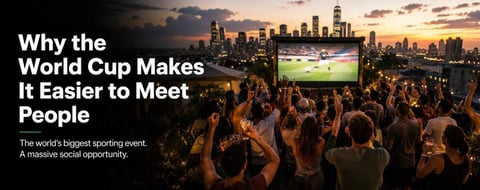


Key Takeaways
- Large cultural events create natural opportunities for connection that dating apps can amplify rather than manufacture.
- The World Cup creates a rare convergence of travel, shared enthusiasm, and social exploration that has historically driven dating app engagement.
- The social power of events like the World Cup lies in their ability to make strangers feel connected to one another in a way dating apps can’t.
- As Gen Z prioritizes organic connection, events that generate collective excitement are becoming increasingly valuable to the dating industry.
The 2026 FIFA World Cup is expected to flood host cities across North America with international tourists, packed sports bars, fan zones, rooftop watch parties, nightlife crowds, and emotionally charged strangers for nearly six weeks straight — all prime opportunities for connection.
And the more I think about it, the more convinced I become that the dating industry has not fully wrapped its head around what that actually means socially.
Most people are focused on the economic impact of the World Cup, but I keep coming back to the human behavior side of it. Specifically, what happens when millions of emotionally energized people from around the world are suddenly dropped into some of the most social, walkable, nightlife-heavy cities on earth at the exact same time?


What you get is a recipe for engagement and growth for dating apps and social media. We’re getting a taste of what this will be like right now as the Knicks compete in the Finals for the first time in nearly 30 years.
Take it from me, someone currently in New York: The energy is palpable. And when passions rise, so, too, does the number of sports fans seeking like-minded connections and memorable interactions.
People Are Willing to Travel for Connections
The idea of “Tinder tourism” itself is not new. Researchers have already documented how travelers increasingly use dating apps to meet locals, explore nightlife, and build social experiences while visiting new cities. What is new is the idea that the people we meet while traveling can become meaningful long-term connections.
OK, maybe all you cruise-lovers out there already knew this. But young daters are only now discovering the bond of a spontaneous travel-based connection.
As international soccer fans descend on host cities, the chance for these types of connections are skyrocketing, which means dating apps’ chance for making connections is also skyrocketing.
As international soccer fans descend on host cities, the chance for these types of connections are skyrocketing, which means dating apps’ chance for making connections is also skyrocketing.
Any event that draws crowds of young people has the potential to be a hotspot for Tinder tourism. Remember Bad Bunny’s month-long residency in Puerto Rico? It was just as much a hotbed for romance as for music, according to Tinder: User activity skyrocketed by 35% in San Juan, and Passport Mode activity increased 52%.
The hype and community support surrounding Bad Bunny was all people needed to connect, no innovation or manufactured chemistry required. Talk about a revelation for Tinder and dating apps everywhere.
The secret to IRL chemistry isn’t AI-generated matchmaking at all, but a shared passion for an artist, a community leader, or, yes — a sporting event.
The World Cup Has Changed Dating App Behavior Before
With the New York/New Jersey region projected to become one of the World Cup’s biggest hubs, dating platforms are at the crux of a rare convergence. Put a huge, beloved sporting event, thousands of international tourists, and the most diverse cities in the world together, and you get massive payoff potential for dating platforms.
After all, we’ve seen this happen with the World Cup before. The 2014 FIFA World Cup brought an estimated 600,000 international visitors to Brazil, which reportedly contributed to a 50% increase in Tinder usage during the tournament.
Tinder has become an essential traveling companion. Some daters practically pack it in their suitcase alongside their tiny shampoo and just-in-case underwear. These tourists go out with the expectation of socialization, meaning it isn’t a matter of if they use dating and friendship apps, but when.
“What we’re hearing from Gen Z is that they want connection to feel more natural, more social, and less like a formal first date,” said Melissa Hobley, Chief Marketing Officer at Tinder, at the app’s inaugural Sparks event. “Events give them something to do together. It takes the pressure off and puts the focus back on shared energy.”


Tinder has evolved to meet this need with its new Events function, which shows daters IRL events near them. And as the World Cup approaches, it will undoubtedly be a key source of connection for thousands of daters on and off Tinder.
Why Does the World Cup Feel So Social?
One of the most interesting concepts I came across while researching this story was something called “collective effervescence” (a term I will now shoehorn into every sentence, thank you very much).
French sociologist Émile Durkheim used it to describe the emotional high people experience during massive shared events like concerts, protests, religious gatherings, and sporting events.
Think about it: Entire bars screaming at the same time. Strangers hugging after goals. People who would never normally speak to each other connecting over their shared passion. It’s what New York City is feeling right now as the Knicks celebrate their victory — can you feel it?
Emotionally shared experiences can increase feelings of social connection, especially when people can physically see one another during the experience.
Research published in Royal Society Open Science found that emotionally shared experiences can increase feelings of social connection, especially when people can physically see one another during the experience.
In these moments, we’re not worried about our frizzy hair, our sweat stains, our awkwardness with new people. The social barriers that keep us from connecting are gone, allowing for authentic interpersonal bonding.


“It is a potent and impactful human phenomenon, and one that we seek to find,” said Cathy Malchiodi, PhD. It’s not only a “sense of energy and harmony we feel when we come together,” but “a homing signal, and internal barometer of well-being and perceived health.”
This homing signal tells us when we’re in an emotionally fulfilling space and when we’re not, making it a vital aspect of modern dating.
Why I Think the Dating Industry Should Be Paying Attention
It’s about time dating platforms see IRL events that fuel collective effervescence, like the World Cup, for what they are: key opportunities for romantic connection. Dr. Malchiodi said that people are actively looking for collective effervescence, and dating apps are uniquely positioned to give it to them.
Whether you realize it or not, this is what you’re looking for when you swipe through dating apps. Good looks are nice, but emotional common ground? That’s the real goldmine.
“[Collective effervescence] is a potent and impactful human phenomenon, and one that we seek to find.” — Cathy Malchiodi, PhD.
Bars, watch parties, fan zones. How can collective effervescence not bubble up in these highly social environments? This isn’t only exciting for dating apps, but for dating professionals who facilitate dating events and meet-ups.
Even with collective effervescence on our side, many of us are not used to socializing in person in our digital-first world. But modern dating, which necessitates in-person interaction, is full of social friction.
Hence the beauty of sporting events like The World Cup, which provide built-in conversation starters, built-in emotion, built-in energy, and built-in group participation.
The dating industry can’t overlook the power of collective effervescence, because it’s a strong indicator of what, exactly, Gen Z daters want in their social lives.
From the perspective of a dating platform or event planner, this means that the hardest part — getting people to take the socialization plunge — is already taken care of.
The dating industry can’t overlook the power of collective effervescence, because it’s a strong indicator of what, exactly, Gen Z daters want in their social lives. The pandemic taught us just how important collective effervescence is to human connection. Now Gen Z is making it clear that they won’t date without it.

