




Key Takeaways
- Users often report that AI companions, although not human, can provide constant availability and non-judgmental listening
- AI can provide companionship during loneliness and may help reduce sadness in the short term. Unfortunately, using AI as a romantic partner can also lower a person’s well-being in the long run.
- AI companions could be used and considered as a category for self-help in the rebound phase before getting back into the real, human dating game.
Did you know that nearly 1 in 5 adults in the U.S. have chatted with an AI romantic companion? Yes, that’s right. The seemingly unattainable fantasy of Spike Jonze’s film “Her” is actually not the stuff of imagination anymore. Except that your AI lover won’t likely be the voice of Scarlett Johansson — I get why he fell in love with her, though. Swoon-worthy.
And whether you would use AI dating companions yourself, the statistics don’t lie. It’s on the rise. Rates are soaring among younger adults with up to 33% of Gen Z turning to their devices — not to swipe on a dating app or DMing their crush on Instagram — but rathe to find solace in their online lover, AKA artificial intelligence.
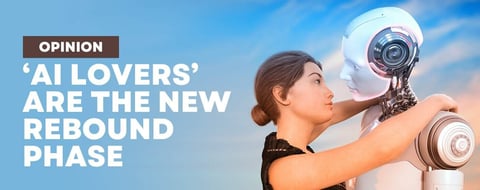
I’d argue that AI isn’t just acting as a replacement lover, either, but even the new rebound phase. Remember that time you fell into the arms of another guy in college after your girlfriend broke up with you? Well, now, instead of turning to an IRL experience, I’d say AI lovers are being viewed as an easier (and even sexually and emotionally safer) rebound option.
But what exactly does that mean for love, healing, and human connection? I’m not sure it can be great.
The Boom of AI Romance
Do you think I’m lying? Well, simply look at the data. AI romance is, for the first time, able to be alive and well.
AI users aren’t just using AI for dating help, either. Many folks who are using it are actually forming emotional and romantic bonds. It seems wild to think about. Americans are falling in love with AI bots, like those on platforms like Replika, Character.AI, and Nomi, which host millions of connections daily.
I mean, when you think about it, 19% of U.S. adults surveyed have used AI to simulate romantic interaction. For those young adults using it, up to 31% of men and 23% of women report interacting with AI romantic partners (but I am sure folks across the gender spectrum have used it, too!).
Oddly enough, even hyperlocal data has been found to support the AI lover boom. In Virginia, for example, 18% of single Virginians said they have actually formed romantic relationships with AI companions. It’s making its way outside of the U.S., too. In Japan, a woman even held a wedding with her AI partner.
So, yeah… It’s a thing. And when it comes to folks turning to AI after breakups, I’d say it’s arguably even more of a thing.
Why People Turn to AI After Breakups
What’s a rebound for if not to help you get over your former lover? But it’s no secret that real relationships can be messy, unhealthy, and hard. Enter: AI lovers as a rebound. If you really think about it, it’s understandable why people are turning to their devices specifically after breakups.
Turning to an AI lover has a certain emotional safety and control that does not exist when you’re eating ice cream from a tub, crying constantly and screaming into the void of breakup TikTok. Users often report that AI companions, although not human, can provide constant availability and non-judgmental listening, which are both super good feelings when healing from a breakup.
And, hey, as someone who recently went through a gut-wrenching WLW breakup, I can understand the appeal.
AI can act as a form of emotional support, too. One study found that users turned to AI for counselling and sex or romance. Seventy-four percent of people surveyed said their AI chatbot was actually a better conversationalist than their last human partner, too. They can talk and they are available whenever you want? I mean, if used after a breakup, did someone say the best rebound ever?
The Pros and Cons of Digital Rebounds
Obviously, everyone has their own views on using AI as a lover, especially folks working in the IRL dating space. But all of this is understandable if you put yourself in the shoes of the recently dumped. So what are the pros and cons of a digital rebound?
Naturally, and more obviously, it can provide companionship during loneliness and may help reduce sadness in the short term. It may even make a user feel seen, understood, and of course, loved. After a breakup, this has to feel amazing. Unlike AI lovers, we’re only human, after all.
But, unfortunately, using AI as a romantic partner can also lower a person’s well-being in the long run, because of increased feelings of isolation. Think about it: If you’re spending all your time confiding in and loving a bot, you’re not getting out into the real world.
Of course, there’s the huge (and relatable, for me!) concern that folks who rely on AI for love and rebounding may weaken their willingness to pursue real, human relationships. Or worse: become a form of addiction.
Is AI a Phase, a Tool, or a Trend That Changes Dating Forever?
So when it comes down to it, is using an AI lover as a rebound a phase, a tool for folks to move on with their lives, or a trend that will forever change dating as we know it?
Well, I think if it’s just in the rebound phase, rather than a long-term attachment, then it can be counted as a true tool. It can even be argued that for singles and those of us in the dating industry (yes, I’m looking at you, reader,) AI companions could be used and considered as a category for self-help in the rebound phase before getting back into the real dating game.
Key word? Before getting back on the IRL, human playing field. There’s even a world where AI can be used alongside human dating, and not just instead of it, which is probably much healthier for us all. I don’t think only having AI companions in the romance department is in anyone’s best interest.
In my humble opinion, using AI companions definitely fills a difficult, brief period of time with a soft landing. But maybe it should only be that: brief.

