




Key Takeaways
- While sharing conspiracy theories can make daters seem more “unique,” that same uniqueness carries social stigma that pushes theorists onto niche apps.
- The study found that theories were perceived as less trustworthy, kind, intelligent, and respectable on dating apps.
- Rapid judgment on dating apps makes even subtle profile cues, like political tags and vaccination status, powerful compatibility signals.
Putting “flat-earth truther” in one’s dating profile narrows the dating pool considerably — but is this really a bad thing?
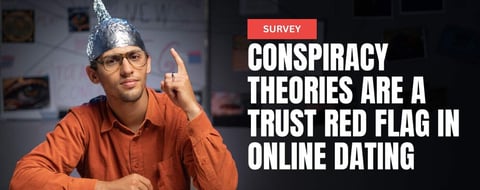
A new study from Personality and Social Psychology Bulletin found that people who post about conspiracy theories on major dating apps are less likely to make meaningful matches.
But in typical “truther” form, these daters tend to seek like-minded connections on their own dating apps, creating a niche market of conspiracy-infused dating platforms.

Researcher Ricky Green from the School of Psychology at the University of Kent didn’t only analyze whether posting conspiracy theories on dating apps attracted or repelled online daters. They also looked into how these theories affected the poster’s perceived trustworthiness, kindness, intelligence, and respectability.
“People reported lower relationship satisfaction with friends and family members who were perceived to believe in conspiracy theories, versus those who were not,” the researchers pointed out. And when it comes to picking out a long-term partner, singles are even more discerning.
There’s a Niche Market for “Unique” Theorists
People who believe in conspiracy theories are considered “more unique” than those who either don’t believe in conspiracies or who don’t mention them on their dating profile, according to the study:
“Standing out from the crowd is usually considered a desirable quality in a mating context, which could suggest a positive function for sharing such conspiracy beliefs in the online dating context,” the researchers posited.
Tinder, Hinge, and even Bumble see their fair share of lonely right-wing, anti-vax flat-earthers who certainly stand out — and often end up standing alone.
As the researchers put it: “Because conspiracy believers are often perceived to violate social norms, sharing such beliefs not only undermines positive impressions but also carries elements of social stigma.”
When up against stigma, people seek community.
And when up against stigma, people seek community. Conspiracy theorists looking for like-minded or judgement-free love have found community — and a niche dating market — in Awake Dating, The Right Stuff (a conservative dating app known for attracting conspiracy theorists), and, if in Germany, the app Schwurbeltreff.
But these apps all have the same problem: Lots of men, not enough women. This poses a significant obstacle for conspiracy-led dating apps, especially since men are more likely to believe in certain conspiracy theories than women, according to a 2020 study published in Cambridge University Press.
Singles Don’t Always Trust Conspiracy Theorists
Generally speaking, posting a conspiracy theory on a dating profile probably isn’t the way to get matches. A majority of respondents said profiles featuring conspiracy theories were less trustworthy and less honest, not to mention less sociable, intelligent, kind, friendly, and respected.
Matchmaker Michal Naisteter put it simply to DatingNews: “You attract bees with honey, not vinegar,” she said. “Dating profiles are not a space to put theories or anything negative or anything that projects fear.”
It all comes down to dating apps providing clarity and safety. Most daters want to know if someone believes in, say, anti-vax conspiracy theories at the beginning of the matchmaking process, rather than when they’re face-to-face on an IRL date, or worse — deciding whether or not to have kids.
You attract bees with honey, not vinegar.
“This is the sort of thing I hope to weed out before meeting someone IRL,” u/izzo1717 said on Reddit. As the study confirmed, daters are concerned that one’s belief in conspiracy theories reveals dark personality traits. A user named u/Caroline_Bintley shared their own story:
“A couple years ago I connected with someone who revealed he believed in conspiracy theories on the first date. By the second date, that sense of paranoia and mistrust quickly spilled over into his dealings with me,” they said. “Would NOT recommend.”
Another study by Kamitz et al. found disparate satisfaction levels between couples when one person believes in conspiracies and the other does not. The disbelieving partner usually reports more frequent conflict and less intimacy and trust.
Daters Want Easy Ways To Weed Each Other Out
Since dating apps are essentially judgment machines, singles have taken to crafting foolproof profiles to boost their chances of a high-quality match. “Because first impressions are important in this context, even seemingly minor cues can have a significant impact,” the researchers said.
And this impact can go both ways. Mainstream apps Hinge, Tinder, Bumble, and OkCupid allow users to indicate vaccination status and political beliefs on their profiles. These apps didn’t introduce these features solely to distinguish vaxxers from anti-vaxxers, but there’s no question that this has been an effect.
Alina Fattakhova, founder of Beau Monde Matchmaking, told DatingNews that conspiracy theorists are “not able to identify which of the matches are supporting their theories.” Apps that make it difficult for people to signal their beliefs from the beginning of the matchmaking process may end up with a retention issue.
Even seemingly minor cues can have a significant impact.
“That’s when [users] come to a matchmaker,” she said. “Or, I can definitely see why they would go to a certain niche dating app.”
Judging by the study, modern singles are open to disclosing their true feelings about certain conspiracy theories on dating apps (even if the extent of their opinion is, “I don’t believe in conspiracy theories”) in the form of tags, filters, and other identifiers.
If this study proves anything, it’s that even something as “seemingly minor” as the word “snowflake” can be the difference between a left swipe and a right swipe on a dating app.
In the end, theorists and non-theorists alike are on the apps, and they’re all looking closely at each other’s profiles for signs of like-minded connection.

