


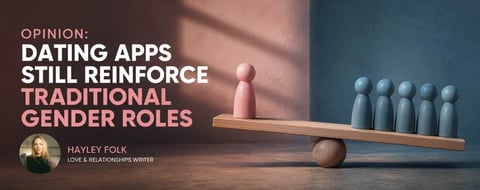


Listen, it’s no secret that dating apps (especially to you) have marketed themselves as the future of love. Whether someone joins the niche Farmersonly.com or the most well-known and salacious Tinder, they all sell algorithmic matchmaking and many, many choices under the guise that it’s better than the traditional way of dating. But what if I told you that many platforms still rely on something much older and traditional? It’s called gender roles.

And yes, they are still alive and well. Even in how folks interact on apps. According to the Pew Research Center’s online dating survey, men are still more likely than women to pay for dating app features, with 41 percent of men versus 29 percent of women. Additionally, and maybe unsurprisingly, higher-income users (mostly men) are significantly more likely to spend money on platforms than lower-income users.
What’s more? 57 percent of male users say they don’t receive enough messages, while women are five times more likely than men to say they receive too many.
So yeah, gender roles are alive and well. While many dating apps claim to be super cool and inclusive, the majority are just spinning the same social scripts we all know (and don’t love). Men pursue, women choose, attractiveness equals value, and traditional desirability wins?
Why Men Pay More for Dating Apps Than Women
Whether admittedly or not, apps often frame themselves as true disruptors, but that’s just not often the case. They’re just pinning the same gender stereotypes over and over again.
“For example, monetization is heavily aimed at men rather than women, as they are traditionally the initiators,” Augusto Blanco, a men’s psychologist who specializes in gender studies, tells Dating News, “So access to matching with women is often restricted behind paywalls.”
Source: Pew Research Center
Apps often assume that men will pay because men are expected to pursue. On the other hand, though, women are positioned as the “desired” side of the marketplace. I know, for myself, that I can definitely relate.
My husband and I are polyamoroys and both on many different dating apps. He pays monthly for using each app — which is hundreds of dollars when you add it all up — and I pay nothing. In the end, I get hundreds of more matches, and he, if in a good month, gets maybe three.
That, my friends, is all because of how apps spin traditional gender roles and treat folks. What is this, the 1950s?!
Dating App Algorithms Reward Traditional Beauty Standards
Pretty faces get you places. Or at least that’s how apps seem to game their system. I don’t agree with it; everyone should have their fair chance at a match or going on a date. Anything else is perpetuating even more stereotypes and gender norms.
“Apps are heavily based on first impressions and even have an algorithm that scores profiles, so the tendency is that hegemonic-looking profiles are pushed to the front and receive plenty of attention,” Blanco shares.
Often, submissive-looking women, young women, and especially feminine-looking women are pushed to the top, just like tall-looking, very fit, financially successful men.
“Profiles displaying privileged traits fare much better [with dating app algorithms].” -Augusto Blanco
While apps may say they’re matching compatibility, their not-so-secret visual-first system is speaking directly to societal and gender norms of attractiveness and status.
“Profiles displaying privileged traits fare much better too,” Blanco adds, “Those that look white, Caucasian, middle class or higher, hegemonic body type and facial features.”
The algorithm isn’t just sorting faces, either. It may also be sorting people according to social (and gender) privilege. Which, let’s face it, sucks.
Why Dating Apps Can Be Harder for LGBTQ+ and Nontraditional Relationships
So if traditional dating scripts are being used, what about those who don’t fit into the script at all? I’m talking about my fellow LGBTQ+ community, those who identify as non-binary, polyamorous (hey, that’s me!) or gender-nonconforming daters,
For queer users, gender-diverse daters, and polyamorous communities, many existing dating platforms force people into predefined relationship structures and identity categories. Which often just doesn’t align or feel inclusive. Not to mention that LGBTQ+ users are far more likely than straight users to experience unwanted sexual content and harassment on apps.
LGBTQ+ users are far more likely than straight users to experience unwanted sexual content and harassment on apps.
In terms of gender roles, though, apps even point to other traditional gender roles, too. Like how men are often socialized to be hyper sexual, whereas women are raised to be puritanical and discreet. Apps like Grindr aim at their traditionally ‘hyper-sexual’ gay male audience, even. And while that works for some folks, it doesn’t for every gay male.
As someone in ethical non-monogamy, even I’ve seen firsthand how platforms build around conventional dating assumptions. While we are trying to date and live how we want to, apps often struggle to make room for other genders and relationship dynamics.
“They are selling engagement, like any other social app out there,” Augusto explains, “Whatever makes you engage the most is what they are going to prioritize. Currently, unachievable fantasies are more engaging than approachable reality.”
What Would Dating Apps Look Like Without Traditional Gender Roles?
Soooo… can dating apps look any other way? Yes, I’d hope so. But it starts with asking the right questions.
What if apps rewarded compatibility over aesthetics? What if profiles prioritized communication styles instead of that guy’s height? What if initiation wasn’t gendered? What if apps stopped assuming everyone wants the same version of love?
I mean, hello, it seems obvious. But apparently it’s so not. The truth is, the dating industry loves to call itself revolutionary, but it’s not always. If it’s still pushing men to pay with little luck, women to be bombarded by men, and no one is really even engaging on the app at all, then what’s the point?
Maybe, just maybe, try evolving beyond traditional gender roles and embrace the now. It’s 2026 after all.

