




Key Takeaways
- The latest Hinge D.A.T.E. report suggests LGBTQIA+ daters are seeking clarity over chemistry in an uncertain world.
- Hinge's research suggests that true compatibility starts with clarity, not chemistry, which explains why 52% said they prefer slowing down early in a relationship.
- LGBTQIA+ daters are prioritizing emotional safety and long-term potential over rushed romance.
- Feeling emotionally desired is a key driver of long-term interest for a whopping 95% of Hinge’s survey respondents.
- An emphasis on emotional fluency is pushing dating platforms to rethink how they build connection, with users craving emotional discovery over algorithmic matching.
- The lack of dating “scripts” is making communication and consistency clear compatibility markers for LGBTQIA+ daters.
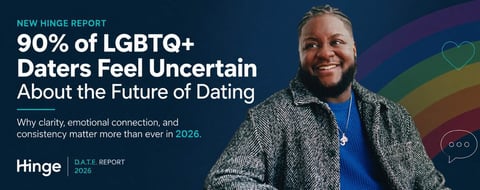
LGBTQ+ daters are entering 2026 with a growing sense of uncertainty about both the world around them and their romantic futures, according to a new report from Hinge.
The dating app’s latest LGBTQIA+ D.A.T.E. Report surveyed more than 31,000 people and found that 76% of those LGBTQ+ daters say uncertainty has affected their dating lives. The feeling is especially pronounced among trans and non-binary daters, 90% of whom reported heightened uncertainty, along with 81% of LGBTQ+ women.
But the report also suggests that uncertainty is reshaping dating priorities. Rather than pursuing instant chemistry or casual connections, many LGBTQ+ singles are placing greater value on clarity, emotional consistency, and long-term compatibility.
DatingNews spoke to Moe Ari Brown, Hinge’s Love & Connection expert and co-author of the report, who said the shift reflects a broader move away from chasing sparks and toward building stable, emotionally fulfilling relationships.
Trans and Non-Binary Daters Who Feel Uncertain About the World
Source: Hinge Labs
Obviously, the reality is far from simple. Chemistry isn’t always the instantaneous sign of a perfect relationship, so Hinge is finding value in another c-word: clarity. And according to Brown, the search for clarity, and for the emotional fulfillment that follows, is what defines LGBTQIA+ dating right now.
This community, which we so often associate with bold self-expression and joyous self-love, has a tender side that carries just as much emotional weight. According to Brown, “quiet, consistent actions” that convey curiosity and interest are what modern LGBTQIA+ daters want most of all.
Why LGBTQ+ Daters Are Slowing Down Their Search for Relationships
“We are taught to believe that the bigger the spark, the better the connection, but this isn’t really how relationships work in everyday practice,” Brown told us. Real chemistry usually “isn’t stable on its own,” a lesson most of us have had to learn the hard way. “The feeling was there. The foundation wasn’t,” Brown put it.
Fifty-two percent of those surveyed say they are choosing to slow down and find relationships that align with their needs rather than jump head-first into something uncertain.
Clarity can help build the foundation we need for successful relationships. Seventy-four percent of LGBTQIA+ respondents to Hinge’s survey report said that the upside to uncertainty is that it makes it easier for us to figure out what we want and what we don’t want.
“LGBTQIA+ Hinge daters aren’t waiting to feel something before they decide what they want,” Brown explained. “Instead, they are getting clear first, and that clarity is what lays the foundation for a quality connection.”


Waiting for clarity instead of “chasing a spark,” as Brown says, may sound like a downgrade. But Hinge’s survey respondents say that waiting for clarity provides a level of stability and satisfaction they wouldn’t have had if they’d simply followed their hormones.
Specifically, 52% are choosing to slow down and find relationships that align with their needs rather than jump head-first into something uncertain. For these daters, true compatibility is born from alignment, not from chemistry.
76% of LGBTQ+ Daters Prefer Building Connections at Their Own Pace
Seventy-six percent of LGBTQIA+ daters surveyed by Hinge said they’d rather focus on building a connection with someone, timeline be damned, than rush chemistry or clarity. Eighty-three percent of bisexual daters feel the same way, a marked increase from 64% of straight daters.
I recently covered the oft-discussed 90-day relationship timeline, and made an interesting discovery: Modern dating experts are far less likely to put a number on relationship success these days.
This includes the dating experts at Hinge. Brown explained how modern LGBTQIA+ daters are embracing a “show, don’t tell” approach to the early days of a relationship. Instead of forcing milestones, daters are “watching how someone actually shows up.”
Daters' Preference for Connection Over Timelines
Source: Hinge Labs
It makes sense that today’s daters, especially those in the LGBTQIA+ community, are seeking out safe, aligned connections with long-term potential. When faced with political and social uncertainty — you know, the kind that targets your very existence — anyone would crave emotional stability and consistency.
“Queer love requires more than the courage to choose a person,” Brown wrote in Hinge’s report. “It requires the courage to author a version of the future that most of us never saw growing up.”
95% Say Feeling Emotionally Desired Increases Long-Term Relationship Interest
We all know that communication leads to clarity, but Hinge learned that communication also helps people feel emotionally desired.
When it comes to communication, the numbers are huge: 89% of respondents feel emotionally desired when their new partner is curious about their life; 85% feel the same way when a partner deliberately makes time for them. And for 79% of respondents, all it takes is a considerate check-in text between dates to make them feel warm and fuzzy.
All it takes is a check-in text between dates for 79% of respondents to feel emotionally desired.
For Brown, the most stand-out statistic to come from the study was the near-universal majority of respondents — 95% — who say that feeling emotionally desired makes them more interested in taking a relationship long-term.
“The reason this matters is that so much of modern dating culture is still organized around compatibility checklists that focus on determining whether someone meets the criteria before deciding whether you feel anything,” Brown told us.
Profile prompts and icebreaker questions have their place in the early stages of getting to know someone, but it’s important for both platforms and daters to remember that real discovery — and real value — comes from throwing the rule book out the window.
“Emotional fluency, the ability to recognize what you’re actually feeling, name it, and move toward it, is the skill that changes dating outcomes.” — Moe Ari Brown
This 95% isn’t a fluke. It is a clear message from thousands of LGBTQIA+ daters: Platforms and dating professionals that put users’ emotional needs first get right to the heart of what modern daters are looking for from relationships.
“What that data point confirms for me is something I’ve been sitting with in my clinical work for a while,” Brown said. “Emotional fluency, the ability to recognize what you’re actually feeling, name it, and move toward it, is the skill that changes dating outcomes.”
What these Findings Mean for Dating Apps
If all daters are searching for positive dating outcomes, then this revelation about emotional fluency has the power to change dating platforms’ matchmaking strategies as a whole.
It’s no longer about instant chemistry or profile checklists, but about facilitating the type of communication that leads to emotional fulfillment.
Or, as Hinge’s report puts it, modern LGBTQIA+ dating is less about PDA and more about PDC — private displays of consistency, such as thoughtful nightly texts or repeated attempts to learn more about you. The more they learn, the more clarity they can achieve.
“What I expect to see is more people getting precise about what they actually mean when they say it,” Brown explained. In this way, the future of LGBTQIA+ dating is as much about discovery as it is about clarity: Discovery of what you want, what you need, and the best way to express both to your partner.


Why LGBTQ+ Daters Are Creating Their Own Relationship Playbook
And Brown says this trend is consistent across the LGBTQIA+ spectrum. “For LGBTQIA+ daters especially, who are navigating connection without a lot of inherited scripts to fall back on, the ability to actually communicate that kind of desire … is what I’d call the most underrated skill of modern dating, and the data just confirmed it.”
The ability to actually communicate [emotional] desire … is what I’d call the most underrated skill of modern dating, and the data just confirmed it.” — Moe Ari Brown
But this is only half the story. Brown explained how an ongoing frustration point among LGBTQIA+ daters is finally knowing that they want emotional availability, but not knowing how to actually identify it.
This reminds me of what Brown said earlier about inherited scripts, and how many in the LGBTQIA+ community are operating without a reference point.
Brown doubled down on this point, too: “When you’re building a connection without a default script, you need more than good intentions from a partner.” This is what makes the rise of so-called PDC so important.
It proves that LGBTQIA+ daters are making repeated, consistent efforts to connect on an emotional level. And this effort carries far more weight than surface-level attraction or a single swipe ever could.

