




Key Takeaways
- According to Taimi, nearly half of nonbinary daters don't consistently feel represented on dating apps, suggesting that inclusion requires far more than expanded gender options.
- Inclusive dating apps don't just acknowledge nonbinary identities — they build products that make sharing them feel safe, from onboarding to messages and beyond.
- A truly inclusive dating app doesn't just prioritize visibility, but makes nonbinary daters feel respected, understood, and safe.
- The best way to support nonbinary daters isn't necessarily through education, but through product features that foster more informed, compatible matches.
- The most meaningful innovation for nonbinary daters begins with the people designing, moderating, and supporting the platform.
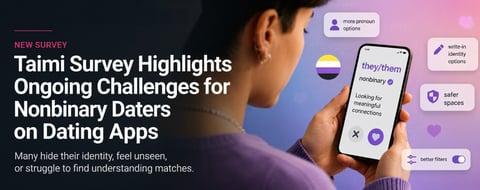
More than half of nonbinary daters surveyed by LGBTQ+ dating app Taimi say they’ve hidden or downplayed their gender identity while using dating apps because they feared how potential matches would respond.
The findings suggest that despite broader efforts toward LGBTQ+ inclusion, many dating platforms still struggle to create experiences where nonbinary users feel represented, understood, and safe.
Taimi spoke to nonbinary users and to Gender & Sexuality expert Edward Reese about how modern apps can not only adapt to new identities, but remain a welcoming place for all daters, regardless of how they identify.
45% of nonbinary survey respondents told the LGBTQ+ dating app they only “sometimes” feel represented on dating apps, while nearly one-third say they rarely feel represented at all. Hidden within this “sometimes” is a population of daters who don’t feel comfortable engaging with apps, and even with other non-cis singles.
Thirty-one percent say they only “rarely” feel represented on apps.
This problem goes far behind antiquated onboarding and profile options. Nonbinary users make up a significant portion of the online dating community. For these daters, a sense of belonging isn’t just a nice bonus — it’s necessary for true engagement.
Only 5% of nonbinary respondents feel represented by dating apps.
There might be a small voice in your head saying, “Surely this is happening on a relatively small scale.” Think again, tiny voice.
A 2022 Pew Research study found that 3% of 10,188 young adults under 30 identify as nonbinary. That actually equates to over 300 people, many of whom are looking for more expansive and meaningful representation on dating apps.
Are Nonbinary Daters Comfortable on Dating Apps?
More than 50% of nonbinary daters surveyed by Taimi say they have hidden or downplayed their gender identity out of fear of how online matches will respond.
After all, 38% say they disclose their gender identity as early as possible during the talking stage, typically before they meet their date in person. For these daters, romance begins with a quickly beating heart — and not necessarily in a good way. The thrill of new love is overcome by the fear of rejection, derision, and even violence.
Because disclosing a nonbinary identity can be both vulnerable and nerve-racking, it’s also one of the clearest opportunities for dating apps to demonstrate thoughtful, inclusive product design.
The best and simplest way to innovate for NB daters is to provide write-in identity, pronoun, and filtering options. Those drop-down lists that only allow users to pick “male”, “female”, and “other” are not only reductive, but demeaning in a way that hurts everyone — the user, and the dating app.
How Often Do You Feel Your Identity is Genuinely Represented By Dating Apps?
Source: Taimi
“Add custom gender and preferred pronouns rather than a rigid selection screen,” one survey respondent said. They were far from the only ones. “Bodies and brains are often a spectrum that don’t fit into only two boxes. We exist out there,” another user said.
For many nonbinary users, the “best possible experience” can only begin with options: Different ways to define “nonbinary” on an app and/or ways to specify or broaden sexual and gender identities, for example.
Taimi gives users 12 pronoun options to choose from, which includes pairs (He/They, etc) and the all-encompassing phrase, “Ask me.”
Reese went a step further, telling DatingNews that the difference between surface-level acknowledgement and authentic inclusion is nuance. “Adding a pronoun field is not enough,” they said. “nonbinary users mustn’t choose to be shown as ‘one of the two’.”
Platforms can market themselves as “inclusive,” but if they don’t have the infrastructure to back it up, then this “illusion of inclusivity,” as Reese put it, will inevitably shatter.
“Meaningful inclusion means the identity propagates — it shapes who you’re matched with, how you’re addressed, what content/safety rules apply, and it’s never silently overridden by a legacy binary assumption somewhere downstream,” Roman Kalynchuk, Taimi’s Product Team Lead, told DatingNews.
Real support looks like vocal advocacy, profile visibility, safety tools, and disclosure assistance, to name just a few. “Adding a dropdown is cheap; making every recommendation, notification and safety check honor it is the actual work,” Kalynchuk added.
Just How Bad is the Dating Industry’s Inclusion Problem?
When 65% of surveyed nonbinary daters feel the need to hide who they are while in queer spaces, then we know thehas an inclusion problem.
According to Taimi’s survey, 43% of NB daters say it’s difficult to find both attraction and understanding in a partner. According to Taimi, this is largely because 44% of respondents say they live “somewhere in between” inclusion and exclusion, acceptance and rejection.
Sometimes, this “in between” state is actually a fantasy state, where the nonbinary dater is relegated to being a mere figment of desire, and not a real person. This may sound almost complimentary — who doesn’t want to be someone’s idea of a fantasy come to life? — but the reality is often much more complicated.
44% of respondents say they live “somewhere in between” inclusion and exclusion, acceptance and rejection.
Being someone’s “fantasy” or fetish actually has very little to do with you, but about what you represent to that particular person. It’s the ultimate minimization. “I’m fetishized and dehumanized as a trans man,” one survey respondent told Taimi.
Another respondent emphasized that their identity isn’t “a fetish, kink, or some sort of sexual fantasy.”
When asked what the hardest part of dating is to them, another NB respondent said, “Chasers and people who only want to date you BECAUSE of your identity rather than your character.”
A consensual fantasy scenario is one thing; a one-sided fantasy that objectifies the other person’s experience is another.
Making your platform a more inclusive and welcoming place depends on how much control you give users to define themselves — and whether you give them the power to hit the brakes on matches that start to feel more exploitative than romantic.
“Honoring a viewer’s filters while not making someone invisible or misrepresented is a real tension,” Kalynchuk explained. “Filters must be preference-based, never a mechanism to erase an identity from the pool.”
Users don’t only want platforms to adapt to their identity, but to the identities they’re attracted to. As Kalynchuk put it: “You need separate ‘who I am’ and ‘who I’m looking for’ signals, and the matcher must respect both directions symmetrically.”
Should Apps Educate Cis Daters About Nonbinary Identities?
40% of nonbinary daters say they “very rarely” come across someone who shares their identity, and only two percent “often” meet people with their identity IRL. This makes IRL meet-cutes, which are a tall order for anyone, even harder to achieve.
It doesn’t help that some nonbinary daters feel just as invisible within the LGBTQ+ community as they do outside. Despite being characterized as a safe space for all non-straight, non-cis identities, 27% of respondents said they often feel relegated to a “footnote” in the LGBTQ+ community.
“I don’t want to constantly have to explain who I am,” one Taimi respondent said. “I’m so so SO tired of it. Use a search engine, I’m not your encyclopedia!” -Taimi survey respondent
This means that nonbinary daters tend to do more heavy-lifting than cis daters on the apps. Just as there’s a gap between inclusion and exclusion, there’s also a gap between understanding and ignorance.
“I don’t want to constantly have to explain who I am,” one Taimi respondent said. “I’m so so SO tired of it. Use a search engine, I’m not your encyclopedia!” Another respondent said that “having to give 101-level crash courses on my identity” is the hardest part of online dating as a NB person.
This doesn’t mean that platforms have to create an “identity index” or something, but platforms should make connecting nonbinary daters with likeminded people easier than it currently is.
Inclusion Begins With The App’s Creators
The root of all these issues is ignorance at the highest level. In other words, the people behind the scenes at these apps aren’t always as knowledgeable about modern identities as they should be.
We’ve seen a vast improvement recently — US-based legacy apps like Tinder, Bumble, and Hinge all offer many pronoun, gender, and sexual identity options — but some apps are still living in a different time.
Facebook Dating, for example, only allows users to choose from “man,” “woman,” and “nonbinary,” with a “let me be more specific” prompt leading users to identify themselves solely as cis man/woman or trans man/woman. And in some countries, even apps like Tinder are still restricted to “man”, “woman,” and “nonbinary” options.
“The whole team behind the app must be educated about LGBTQ+ identities, especially those who communicate with users directly, like Support and Moderation teams.” -Edward Reese
Of course, as I said earlier, expanded identification options is really just the first step to becoming a trusted space for nonbinary users. For Taimi, it’s just as important to go to the source. “We have reached out to GLAAD for consultations to create the best possible experiences for our users,” Reese told us.
In fact, Reese said nonbinary representation doesn’t start with the user, but with the people creating the app itself, requiring education across product, moderation, and support teams. “The whole team behind the app must be educated about LGBTQ+ identities, especially those who communicate with users directly, like Support and Moderation teams,” they explained.
As dating platforms continue expanding gender and pronoun options, the survey suggests many nonbinary users are still looking for experiences that go beyond visibility and toward genuine inclusion.
“I don’t fit ‘boy’ and I don’t fit ‘girl’, I am just somewhere in between,” one person told Taimi. “I’m still just a normal human.”
Taimi shared the findings of a proprietary survey with DatingNews. The survey included 600 self-selected single respondents. The company provided summary findings and respondent quotes but did not publicly release the full survey methodology.

