




Key Takeaways
- By putting 18 personality assessments into one platform, EQIQ addresses the dating industry's need for more comprehensive compatibility insights.
- Despite their insights, personality tests struggle to account for the real-life experiences and emotional nuance that shape how people love and connect.
- Limitations aside, personality tests are valuable in the dating industry for helping people better understand themselves and express their relationship needs.
- EQIQ enters an industry divided on personality tests, which remain popular despite ongoing skepticism about their accuracy and predictive value.
I’m an Enneagram 6, so naturally, I’m going to die alone. Or am I? EQIQs’ new Relationship and Team Intelligence Platform is designed to combine more than a dozen personality tests into a single self-discovery tool. With it, daters like me can gain insight into our relationship needs.
But there’s a vital caveat to remember: Insights and outcomes are not the same things.
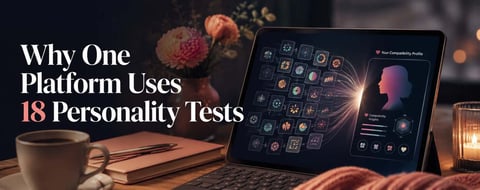
EQIQs’ platform generates interactive reports that compile results from 18 assessments such as Myers-Briggs, Enneagram, and the Big Five, alongside compatibility scores and relationship insights. As someone with a thirst for self-improvement, this is music to my ears. Dating experts, however, aren’t as convinced.
Some matchmakers see personality tests as helpful tools; others think they’re about as illuminating as a game of MASH. Like most matters of the heart, this issue isn’t black and white.
Yes, EQIQs’ platform certainly eliminates friction and makes personality testing easier from a logistical standpoint. But the real question is whether personality testing is useful enough for dating pros to even want a comprehensive space like EQIQs’ Relationship and Team Intelligence Platform.
How EQIQs’ Personality Platform Works
Do you know how it feels to be truly seen? You know what I’m talking about; that warm, fuzzy feeling in the pit of your stomach when someone just gets it. This is the feeling that personality tests capitalize on. And EQIQs argues that this warm, fuzzy feeling is a necessary part of the matchmaking process — and even a part worth paying for.
EQIQs’ Relationship and Team Intelligence Platform’s founder, Jessica Baker, describes it as a solution to a longstanding problem: personality tests that reveal only part of a person’s identity. “Most personality tools give you one lens,” Baker said. “Real relationships are complex — you need 18.”
By consolidating 18 different personality tests into a single experience, EQIQs makes it clear that self-understanding is a vital prerequisite for long-term love. Think of it as a box of crayons. If you want to create the most vibrant, dimensional picture possible, you’ll have to use every crayon in the box.
“Most personality tools give you one lens … Real relationships are complex — you need 18.” -Jessica Baker, EQIQs Founder
Daters’ list of demands for dating platforms are starting to rival CVS receipts. But their top priorities haven’t changed: They want authentic interactions and frictionless matching. Oh, and positive outcomes, of course. You can’t get any of these things without first understanding what you want from a partner.
Swipes, prompt responses, icebreakers, profile photos; users say that these classic elements of modern dating no longer signal compatibility in the way they once did. Now, they don’t only want to choose a nice profile pic. They want to understand why this pic will better convey their needs than that pic.
EQIQs claims it can fulfill this need for self-knowledge while providing a frictionless and meaningful experience. This is why it markets to diverse groups, including matchmakers, coaches, recruiters, therapists, and dating apps.
The Limits of Personality Tests in Dating
Learning that you’re an extrovert or an introvert is fine and dandy until you’re sitting across from your date, pushing your salad around with your fork and struggling to connect about anything, literally anything, else.
Personality assessments may be written by real people, but they can’t account for the entire human experience (nor would I expect them to). In fact, no quiz or test can understand the nuance of what it means to be human, and what it means to love, and how often our experiences with love are shaped by very human, but very traumatic, events.
It’s like Mõttus said: Human behavior is highly complex. So complex, in fact, that assessment results can vary depending on the test used, the respondent’s mood, or even who is doing the rating.
Imagine, for a moment, the lingering grief following a parent’s divorce, or the self-doubt that comes with a betrayal. These are compatibility-shaping events, and yet, these tests can’t possibility know about them. So how can we trust them to gauge who we’re most compatible with?
This is partly why psychologist René Mõttus, Ph.D., has argued that personality testing should be viewed with caution. “The accuracy of personality testing is not comparable to measurement accuracy in hard science,” he wrote in Psychology Today.
In other words, personality testing is not as reliable as 2+2=4. Just because your parents got divorced does not mean you’ll get divorced. But it doesn’t not mean that, either. Maybe you were traumatized by it; maybe you weren’t.
“To get a more accurate picture of your traits, it is a good idea to take a test twice or take multiple tests, and see where the results agree.” -René Mõttus, Ph.D
Regardless, a personality test doesn’t usually have this kind of insight. It depends on your own self-awareness, which is a famously unreliable metric. I know, I know; it’s annoying, but true.
It’s like Mõttus said: Human behavior is highly complex. So complex, in fact, that assessment results can vary depending on the test used, the respondent’s mood, or even who is doing the rating.
It seems to me that all the innovations in the world can’t replace a human’s instinct for compatibility. Believe me when I say that this industry has tried. I’m a proponent for human-led matchmaking any day, but my lazy lizard brain is still disappointed that personality assessments can only provide clues, and can’t predict romantic success. Bummer.
Why the Dating Industry Still Values Personality Testing
A dating profile provides as accurate a glimpse into someone’s real life as a gas station mirror. And yet, personality tests remain popular, mainly because they can help users better understand themselves and communicate their needs. Consider, for a moment, a regional map.
When you look at a map of Canada, you know you’re not looking at a map of the entire world. But you are able to learn a lot about Canada, which is still valuable knowledge, so long as you recognize that Canada’s characteristics are not representative of the rest of the world.
But what if you were to look not only at Canada, but the entirety of North America? This would definitely teach you about a greater swath of the world. Maybe Mõttus is right: the more tests you take, the clearer the picture of your personality.
EQIQs’ platform not only consolidates personality tests, but makes them available to the average person, sparking newfound self-awareness as a result.
“To get a more accurate picture of your traits, it is a good idea to take a test twice or take multiple tests, and see where the results agree,” he wrote. “If you keep getting the same result, it probably is trustworthy.”
This is exactly what EQIQs is going for. Rather than asking users to choose between Myers-Briggs, Enneagram, or the Big Five, the company attempts to put them into a single convenient system. I can only assume that patterns appearing across multiple frameworks may paint a fuller picture than any individual assessment can provide.
For matchmakers and dating coaches, this may be where personality testing has the most value. EQIQs’ platform not only consolidates personality tests, but makes them available to the average person, sparking newfound self-awareness as a result.
The Future of Personality Testing in Dating
Whether EQIQs’ approach will be a success is anybody’s guess. Personality assessments are particularly controversial nowadays, and you’re just as likely to find a matchmaker who consults the stars as one who solely consults their own expertise.
If you’ve ever had a hankerin’ for a “Which Type of Bread Are You?” BuzzFeed quiz, then you probably understand the allure of even the wackiest personality quizzes. There’s something fascinating about the idea that someone, somewhere, can type up ten questions and see into your soul as a result.
Some scientists consider the human personality to be as mysterious and unexplored as the ocean floor, making personality assessments that promise self-understanding not only misleading, but downright dangerous.
Of course, real personality assessments are more complicated than this. Some are born from boredom, but others, like Myers-Briggs, are a unique combination of psychology, philosophy, and sociology, and created by people with scientific backgrounds. And yet, many of these tests still garner their share of raised eyebrows.
I can understand why. Some scientists consider the human personality to be as mysterious and unexplored as the ocean floor, making personality assessments that promise self-understanding not only misleading, but downright dangerous.
But I would argue that responsible self-learning is important, and not only for daters, but for everyone. Understanding a fraction of your personality is better than not understanding any of it at all.
I like to think of personality tests like those compiled by EQIQs as a flashlight. They may not illuminate the entire ocean floor, but they make it possible to move forward.

